What Product Images Does Your Armchair Need for Top Performance on Otto

Armchairs sell on Otto through images - not through descriptions. Customers can’t try sitting in them, can’t touch the fabric, can’t gauge the proportions in a room. Your product images take over this task entirely.
A cutout alone isn’t enough. This article shows you which image types your armchair listing needs, what technical requirements Otto has, and how to create lifestyle images without an elaborate photo shoot. Related topics: Armchairs on Amazon and Armchair product images on Home24 - the image types and best practices are transferable.
Why Product Images Determine Your Otto Performance
On Otto, the main image decides within seconds whether a customer clicks on your armchair listing. Unlike in a furniture store, nobody can try sitting in it, touch the fabric, or gauge the proportions in a room. Your images take over this task entirely.
Image quality directly influences two key metrics: click-through rate and conversion. Lifestyle images - shots that show the armchair in a furnished living scene - typically achieve significantly higher conversion rates than plain cutouts. The reason is simple: customers make the purchase decision more confidently when they see how the furniture piece looks in a real room.
At the same time, the return rate drops when images show the product realistically. An armchair next to a side table conveys size proportions better than an isolated cutout on a white background.
Why Armchairs Are Difficult to Photograph
Armchairs are among the most demanding product categories in furniture photography. Their compact form, soft surfaces, and many design details require a thoughtful approach for the result to be convincing on Otto.
Compact, Round Shapes Create Complex Shadow Patterns
Armchairs rarely have clear edges or straight lines. The soft, organic curves of the seat, backrest, and armrests create shadow gradients that you can barely light evenly with a single light source. Uneven shadows quickly make the armchair look flat or misshapen, even though the product is actually of high quality.
Upholstery Textures and Fabric Quality Often Look Undifferentiated in Photos
The feel of an armchair is a central purchase argument that you need to convey purely visually. Fine structural differences between corduroy, boucle, or velvet upholstery are easily lost in photos when lighting and camera settings aren’t right. For your images to make the fabric quality palpable, you need targeted close-ups with controlled side lighting.
Color Reproduction Varies Greatly Depending on Light Source and Camera Settings
An anthracite-colored armchair can appear greenish, bluish, or too light in photos, depending on whether you work with daylight, studio flash, or LED panels. Incorrect white balance settings amplify this problem further. Therefore, pay attention to a consistent color space and always compare your images against the original product before uploading them to Otto.
Armrests, Backrest, and Seat Need to Be Captured from Multiple Angles
A single photo can never show all relevant design features of an armchair simultaneously. The shape of the armrests is best seen from the side, the seat depth from a slightly elevated angle, and the backrest from the front. You need a well-planned perspective strategy so customers get a complete impression of the product.
Image Types for Armchair Listings on Otto
Cutout as the Foundation for Every Listing
A cutout shows your armchair on a white or neutral background - without distraction, without context. Otto requires this image type as the main image because it makes shape, color, and proportions clearly recognizable.
Make sure the cutout is high-resolution and shows the product completely. Cut-off feet or overexposed fabric structures immediately stand out negatively and look unprofessional.
Lifestyle Images and Staged Shots
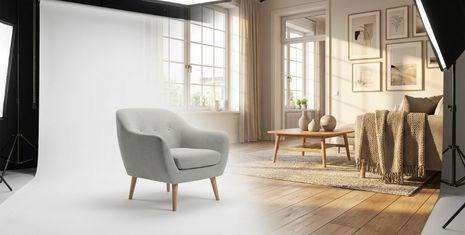
Lifestyle images show the armchair in a furnished living scene - for example in a Scandinavian living room with wooden floors and daylight. They help the customer imagine the product in their own home.
While the cutout informs, the lifestyle image sells. This is exactly where the difference between a click and a purchase emerges.
Detail Views of Material and Craftsmanship
Close-ups of fabric structure, stitching, armrests, or feet answer questions about quality. Especially with higher-priced armchairs, customers expect to be able to assess the craftsmanship before buying.
A good detail image shows the feel of the material - even though the customer can’t touch it. Think of the texture of the fabric, the precision of the stitching, the surface of the wooden feet.
Dimension Drawings and Technical Illustrations
Dimension drawings are schematic illustrations with all relevant measurements: seat height, seat depth, overall width, armrest height. Customers want to know whether the armchair fits in their intended corner.
This image type measurably reduces inquiries and returns. Many furniture shops now use dimension drawings as standard - and Otto customers increasingly expect them.
Perspectives and All-Around Views
Different camera angles - frontal, side, angled from above - convey a complete product impression. All-around views go even further and show the armchair from all angles.
Especially with armchairs featuring asymmetric shapes or special back designs, the effort pays off. Customers get a sense of the product that comes close to a visit to the furniture store.
| Image Type | Purpose | When to Use |
|---|---|---|
| Cutout | Show product shape | Main image, required |
| Lifestyle image | Convey living context | Gallery, boost conversion |
| Detail view | Communicate quality | With premium materials |
| Dimension drawing | Clarify size | Always recommended |
| All-around view | Give complete impression | With complex shapes |
Technical Image Requirements on Otto
Resolution and File Size
Otto sets minimum requirements for image resolution so the zoom function works. Customers use this function intensively - especially with furniture, where fabric structures and craftsmanship are crucial.
Upload images with at least 2000 pixels on the longest side. Images that are too small look unprofessional and are displayed less prominently by the platform.
Formats and Color Spaces
Otto accepts common file formats like JPG and PNG. Use the sRGB color space to ensure correct color display on all devices.
Incorrect color spaces cause your anthracite-colored armchair to appear greenish or bluish on some screens. This is a common reason for returns that can easily be avoided.
Mobile Optimization for Otto Users
A large proportion of Otto customers shop on mobile. Your images need clear subjects and sufficient contrast to be convincing even on small screens.
Avoid overloaded scenes with too many decorative elements. The armchair remains the protagonist - everything else is supporting cast.
How to Stage Armchairs for Maximum Conversion
Show Living Worlds and Room Context
Place the armchair in matching interior styles: modern, Scandinavian, classic, or industrial. This shows the customer how the furniture piece can enhance their own space.
The choice of style depends on your target group. A wing chair in a classic style looks out of place in a modern loft setting - and vice versa.
Visually Convey Comfort and Function
Transport the seating comfort visually: soft cushions, an inviting atmosphere, perhaps a reading lamp beside it. For function armchairs - such as those with adjustable backrests - show the function in action.
Customers aren’t just buying a piece of furniture. They’re buying a feeling, an idea of what their everyday life could look like with this armchair.
Choose the Right Perspective
The perspective influences how customers perceive the armchair:
- Slightly elevated: Shows proportions and overall shape optimally
- Eye level: Creates a natural, inviting impression
- Side view: Emphasizes depth and the shape of the armrests
Extreme angles - such as steeply from above or very close to the floor - distort proportions and confuse customers. Stick to classic perspectives that show the product favorably.
Images for Color Variants and Furniture Sets
Create Images for Color Variants Without Prototypes
Running a separate photo shoot for each fabric color is expensive and slow. With 10 color variants, costs multiply accordingly - and the time to publication extends considerably.
AI image generation solves this problem: from a single cutout, numerous color variants are created in seconds. Tools like showcase are specialized for this application in the Home & Living sector and preserve the shape and details of the original product.
Multi-Product Staging for Cross-Selling
Combine the armchair in a scene with matching products: side table, floor lamp, rug. This presentation inspires customers to make additional purchases and increases the average cart value.
For sellers with a broad range, multi-product staging is an underestimated conversion lever. Instead of showing individual products in isolation, you present a cohesive overall picture.
Creating Lifestyle Images Without a Photo Shoot
Traditional Shooting vs. AI Image Generation
A traditional shoot requires a studio, photographer, props, and elaborate post-processing. The lead time is typically 2-6 weeks, the cost 250-500 EUR per product and scene.
AI image generation works differently: you upload a cutout, select a scene or describe it via text, and the AI creates a photorealistic lifestyle image. The entire process takes seconds to minutes.
| Aspect | Traditional Shooting | AI Image Generation |
|---|---|---|
| Time required | 2-6 weeks lead time | Seconds to minutes |
| Cost per scene | 250-500 EUR | 0.50-1.50 EUR |
| Flexibility | New scene = new shooting | Scenes changeable at any time |
| Scalability | Linear with costs | Hundreds of images possible |
When AI Images Pay Off for Furniture
AI images are particularly suitable for certain scenarios:
- Large ranges: With 50, 100, or more armchairs, a traditional shoot is hardly affordable
- Fast product cycles: New collections can be photographed immediately
- Many color variants: Each color gets its own lifestyle images without additional shooting
- Limited budget: Professional results at a fraction of the cost
Specialized solutions like showcase are tailored to the Home & Living sector. This means: the AI models are trained to correctly reproduce furniture shapes, fabric textures, and proportions.
Comparison: Product Photography and AI Image Generation
The direct comparison shows clear differences in terms of time-to-market, cost structure, and scalability. Important: the AI replaces the elaborate shooting process, not the product itself.
- Product fidelity: Specialized AI models preserve the shape, color, and details of the original product
- Brand consistency: Brand identity features ensure uniform visual worlds across the entire range
- Scalability: From one image to hundreds of variants at the push of a button
Traditional photography remains sensible for hero campaigns, catalog covers, and premium print media. For daily product communication and marketplace content, AI is the more efficient choice today.
Checklist for High-Performing Armchair Images on Otto
Before publishing your armchair listing on Otto, use this checklist to verify that your image material meets all important criteria.
- Cutout on pure white background available
- At least one lifestyle image in living context
- Detail shots of upholstery, fabric, and feet
- Dimension drawing with seat height, width, and depth
- Multiple perspectives (frontal, side, angled from above)
- All color and fabric variants individually photographed
- Resolution at least 1500 x 1500 pixels
If you can check off all points, your listing is visually optimally positioned and ready for maximum performance on Otto.
From Cutouts to High-Selling Product Images
The recommendation is clear: start with high-quality cutouts and strategically supplement them with lifestyle images and dimension drawings. This combination covers both Otto’s mandatory requirements and the expectations of discerning customers.
Tools like showcase automate the entire workflow - from uploading the cutout to the finished lifestyle image. The brand identity feature analyzes your brand and automatically generates matching scenes, so all images are visually cohesive.
Try it out: Upload 5-10 cutouts, generate your first lifestyle images, and judge the results based on your own products.
Get started for free, no credit card required.
Frequently Asked Questions About Product Images for Armchairs on Otto
How many images should I upload per armchair listing on Otto?
Upload at least one cutout main image plus 4-6 supplementary images. The combination of lifestyle shots, detail views, and dimension drawings gives customers all the information they need for a purchase decision.
What image size is optimal for Otto product listings?
Use high-resolution images with at least 2000 pixels on the longest side. This ensures the zoom function works flawlessly and customers can closely examine fabric structures and craftsmanship.
Can I use AI-generated images for furniture listings on Otto?
Yes, as long as the images depict the product realistically and truthfully. AI-generated lifestyle images are a common and accepted method for product photography - many sellers are already using them.
How long does it take to create lifestyle images for armchairs?
With traditional shoots, the process from planning to the final result often takes several weeks. With AI image generation, you receive finished lifestyle images within seconds to minutes.
How much does professional product photography for furniture cost compared to AI images?
Traditional shoots incur costs of 250-500 EUR per product and scene. AI image generation is 0.50-1.50 EUR per image and scales without proportional cost increase - with 100 products, you don’t pay 100 times as much.
About the author

Author
Tim Hoffmann
Chief Product Officer, getshowcase.ai
Tim Hoffmann leads the product strategy for the AI image studio at showcase (getshowcase.ai). He brings years of e-commerce experience in product data, marketplace integrations, and visual content creation. His focus: helping Home & Living retailers turn product cutouts into photorealistic lifestyle images and room scenes in minutes – without expensive shoots, with measurably better conversion. Tim shares practical strategies for product images that perform on marketplaces and in your own shop.