How to Create Compelling Sofa Images for Your Etsy Shop

Listing a sofa on Etsy is easier than ever - but successfully selling a sofa on Etsy often fails due to a single factor: the images. Buyers can’t touch your furniture, can’t try sitting on it, can’t place it in their living room. All they have are your photos.
This article shows you what technical requirements Etsy has, how to create lifestyle images that convince buyers, and how AI image generation helps you achieve professional results in minutes instead of weeks. Related topics: Sofa images on ManoMano and Sofa conversion on Shopify.
Why Sofa Images on Etsy Often Don’t Convert
Etsy buyers are looking for unique furniture pieces they can’t find anywhere else. But before someone buys a sofa, they want to know how it looks in their own living room. This is exactly where most listings fail - not because of the product, but because of the images.
A sofa isn’t a t-shirt. Buyers can’t try it on, can’t touch it, can’t test sitting on it. The only way to make a purchase decision is through your photos. If those aren’t convincing, the buyer clicks away - no matter how good your sofa actually is.
Cutouts Without Room Context
A sofa cut out against a white background shows the product but not its effect. Buyers can neither estimate the size nor imagine how the furniture looks next to their coffee table or under their window.
The problem: uncertainty leads to hesitation. And hesitation leads to buyers clicking away instead of buying. A sofa without room context is like a recipe without a photo of the finished dish - technically complete, but not appetizing.
Inconsistent Lighting and Image Quality
When your first image was taken in warm daylight and the second with cold flash lighting, your shop looks thrown together. Different color temperatures make the same sofa look like two different products across images.
Buyers notice such inconsistencies, even if they can’t pinpoint exactly what’s bothering them. The result is a vague feeling of unprofessionalism - and that transfers to the perceived product quality.
Missing Perspectives and Details
A single front view doesn’t answer the questions buyers have. How deep is the sofa? What does the armrest look like from the side? What texture does the fabric have?
Without answers to these questions, too many unknowns remain. And with a purchase of several hundred euros, a single open question is enough to prevent the decision.
Technical Requirements for Etsy Listing Images
Etsy has clear specifications for product images. Those who ignore them lose visibility in search and appear less professional than sellers who follow them.
| Specification | Recommendation |
|---|---|
| Minimum size | 2000 px on the shortest side |
| File formats | JPG, PNG, GIF |
| Thumbnail display | 570 x 456 px |
| Color profile | sRGB |
| Maximum images per listing | 10 |
File Formats and File Types
For product photos, JPG is the best choice - small file size with good quality. PNG is only suitable when you need transparency, such as for graphics or overlays. GIF is intended for animated content and is rarely relevant for furniture photos.
Optimal Image Size and Resolution
The 2000-pixel recommendation exists because of Etsy’s zoom function. Buyers want to examine fabric textures and seams up close. Images that are too small are not only displayed less well but can also be disadvantaged in search results.
Always upload the highest available resolution. Etsy automatically compresses for display, but the original file is preserved for zooming.
Setting the sRGB Color Profile Correctly
sRGB is the standard color space for web display. If your images are saved in a different color profile - such as Adobe RGB from Photoshop - the colors can appear distorted on Etsy. A gray sofa might suddenly look bluish, a beige one slightly greenish.
Most image editing programs offer an “Export for Web” or “Convert to sRGB” option. Use it before every upload.
Best Practices for Sofa Product Photos on Etsy
Good product photos follow a clear system. The following five points help you optimize your listings without needing to be a professional photographer.
1. Choose the Right Number of Images Per Listing
Etsy allows up to ten images per listing. Use all slots. Buyers who scroll through multiple images are already interested - they just need enough information to make the purchase decision.
A typical sofa listing could be structured like this:
- Image 1: Lifestyle shot in room context
- Image 2-3: Front and side views
- Image 4-5: Detail shots of fabric, seams, feet
- Image 6-7: Additional perspectives or color variants
- Image 8-10: Dimensions, care instructions, delivery information
2. Set the Strongest Image as the Thumbnail
Your first image appears in search results as the thumbnail. It determines whether someone clicks or scrolls past. Choose an image that works even in small display - ideally a lifestyle image showing the sofa in room context.
Avoid images with too many details or too much white space. At the thumbnail size of 570 x 456 pixels, fine details are lost.
3. Show Different Perspectives
A complete sofa listing needs at least four views:
- Front view: Overall impression and proportions
- Side view: Depth, armrest shape, seat height
- Detail shot: Fabric texture, seams, upholstery
- Room view: The sofa in a living context
Each perspective answers different questions. Together they form a complete picture.
4. Use Diffused or Natural Light
Hard light creates harsh shadows and makes fabrics look flat. Soft, diffused light - such as from a large window on an overcast day - shows textures and colors more realistically.
If you work with artificial light, use softboxes or diffusers. Direct flash lighting is almost always unsuitable for furniture photos.
5. Keep Backgrounds Consistent
When each of your listings has a different image style, your shop looks thrown together. A unified visual style - such as always the same room type or the same color palette - signals professionalism and creates recognition value.
Creating Lifestyle Images for Sofas
Lifestyle images show your sofa in a real living context - with floor, walls, light, and often accessories. They help buyers envision the product in their own home, and that’s crucial for furniture.
Room Scenes That Convince Buyers
A convincing room scene needs more than just a background. Pay attention to realistic proportions - the sofa shouldn’t look too large or too small for the room. The lighting mood also plays a role: daylight feels inviting, rooms that are too dark are off-putting.
Also show the floor. A sofa that appears to float in the air looks unnatural. Visible feet and a recognizable surface give the furniture a place.
Strategically Place Accessories and Decoration
A few cushions, a rug, or a side table can make the scene more lively. But don’t overdo it - the sofa remains the star. Too many accessories distract and can confuse buyers about what’s actually for sale.
Choose accessories that match your sofa’s style. A minimalist sofa doesn’t need opulent decoration, a vintage piece doesn’t need ultra-modern side tables.
Brand Consistency Across All Listings
When all your lifestyle images share the same style - whether Scandinavian-bright or industrial-warm - a coherent brand presence emerges. Buyers recognize your products and develop trust.
This doesn’t mean every image must look identical. But a recognizable visual signature helps set your shop apart from the competition.
Generate Sofa Room Scene Images with AI
Traditional lifestyle shoots for furniture quickly cost 300-500 € per product - photographer, location, styling, and post-processing included. With multiple sofas and color variants, the budget is quickly exhausted.
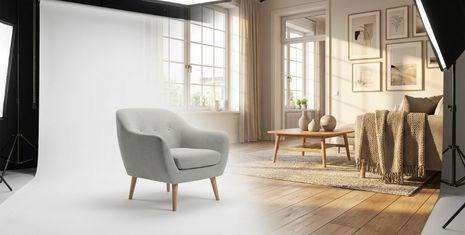
AI image generation offers an alternative: From a simple cutout, photorealistic room scenes are created in seconds. No studio, no scheduling, no weeks of waiting.
Create Living Spaces from Cutouts
The workflow is simple: Upload your cutout, choose a room style, and the AI generates a room scene image with matching background, shadows, and lighting.
Tools like showcase are specifically optimized for Home & Living and ensure that shape, color, and details of your sofa are preserved. This is what distinguishes specialized solutions from general image generators that often distort furniture proportions.
Room Scenes in Seconds Instead of Weeks
A traditional shoot needs weeks of lead time - scheduling, delivery, setup, post-processing. With AI generation, you have the finished image in under a minute.
This means: New products can go online immediately. You’re not waiting for the next shoot date - you’re selling while the competition is still planning.
Multi-Product Staging for Cross-Selling
When you offer a sofa, armchair, and coffee table as a set, you can combine all three products in one scene. This shows buyers how the pieces work together - and increases the average order value.
With traditional photography, every additional product in the scene means more effort. With AI generation, it’s just another upload.
Visualize Color Variants Without a Photo Shoot
Many sofas come in multiple fabric colors or materials. Photographing each variant individually is time-consuming - and with ten color options, quickly unaffordable.
Show Fabric Options and Materials Realistically
AI tools can change the color of your sofa without needing a new cutout. The shape and details are preserved - only the color or material changes.
This works particularly well with solid-colored fabrics. With complex patterns or heavily textured materials, a quick test is worthwhile to check whether the result is realistic enough.
Create Images for Product Variants Without Prototypes
Planning a new color variant but the prototype doesn’t exist yet? With AI generation, you can show the product anyway and test how buyers react - before you go into production.
This saves not only costs but also time. Instead of waiting months for prototypes, you can offer new variants within days.
Optimize Sofa Images for Etsy Search
Good images alone aren’t enough - they also need to be found. The following optimizations help make your listings more visible in Etsy search.
Image Sequence for Better Conversion
Arrange your images so they tell a story. First the lifestyle image for attention, then detail shots for information, and finally dimensions for the final decision.
The sequence follows the customer journey: spark interest, answer questions, enable the purchase.
Optimize Thumbnails for Search Results
Etsy displays thumbnails in the 570 x 456 px format. Check whether your first image works well in this crop. Sometimes a separate crop that shows the sofa more prominently is worthwhile.
Avoid images where important parts of the sofa are cut off. The thumbnail is your first impression - and often the only one.
Use File Names and Alt Texts
Name your image files with relevant keywords, such as “velvet-sofa-green-scandinavian.jpg” instead of “IMG_4523.jpg.” This helps not only Etsy but also Google Image Search.
Alt texts are also important. Describe what’s shown in the image - briefly, precisely, and with relevant terms.
Checklist for Compelling Sofa Images on Etsy
Before you publish your listing, go through this checklist to ensure your sofa images meet all important criteria:
- At least 8 of 10 image slots used
- Lifestyle image set as the first thumbnail
- Minimum resolution of 2000 px on the shortest side
- Detail shots of fabric, seams, and upholstery
- Multiple perspectives (front, side, detail)
- Color profile set to sRGB
- File names with relevant keywords
If you can check off every item, your listing is visually optimally positioned and ready for publication.
Your Path to Sofa Images That Sell
Compelling sofa images need room context, consistent quality, and multiple perspectives. With AI image generation, you achieve this in seconds instead of weeks - without a photo studio, without weeks of planning, without exploding costs.
Get started for free, no credit card required. → Start showcase
FAQs on Sofa Images on Etsy
How many images should I upload per sofa listing on Etsy?
Etsy allows up to ten images per listing. Use all slots to show different perspectives, details, and lifestyle views. Buyers who scroll through multiple images are already interested - more images mean more chances to answer their questions.
What image format does Etsy accept for listing photos?
Etsy accepts JPG, PNG, and GIF. For product photos, JPG is the best choice. The recommended minimum size is 2000 pixels on the shortest side so the zoom function works and details remain recognizable.
Can I use AI-generated product images on Etsy?
Yes, AI-generated images are allowed on Etsy. What’s important is that they accurately represent your actual product. Color, shape, and material must not be distorted - buyers expect the delivered sofa to match the image.
How do I show different fabric patterns of my sofa in the image?
Use detail shots that clearly show the texture. Alternatively, AI tools can realistically visualize material variants without you having to photograph each option individually. With complex patterns, a quick test of the results is worthwhile.
Do I need to take a separate photo for each color variant of my sofa?
Not necessarily. With AI image generation, you can create different color variants from a single cutout. This saves time and costs - especially when you offer many color options and can’t photograph each one individually.
About the author

Author
Tim Hoffmann
Chief Product Officer, getshowcase.ai
Tim Hoffmann leads the product strategy for the AI image studio at showcase (getshowcase.ai). He brings years of e-commerce experience in product data, marketplace integrations, and visual content creation. His focus: helping Home & Living retailers turn product cutouts into photorealistic lifestyle images and room scenes in minutes – without expensive shoots, with measurably better conversion. Tim shares practical strategies for product images that perform on marketplaces and in your own shop.