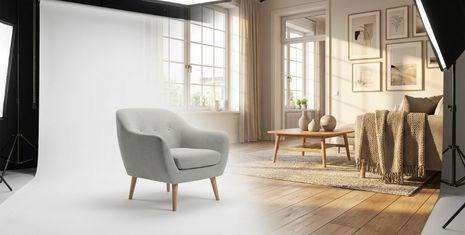
What Image Strategy Increases Your Couch Conversion in Your Shopify Shop?

What Image Strategy Increases Your Couch Conversion in Your Shopify Shop?
Furniture is one of the product categories with the lowest conversion rates in e-commerce—on average 0.8 to 1.5 percent for sofas and couches. If you sell a couch in your own Shopify shop, you’re not only competing against this industry average but also against Amazon, Westwing, and others who work with larger budgets and more trust. The decisive lever you have as a shop owner is your image strategy. In this article, you’ll learn which image combination accelerates the purchase decision, what Shopify offers technically, and how to create Westwing-quality images for your own shop without a traditional photo shoot.
Why Couches Are Particularly Hard to Photograph
The core problem when researching a couch online is the scale problem: A couch on a white background doesn’t communicate whether it fits in the living room. Customers have to actively imagine how the piece of furniture will look in their own space—and this cognitive work costs persuasiveness. Studies show that missing room context is one of the most common reasons for cart abandonment when buying couches online.
Add to that the haptics gap. Whether a fabric feels like soft velvet, coarse linen, or easy-care microfiber is a purchase decision for many customers—and barely communicable in a photo. Without detail shots that show fabric texture, cushion fill, and seam quality, you lack the trust that a furniture store would otherwise build.
Couch photography becomes especially costly due to variant diversity: A single model often comes in 10 to 30 upholstery options, combined with various leg variants, configurations (2-seater, corner couch, U-shape), and colors. Hauling each variant into the studio is logistically and financially barely feasible—a couch weighs 40 to 80 kilograms. The result: Many shop owners show only 2 to 3 images per variant, even though research shows that the conversion effect for upholstered furniture only becomes clearly visible from 7 images onward.
The most common return reason for couches bought online is incorrect size and color expectations—both directly attributable to inadequate image strategy.
Image Requirements on Shopify for Couch
Shopify is not a marketplace with fixed specifications but a shop system that gives you as the owner design freedom. That also means: You are responsible yourself for image quality that convinces your target audience.
Technical specifications:
- Maximum resolution: 5,000 x 5,000 pixels (25 megapixels)
- Recommended resolution: 2,048 x 2,048 pixels—sufficient for zoom function and Retina displays
- Minimum resolution for zoom: 800 x 800 pixels
- Maximum file size: 20 MB per image
- Recommended target file size: 100–300 KB for fast loading times
- Formats: JPG (product photos), PNG (graphics/infographics), WebP (automatic conversion by Shopify)
- Recommended aspect ratio: 1:1 (square) for consistent display in product galleries and collections
Main image requirements:
- Cutout or light, neutral background for the first image
- Full view of the couch, completely in frame (not cropped)
- Sufficient resolution for hover zoom on desktop
Additional image options:
- Shopify natively supports videos, 3D models (.glb/.usdz), and images in a product gallery
- On desktop: Thumbnail navigation configurable left, right, or below
- On mobile devices: Automatic swipe carousel (thumbnails hidden depending on theme)
- Video upload works like image upload and appears in the normal gallery
Shopify-specific features:
Unlike marketplaces, you control the entire context here. That means: Your images must not only show the product but also build the trust that a marketplace brings automatically through brand recognition. Shopify offers zoom plugins (Magic Zoom Plus), 360-degree views, and AR integrations—tools that have particularly strong conversion effects for upholstered furniture. Research data shows that 360-degree views for furniture can generate up to 27 percent more conversions and reduce return rates by 30 to 40 percent.
Which Image Types Your Couch Listing Needs
| Image position | Image type | Why important for couch |
|---|---|---|
| Image 1 | Cutout (front view) | Quick product identification in collection views and Google Shopping—Shopify uses this image in thumbnails |
| Image 2 | Lifestyle image (living room scene) | Solves the scale problem—customers see the couch in room context and can imagine using it. Strongest single lever for conversion |
| Image 3 | Detail shot (fabric texture/seam) | Closes the haptics gap—shows fabric structure, cushion fill, and workmanship quality that builds trust |
| Image 4 | Dimension drawing/infographic | Reduces the most common return reason (incorrect size expectation) directly in the image—customers don’t have to scroll to the product description |
| Image 5 | Perspective view (45 degrees) | Shows depth, armrest height, and seat configuration—especially relevant for L-couches or sleeper sofas |
| Image 6 | Color variants overview | Shows all upholstery options at a glance—important when Shopify displays variants as separate swatches |
| Image 7 | Lifestyle detail (lived-in) | Couch with pillows, blankets, magazines—suggests coziness and activates emotional purchase motives |
Creating Lifestyle Images for Couch Without a Photo Shoot
AI Workflow Step by Step
- Prepare cutout—Upload your existing couch photo to showcase. Background removal runs fully automatically and returns a clean cutout.
- Choose scene—Select a living room setting that fits your shop’s positioning: minimalist Nordic, warm Southern European, or urban industrial.
- Place and align product—showcase inserts your couch perspectively correct into the scene. You can adjust size, position, and viewing angle until proportions and room effect are right.
- Generate all variants via batch—With the batch function, you create all color variants of your couch from one cutout automatically—with identical lighting and perspective.
What AI Does Particularly Well for Couch
AI image generation hits exactly the weak points of traditional couch photography: The scale problem is solved because showcase automatically inserts your couch to scale in a real room. Variant diversity is reduced from weeks to minutes—batch generation for 20 color variants runs in under an hour. Lighting consistency remains identical across all generated images, so a couch in blue and one in beige look the same quality in the same scene. showcase optimizes for maximum fidelity in form, color, and material—fabric textures like bouclé or velvet remain visible.
Scene Types That Work for Couch on Shopify
- Bright living room, Nordic style—Oak parquet, white walls, natural materials as accessories. Universally applicable, appeals to the broadest buyer segment.
- Warm loft, industrial style—Exposed concrete, high ceilings, large window. Ideal for modern design couches in darker colors.
- Cozy period building—Herringbone parquet, warm wall colors, mix of vintage and modern. Activates emotional coziness motives.
- Minimalist studio—Little decoration, focus on the piece of furniture as a statement. For design couches that should speak for themselves.
For Shopify stores, it pays to match the scene to your shop’s target audience: A shop with Scandinavian assortment needs different scenes than a shop with mid-century furniture.
Efficiently Photographing Color Variants and Materials
Couches are one of the most variant-rich products in furniture e-commerce. A single model often comes in 15 to 30 upholstery variants—corduroy, bouclé, velvet, woven fabric, leather—combined with various leg options. On Shopify that means: If you take every variant seriously, you need up to 150 images for a single model (6 views × 25 colors).
With showcase you take this path without logistics effort: You upload one cutout, set up your brand identity, and the color variants tool generates all upholstery options automatically. The recoloring considers the material structure—a velvet cover in dark green looks visually different than a linen cover in dark green. Each variant automatically receives a matching lifestyle image with identical lighting.
For the Shopify product page this is especially valuable: When customers click a color swatch and the associated images load, they see a complete set—cutout, lifestyle image, detail shot—for every single option.
What Does Couch Product Photography Really Cost?
| Method | Cost | Time effort | Scalability | Quality |
|---|---|---|---|---|
| Traditional photo studio | 800–2,000 Euro per couch setup (excl. transport) | 1–3 weeks incl. logistics | Low—each variant individually | High |
| DIY photography | 200–500 Euro (equipment) | 2–5 days per couch | Low—space and light limit | Medium |
| 3D rendering | 500–1,500 Euro per model | 1–2 weeks | Medium—variants cheaper | High—high entry costs |
| AI image generation (showcase) | From 1 Euro per image | Minutes per variant | High—all variants automated | High—consistent across all variants |
For couches with high variant diversity, the math is especially clear: If you offer 20 color variants and need 6 images for each, you’re talking about 120 images per model. In a studio that quickly costs 15,000 to 20,000 Euro including transport and retouching. With showcase you reduce that to a fraction—and create all variants with consistently high quality in a fraction of the time.
Common Mistakes With Couch Images on Shopify
1. Too few images for a high-consideration product Mistake: Shop shows 2–3 images per couch. Why it happens: Effort and cost of photography limit the number of images. Solution: At least 7 images per couch variant. Research data shows that each additional image up to the seventh measurably increases conversion. showcase makes the 7th image cost-efficient too.
2. Only cutouts, no lifestyle image Mistake: All images show the couch on white background without room context. Why it happens: Cutouts are easier to produce and were long the standard. Solution: At least one lifestyle image per variant that shows the couch in a real living space. Lifestyle images are according to studies the strongest single lever for conversion for furniture.
3. Inconsistent image quality across variants Mistake: The blue couch looks professional, the beige variant was quickly re-photographed and looks amateurish. Why it happens: Variants are added at different times with different setups. Solution: Generate all variants from a single workflow. showcase ensures that every color option is generated with identical lighting and perspective.
4. No dimension information visible in the imagery Mistake: Dimensions are only in the product description, but not as an image. Why it happens: Dimension images are considered optional. Solution: Set up a dimension drawing as a mandatory image. Couches are a product where the scale problem demonstrably influences purchase decisions. showcase generates dimension drawings automatically.
5. Mobile image display not optimized Mistake: Images in the wrong aspect ratio lead to unfavorable crops on mobile devices. Why it happens: Shop was primarily optimized for desktop. Solution: Create all couch images in 1:1 format (square)—the standard format that Shopify displays consistently on desktop and mobile.
Checklist—Optimize Couch Images for Shopify
- At least 7 images per couch variant (cutout, lifestyle, detail, dimension, perspective, variants, lifestyle detail)
- Resolution min. 2,048 x 2,048 pixels for zoom functionality on desktop
- Aspect ratio 1:1 for consistent display in collection grid and on mobile devices
- At least 1 lifestyle image that shows the couch in room context
- Dimension drawing with seat, reclining, and overall dimensions as separate image
- All color variants photographed with consistent image quality and complete image set
- Detail shot of fabric texture for each main material variant
- Zoom function in Shopify enabled and fed with sufficiently high-resolution images
FAQs on Couch Product Images on Shopify
How many images does a couch really need in my Shopify shop? For upholstered furniture, conversion studies recommend at least 7 images per variant—significantly more than the typical 3–4 images of smaller shops. Each additional image up to the seventh measurably increases the likelihood of a purchase decision. That sounds like a lot of effort, but can be efficiently scaled with AI image generation: showcase creates all variants automatically from one cutout including lifestyle images.
Which aspect ratio should I choose for couch images in Shopify? The 1:1 (square) aspect ratio is the safest choice for Shopify shops. It ensures consistent display in the collection grid on desktop, in the swipe carousel on mobile devices, and in Google Shopping Ads. If you use 3:2 or 4:3, you risk unfavorable automatic crops in certain theme contexts.
Is a 360-degree view worth it for my couch shop? For couches and upholstered furniture, yes—studies show for furniture up to 27 percent higher conversion and 30 to 40 percent lower return rates with 360-degree views. Shopify natively supports 3D models, and for simpler 360-degree swipers there are affordable apps. The effort pays off especially for your best-selling models.
Can I automatically optimize my images for Shopify SEO? Shopify offers alt text fields for every image—use these consistently with keyword-relevant descriptions (e.g., “Couch 3-seater Gray Velvet Shopify”). Several apps like AltText.ai automate this for large assortments. File naming before upload also with keywords—Shopify reads these and uses them internally.
Should my first image be a cutout or a lifestyle image? For Shopify collection pages and Google Shopping, a clear cutout as main image works better—it enables quick product identification when browsing. The lifestyle image comes as the second image: Customers see it immediately when they open the product page or click desktop thumbnails. Many successful furniture shops use a hover function that automatically shows the lifestyle image when hovering.
Related articles:
- Wie erstellst du perfekte Couch-Produktbilder für Amazon? - Couch images for the largest marketplace
- Welche Bildqualität braucht deine Couch für eine Listung bei Westwing? - Couch images for the curated premium segment
- [INTERN: Couch/Otto] - Couch images for the second-largest German marketplace
Your next step: You have a cutout of your couch but not yet a complete image set that drives conversion? Try showcase for free—no credit card required: https://getshowcase.ai/
About the author

Author
Tim Hoffmann
Chief Product Officer, getshowcase.ai
Tim Hoffmann leads the product strategy for the AI image studio at showcase (getshowcase.ai). He brings years of e-commerce experience in product data, marketplace integrations, and visual content creation. His focus: helping Home & Living retailers turn product cutouts into photorealistic lifestyle images and room scenes in minutes – without expensive shoots, with measurably better conversion. Tim shares practical strategies for product images that perform on marketplaces and in your own shop.