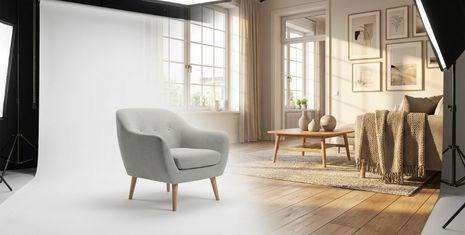
Which Image Strategy Increases Your Dining Table Conversion in Your Shopify Store?

A dining table priced at 1,200 euros, presented with a single cutout on a white background - that’s like selling a car without showing the engine. Your customers can’t touch it, can’t try sitting at it, can’t check whether the table fits their own dining room. All they have are your images.
The conversion rate for furniture in eCommerce typically ranges between 1 and 3 percent. The difference between the lower and upper end often comes down to image strategy. This article shows you which image types your Shopify store needs, which strategies boost conversion, and how to create professional lifestyle images without a traditional photo shoot. Similar approaches for other furniture: Sofa conversion on Shopify and Dining table images on Otto.
Why Product Images Determine Your Dining Table Conversion
Your customers can’t touch the dining table. They can’t check how the wood surface feels or whether the proportions fit their own dining room. All they have are your images - and that’s exactly why these images determine whether someone buys or moves on.
With high-priced products like dining tables, this is especially critical. A table priced at 800 or 1,200 euros isn’t an impulse purchase. Customers need visual reassurance before they click “Buy.” If your images don’t provide that reassurance, you lose the sale - often without even realizing it.
The conversion rate describes the percentage of your store visitors who actually make a purchase. For furniture in eCommerce, this value typically ranges between 1 and 3 percent. The difference between the lower and upper end often depends on image quality. Stores with context-rich lifestyle images report significantly higher values than those with cutouts alone.
Why Dining Tables Are Difficult to Photograph
Dining tables are among the most challenging products in furniture photography. Their size, materials, and design present challenges you’d never face with smaller products.
Large, Flat Tabletops Reflect Light and Reveal Every Imperfection
A tabletop measuring two meters in length is essentially a giant mirror - especially with lacquered or oiled surfaces. Every light source creates reflections that obscure the view of the material itself. At the same time, the smallest scratches, dust particles, or unevenness become immediately visible on the large surface, making post-processing time-consuming.
Proportions and Actual Size Are Hard to Judge in Photos
Whether your dining table is 160 cm or 220 cm long is nearly impossible to tell from a photo. Without reference points like chairs or tableware, the actual size remains abstract. You need to consciously include elements in every image that give your customers a sense of the dimensions.
Wood Grain and Surface Textures Require Precise Lighting
The grain of oak or the texture of brushed wood only comes to life with the right lighting. Light that’s too harsh makes the surface look flat, while light that’s too soft swallows the fine details. You need side lighting that emphasizes textures without creating unsightly shadows.
Table Legs and Bases Require Additional Perspectives
Most dining table photos show the tabletop from above or at a slight angle - leaving the base invisible. Especially with designer tables featuring distinctive leg shapes or frames, this is a problem. You need at least one additional perspective that shows the entire table including legs and joints.
The Image Types Your Shopify Store Needs for Dining Tables
Not every image serves the same purpose. A complete product listing combines different image types that answer different customer questions.
Cutouts on White Background
The cutout shows your product without distraction - isolated against a neutral background. It’s the foundation for any store and often the first image in the product overview. Shopify recommends square images at a minimum of 2048 x 2048 pixels for optimal display across all devices.
Lifestyle Images and Room Scenes
Room scene images show the dining table in a furnished setting - a dining room, an open kitchen, a loft. They help customers envision the product in their own home. This is exactly where the emotional connection forms that triggers purchase decisions.
Detail Shots of Material and Craftsmanship
Close-ups of wood grain, table edges, or joints build trust in quality. Especially with dining tables that are used daily, customers want to see what they’re getting. A close-up image of the tabletop says more than three paragraphs of product description.
Dimension Drawings and Size Comparisons
Technical drawings with measurements are essential for furniture. A dining table that doesn’t fit in the room gets returned. Dimension drawings with measurement lines significantly reduce returns and inquiries.
Color Variants and Material Options
Show all available finishes visually - natural oak, smoked oak, walnut. Customers don’t like clicking through dropdown menus when they can’t see the variants. One image per variant makes the selection easier.
360-Degree Views and Zoom Function
Interactive elements give customers control. They can rotate the table, zoom into details, and view the product from all sides. This comes closest to the experience in a furniture showroom.
6 Image Strategies for Higher Conversion Rates on Dining Tables
1. Show Your Dining Table in a Room Context
Place your dining table in a realistic dining room scene. A set table with chairs and decor tells a story. Customers see themselves sitting at the table and can better estimate the proportions.
- Emotional appeal: Context images evoke visions of their own home
- Size estimation: The room context shows how much space the table actually takes up
2. Use the Optimal Number and Sequence of Images
Too few images cost you trust. Too many overwhelm. The right sequence guides the customer through the decision process - from first impression to technical confirmation.
| Position | Image Type | Purpose |
|---|---|---|
| 1 | Hero shot (lifestyle or cutout) | First impression, attention |
| 2 | Room scene | Context and imagination |
| 3-4 | Detail shots | Show quality and material |
| 5 | Dimension drawing | Technical reassurance |
3. Communicate Dimensions and Proportions Visually
Integrate measurements directly into the image - not just as text in the description. Dimension drawings with measurement lines or comparison objects like chairs help customers gauge the size. This is especially important because “180 cm length” remains abstract for many people.
4. Stage Sets for Cross-Selling
Show the dining table with matching chairs and decor in one scene. Customers are more likely to buy the complete set rather than individual products. At the same time, they see how the products work together - which reduces uncertainty.
- Complete room concepts: Present related products together
- Higher average order value: Multi-product scenes can noticeably increase average order value
5. Maintain a Consistent Visual Language for Your Brand
Consistent lighting, color palette, and scene types across all products create recognition. When a customer scrolls through your store, everything looks cohesive. This signals professionalism and builds trust.
6. Optimize Images for Mobile and Fast Loading Times
Over 60 percent of Shopify visitors come via mobile. Use the WebP format, compress images to under 500 KB, and test loading times regularly. Every second of delay costs conversions - especially on smartphones.
Create Professional Dining Table Images Without a Photo Shoot
Traditional furniture photography is time-consuming: rent a studio, book a photographer, transport the table, build the scene, post-process. For a single dining table in three scenes, two weeks can easily pass - along with 500 euros or more.
Traditional Product Photography vs. AI Image Generation
AI-powered image generation offers an alternative. An AI analyzes your uploaded product image and places it in a generated background - complete with matching shadows and lighting.
| Criterion | Traditional Photo Shoot | AI Image Generation |
|---|---|---|
| Time required | 2-6 weeks | Seconds to minutes |
| Cost per scene | 150-300 € | 0.50-2 € |
| Flexibility | Low (new scene = new shoot) | High (scenes changeable anytime) |
| Color variants | New shoot required | Automatically generated |
Generate Room Scene Images in Seconds
The process is simple: Upload your product image, choose a scene - Scandinavian dining room, modern loft, rustic kitchen - and generate the image. Tools like showcase are specifically optimized for Home & Living and ensure product fidelity: shape, color, and details are preserved.
Through the Brand Identity feature, scenes automatically adapt to your brand identity. This saves time on post-processing and ensures consistent results across your entire catalog.
Create Images for Color Variants Without Prototypes
Planning a new color variant but don’t have a prototype yet? AI tools recolor your product - without a new photo, without waiting. This way you can test variants and display them in your store before they’re even produced.
Start for free with showcase - no credit card required.
Test and Optimize Your Image Strategy with A/B Tests
An image strategy is only as good as its results. Test different approaches and measure what works for your customers.
Which Metrics You Can Track
- Conversion rate: Percentage of visitors who buy
- Time on product page: Shows engagement with your images
- Add-to-cart rate: How many add the product to their cart?
- Bounce rate: Are customers leaving the page quickly?
How to Run A/B Tests for Product Images
Test one variant with a cutout as the main image against one with a lifestyle image. Shopify apps like Neat A/B Testing make this easy. Let the test run for at least two weeks before drawing conclusions - shorter periods often don’t produce reliable data.
Checklist for Compelling Dining Table Images in Your Shopify Store
Before you publish your dining table product page, go through this checklist. It helps ensure your images address all important purchase concerns and that your conversion doesn’t suffer from avoidable gaps.
- Cutout on neutral background available
- At least one lifestyle image with chairs in a dining area
- Detail shot of wood grain or surface material
- Dimension drawing with length, width, and height
- Multiple perspectives (top view, side view, leg detail)
- All material and color variants individually photographed
- Alt texts and file names with relevant keywords
If you can check off every item, your product page is visually complete. Missing items show you exactly where to focus next.
Start Now with Better Product Images
Lifestyle images and image variety can noticeably improve conversion. Traditional photo shoots are often too slow and too expensive for large assortments. AI-powered image generation makes professional lifestyle images scalable - in seconds instead of weeks.
With showcase, you create photorealistic living spaces from simple cutouts. Upload 5-10 cutouts, generate your first lifestyle images, and evaluate the results based on your own products.
Get started for free, no credit card required.
FAQs on Image Strategy for Dining Tables in Shopify Stores
How many product images does a dining table need in a Shopify store?
Five to seven images is a good benchmark: a cutout, two lifestyle shots, two detail images, and a dimension drawing. Each image type addresses different purchase concerns.
What image size and format are optimal for Shopify?
Shopify recommends square images at 2048 x 2048 pixels. The WebP format offers fast loading times with high quality.
Do lifestyle images increase the conversion rate for furniture?
Context images help customers envision the product in their own home. Stores with lifestyle images report higher conversion rates than those with cutouts alone.
What does professional furniture photography cost compared to AI-generated images?
Traditional photo shoots cost 150-500 euros per product and scene. AI-generated images cost 0.50-2 euros - a difference of 100x or more.
How many product images should I show per dining table in my Shopify store?
Plan for at least five to seven images per dining table: one cutout, two lifestyle shots from different angles, one to two detail images of material and craftsmanship, plus a dimension drawing. For tables with multiple color variants, add one to two additional images per variant. More than ten images are rarely necessary - what matters more than sheer quantity is that each image answers a specific customer question.
About the author

Author
Tim Hoffmann
Chief Product Officer, getshowcase.ai
Tim Hoffmann leads the product strategy for the AI image studio at showcase (getshowcase.ai). He brings years of e-commerce experience in product data, marketplace integrations, and visual content creation. His focus: helping Home & Living retailers turn product cutouts into photorealistic lifestyle images and room scenes in minutes – without expensive shoots, with measurably better conversion. Tim shares practical strategies for product images that perform on marketplaces and in your own shop.