What Images Does Your Dining Table Need for Strong Performance on Otto?

A dining table on Otto doesn’t sell through dimensions and material descriptions - it sells through images. Customers can’t touch the wood, test the stability, or check whether six people can sit comfortably.
That’s exactly why your product images determine click-through rate, conversion, and return rate. This article shows you which image types Otto expects for furniture listings, which perspectives and styles work for dining tables, and how to create high-quality lifestyle images without a traditional photo shoot. Also see Dining table product images for Amazon and Dining table images on Home24 for platform-specific requirements.
Why Product Images Determine Your Success on Otto
Otto customers can’t touch your dining table, try sitting at it, or check whether it fits in their own dining room. Your product images take over exactly this role - they convey quality, feel, and spatial impact. If the images don’t deliver on this, you’ll lose buyers to the competition.
Poor images directly impact your business. Low click-through rates in search, high abandonment rates on the product page, and expensive returns are the consequences. The Otto algorithm registers these signals and ranks your product as less relevant.
- Only cutout images available: Customers can’t imagine the table in a room and abandon the purchase
- Poor image quality: The product looks cheap, trust drops
- Missing detail shots: Uncertainty about material quality leads to purchasing from a competitor
- Unclear proportions: The table doesn’t fit the room - returns and negative reviews follow
Why Dining Tables Are Difficult to Photograph
Dining tables are among the most demanding furniture pieces in product photography. Their combination of large surfaces, sensitive finishes, and complex geometry presents challenges you should be aware of before starting image production.
Large, Flat Surfaces Reflect Light and Show Every Imperfection
A tabletop is essentially a huge, continuous surface - and that’s exactly what makes it so tricky. Every light source creates reflections that can distract from the actual material. Even minimal scratches, fingerprints, or dust particles become immediately visible with the wrong lighting, making your product look less premium.
Proportions and Actual Size Are Hard to Judge in Photos
A dining table for six and a small kitchen table can look almost identical in a photo. Without reference objects like chairs, tableware, or room context, the customer has no way to gauge the actual dimensions. This problem leads to false expectations and ultimately expensive returns.
Wood Grains and Surface Textures Require Precise Lighting
The grain of a solid wood table is often the decisive purchase argument - but only if you capture it correctly. Frontal light makes the surface look flat and dull, while side raking light highlights the depth and character of the texture. Without the right lighting, you lose exactly what sets your product apart from cheaper alternatives.
Tabletops and Legs Must Be Shown from Multiple Angles
A dining table consists of at least two visually distinct elements: the top and the base. From a single perspective, you can rarely showcase both convincingly. You need multiple shooting angles to fully show both the elegance of the tabletop and the construction and design of the legs.
Image Types Otto Requires for Dining Table Listings
For a complete furniture listing, Otto expects a mix of different image categories. Each image type serves a specific purpose in the purchasing process.
Cutout on White Background
A cutout shows your product in isolation, without background or decoration. Otto requires this image as the main image because it enables a neutral, factual presentation. Customers can directly compare different tables with each other.
Lifestyle Images and Staged Shots
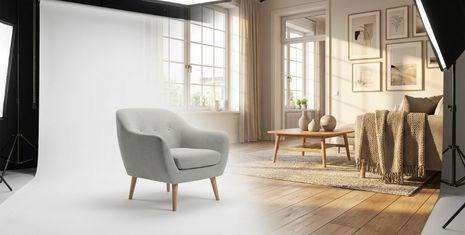
A staged shot shows your dining table in a realistic living environment - such as a furnished dining room with chairs, tableware, and appropriate lighting. This context helps customers imagine the furniture piece in their own home.
The difference in impact is measurable: lifestyle images typically achieve higher conversion rates than plain cutouts because customers make purchasing decisions more confidently with contextual images.
Detail Images of Material and Craftsmanship
Close-ups of wood grain, edges, table legs, or joints demonstrate the quality of craftsmanship. For solid wood tables, such detail images are particularly important because they show the authenticity of the material and justify a higher price.
Dimension Drawings and Size Representations
Dimension drawings are technical sketches with all relevant measurements: height, width, depth, legroom. They significantly reduce incorrect size expectations and thus the return rate.
| Image Type | Purpose | Status |
|---|---|---|
| Cutout | Neutral product presentation, comparability | Required |
| Staged shot | Emotional appeal, context, inspiration | Strongly recommended |
| Detail image | Proof of quality, trust building | Strongly recommended |
| Dimension drawing | Size understanding, return reduction | Strongly recommended |
How Many Images Your Dining Table Listing Needs
Aim for at least 5-7 images, with 8-12 being optimal. More relevant images increase customer trust - though quality over quantity applies. Ideally, each image in the listing contributes new information: a different perspective, a detail, a room context.
The Most Important Perspectives for Dining Table Photos
Customers want to view the table from all sides, as if they were standing right in front of it. Different angles answer different questions and reduce pre-purchase uncertainties.
Frontal Full View
The frontal view shows proportions and overall impression. It’s ideal as the main image because it shapes the first impression and conveys the key features at a glance.
Top-Down View of the Tabletop
The top-down perspective shows the size of the tabletop and the surface structure. For wood tables, the grain becomes visible; for glass, the transparency and reflections.
Side Perspective Showing Legroom
A slightly angled side view shows the construction of the table legs and conveys an impression of the legroom. Customers can assess whether their existing chairs will fit.
Close-Ups of Edges and Joints
Detail shots of edges, corners, and joints serve as proof of high-quality craftsmanship. For solid wood tables, they show the authenticity of the material and distinguish real wood from imitations.
Cutouts vs. Lifestyle Images Compared
Both image types serve different functions in the purchasing process. Cutouts inform factually, lifestyle images inspire emotionally. You need both to support both rational and emotional purchasing decisions.
| Criterion | Cutout | Staged Shot |
|---|---|---|
| Purpose | Factual information, comparability | Emotional appeal, inspiration |
| Emotional effect | Neutral, informative | Inspiring, homely |
| Otto requirement | Required as main image | Strongly recommended |
| Placement | Main image, variant images | Image gallery, marketing |
Creating Lifestyle Images for Different Interior Styles
Your dining table probably suits multiple interior styles. By tailoring lifestyle images to different target groups, you directly appeal to more potential buyers.
Modern and Minimalist
Clean lines, neutral colors like grey, white, and black, very little decoration. The focus is on form and function - ideal for design-oriented buyers.
Scandinavian and Bright
Light woods, plenty of natural light, a cozy atmosphere. Combine the table with light textiles and subtle plants for the popular Hygge look.
Country House and Rustic
Warm tones, natural materials, cozy room settings. Ceramics, linen, and elements that radiate warmth work particularly well here.
Industrial and Urban
Metal accents, dark colors, brick walls, rough textures. This style looks edgy and modern - perfect for a loft ambiance.
Showcasing Materials and Surfaces Convincingly
The feel of a material is difficult to convey online. However, with the right lighting, you can give customers a sense of texture and quality.
Solid Wood and Real Wood Veneer
Use warm, side lighting to emphasize grain and pores. Close-ups make the natural texture visible and distinguish real wood from imitations.
Glass and High-Gloss Surfaces
Control reflections carefully. Soft, diffused light shows the elegance of the surface without distracting reflections.
Metal and Mixed Materials
Highlight contrasts between different materials. With metal, targeted light reflections can emphasize the industrial character or a brushed surface.
Showing Dimensions and Proportions Visually
Numbers alone are often not enough to make the size of a table understandable. Visual aids make proportions tangible.
- Dimension drawings: Technical sketches with all relevant measurements
- Reference objects: Chairs at the table or a place setting show the usable surface
- Room context: The table in a furnished room conveys the relationship to other furniture
- People in the image: A seated person immediately gives a sense of height and legroom
Efficiently Creating Images for Color and Size Variants
Every color and size variant of your dining table needs its own set of product images. Traditional photo shoots for each individual variant are extremely expensive - with 5 color variants and 3 sizes, you quickly end up with 15 separate shooting efforts.
With AI-powered image generation, you create realistic recolorings and complete image series for each variant from a single cutout. What used to take weeks now works in minutes. Tools like showcase are specifically optimized for Home & Living and preserve the shape, color, and details of your product.
Avoiding Common Image Mistakes in Dining Table Listings
Certain product image mistakes actively harm your ranking and conversion rate. Here are the typical pitfalls.
Wrong Resolution and Image Size
Otto requires a minimum resolution for the zoom function. Images that are too small look unprofessional; files that are too large lead to long loading times.
Missing Room Context
Listings with only cutouts are not enough. Without lifestyle images, the visual aid for how the table looks in a real room is missing.
Inconsistent Visual Language
Different lighting moods, styles, and backgrounds make your listing look unprofessional. A consistent visual language strengthens your brand presence and builds trust.
Unrealistic Color Representation
Nothing leads to returns faster than wrong colors. If the delivered oak table looks significantly different from the photos, customers feel deceived - and rate accordingly.
Creating Dining Table Images in Minutes Instead of Weeks
Traditional furniture photo shoots quickly cost 300-500 EUR per product and scene - photographer, studio, styling, and post-processing included. With 50 dining tables at 3 variants each, that adds up to 45,000-75,000 EUR.
showcase solves this problem: Upload a cutout and generate lifestyle images in various styles, color variants, and technical dimension drawings from it in minutes. The AI models are specifically optimized for Home & Living and preserve the shape, color, and details of your product.
| Traditional Shooting | showcase AI | |
|---|---|---|
| Cost per scene | 300-500 EUR | 0.50-1.50 EUR |
| Lead time | 2-6 weeks | Minutes |
| Color variants | New shooting required | Automatically generated |
Start for free, no credit card required: getshowcase.ai
Checklist for High-Performing Dining Table Images on Otto
Before publishing your dining table listing on Otto, go through this checklist. It summarizes the key requirements and helps you avoid missing any crucial image.
- Cutout on pure white background available
- At least one lifestyle image with chairs in a dining area
- Detail shot of wood grain or surface material
- Dimension drawing with length, width, and height
- Multiple perspectives (top-down, side view, leg detail)
- All color and material variants individually photographed
- Resolution at least 1500 x 1500 pixels
If you can check off all points, your listing is visually solid and has the best conditions for strong performance on Otto.
FAQs About Product Images for Dining Tables on Otto
What image size does Otto require for product photos?
Otto recommends a minimum resolution of 1280 pixels on the longest side for the zoom function to work. You can find the current guidelines in the Otto Partner Connect Portal.
How many images does a furniture listing on Otto need at minimum?
A complete dining table listing includes at least 5-7 images: cutout as the main image, multiple lifestyle images, detail shots, and a dimension drawing. The more relevant perspectives, the better.
Can I use AI-generated product images on Otto?
Yes, as long as the images depict the product realistically and truthfully. Ensure high product fidelity in shape, color, and material to avoid returns.
How much does professional product photography cost for a dining table?
Traditional shoots with studio, photographer, and post-processing quickly cost several hundred to a thousand euros per product. AI-powered alternatives enable professional image production at a fraction of the cost.
How long does it take to create lifestyle images without a traditional photo shoot?
With AI image generation, you create high-quality lifestyle images in minutes. Upload a cutout and generate different living worlds and styles with a click of a button - instead of waiting weeks for a shoot.
About the author

Author
Tim Hoffmann
Chief Product Officer, getshowcase.ai
Tim Hoffmann leads the product strategy for the AI image studio at showcase (getshowcase.ai). He brings years of e-commerce experience in product data, marketplace integrations, and visual content creation. His focus: helping Home & Living retailers turn product cutouts into photorealistic lifestyle images and room scenes in minutes – without expensive shoots, with measurably better conversion. Tim shares practical strategies for product images that perform on marketplaces and in your own shop.