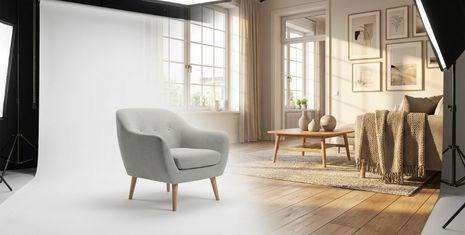
What Makes a Dining Table Product Image Successful on Home24?

A dining table on Home24 doesn’t sell through specifications — it sells through images. Customers scroll through dozens of listings in seconds, and only the products with compelling visuals end up in the shopping cart.
The problem: a traditional photo shoot for a single dining table quickly costs 300-500 € and takes weeks. This article shows you which image types a successful listing needs, how to optimally photograph different materials and table shapes, and how AI image generation accelerates the entire process. Similar requirements for other furniture on Home24: armchair product images on Home24 and dining table images on Otto.
Image Requirements for Dining Table Listings on Home24
A successful dining table product image on Home24 shows the product clearly, in detail, and in the right context. The platform expects multiple views that convey material, size, and style — a single image isn’t enough to convince customers.
Technical Specifications
Home24 requires images with at least 1000 x 1000 pixels. Higher resolutions are better because they support the zoom function. Accepted formats are JPG and PNG.
The main image needs a pure white background. The aspect ratio is typically 1:1 or 4:3, with the product occupying at least 80% of the image area. Too much white space looks unprofessional and wastes valuable detail view.
Optimal Image Count and Order
Listings with 5-7 images typically outperform those with only 2-3 views. The order influences how customers perceive the product.
A proven sequence looks like this:
- Main image (cutout): Clear product view on white background
- Lifestyle image: The table in a realistic living situation
- Detail shot: Close-up of material or craftsmanship
- Dimension drawing: Technical representation with all measurements
- Second lifestyle image: Alternative perspective or different room style
- Additional details: Table legs, extension mechanism, or edge finishing
Why Dining Tables Are Hard to Photograph
Dining tables are among the most challenging furniture pieces in product photography. Their size, the variety of materials, and the importance of proportions make every shoot a challenge.
Large, Flat Tabletops Reflect Light and Show Every Imperfection
A large, flat surface reflects light sources like a mirror — especially with lacquered or polished tops. Every scratch, every dust particle, and every uneven illumination becomes immediately visible. You need diffused, even light to control these reflections and achieve a clean presentation.
Actual Size and Proportions Are Hard to Gauge in Images
A six-person dining table and a compact two-seater can look almost identical in a photo. Without reference objects or dimensions, your customers have no sense of the actual size. This leads to uncertainty and, in the worst case, returns because the table doesn’t fit in the intended space.
Wood Grain and Surface Textures Need Precise Lighting
The grain of oak, walnut, or acacia is often the strongest selling point of a dining table. Wrong light makes this natural texture appear flat and lifeless or unnaturally overemphasizes it. You need to work with angled raking light to capture the depth of the grain without creating hard shadow edges.
Table Legs and Base Require Additional Perspectives
The base of a dining table is often an important design element that’s barely visible in standard top-down shots. Whether filigree metal legs, solid wooden side panels, or a central pedestal — you need deliberately chosen additional perspectives to capture these details. A single shot isn’t enough to convincingly present both tabletop and base.
Which Image Types a Dining Table Listing Needs
Not every image serves the same purpose. A well-thought-out mix of four image types answers the most important customer questions — from “What does the table look like?” to “Does it fit in my room?”
Cutout as the Foundation
A cutout shows the product isolated on a pure white background, without distraction and without context. It serves as the main image because it presents the product clearly and consistently. Marketplaces like Home24 require this image type as the first view.
Lifestyle Images for Context
Lifestyle images (also called ambiance images) show the dining table in a real living situation. Customers can better envision how the table would look in their own home. The difference is measurable: lifestyle images typically achieve higher conversion rates than plain cutouts.
Detail Shots for Material and Craftsmanship
Close-ups prove quality. They show the grain of the wood, the edge finishing, or the connections between top and base. Especially with higher-priced tables, such details are decisive for the purchase.
Dimension Drawings for Size Reference
Technical drawings with exact measurements help customers assess the proportions. Does the table fit in the room? How much space remains between chair and wall? Dimension drawings reduce uncertainties — and thus also returns.
| Image Type | Purpose | Typical Position in Listing |
|---|---|---|
| Cutout | Clear product presentation | Main image (position 1) |
| Lifestyle image | Emotional purchase decision | Positions 2 and 5 |
| Detail shot | Quality proof | Positions 3 and 6 |
| Dimension drawing | Size reference | Position 4 |
Photographing Dining Table Materials Convincingly
Each material has its own requirements for light and perspective. What works for solid wood can be completely wrong for glass.
Showing Solid Wood and Wood Grain Properly
Solid wood lives through its grain. Soft, angled light emphasizes the natural texture of oak, acacia, or walnut without creating hard shadows. Show the grain in close-ups — it’s often the strongest selling point.
Glass Without Distracting Reflections
Glass tables are photographically demanding because they mirror light sources. Diffused light minimizes reflections, while a slightly tinted background emphasizes the transparency. Avoid direct light sources reflecting in the surface.
Metal and Surface Textures
Metal bases in an industrial look need targeted light accents. Raking light highlights the texture without reflecting too strongly. Make sure brushed or matte surfaces don’t appear glossy — that distorts the impression.
Ceramic and Marble
With ceramic and marble tops, it’s all about the unique surface structure. Raking light emphasizes the texture, while even illumination brings out the patterning. The natural variation is the selling point here.
Perspectives for Different Table Shapes
The shape of the table determines the optimal camera perspective. What works for a rectangular table can make a round table look flat and unattractive.
Rectangular Dining Tables
The classic diagonal view from slightly above shows both length and width simultaneously. This perspective gives the table depth and makes its proportions look realistic.
Square Dining Tables
Square tables benefit from frontal or diagonal views. Both variations emphasize the compact, space-saving form — an important selling point for smaller dining areas.
Round and Oval Dining Tables
A slightly elevated perspective shows the curved shape best. Frontal shots often make round tables look flat and waste their harmonious effect.
Staging Dining Tables by Living Style
Lifestyle images have their full impact when the surroundings match the table’s design. An industrial table in a country house setting confuses customers more than it convinces them.
Industrial and Loft
Dining tables with an industrial design need raw materials as a backdrop: exposed brick walls, concrete floors, striking metal accents. The setting underlines the urban character of the product.
Country Style
Cozy country-style dining tables come into their own in warm settings. Natural wood tones, textiles, and rustic accessories create the right atmosphere.
Scandinavian and Modern
Bright, minimalist settings with clean lines and plenty of natural light are the perfect stage for Scandinavian or modern designs. Less is more here.
Tip: With AI tools like showcase, you can stage the same dining table in different living styles — without planning multiple shoots. From a single cutout, lifestyle images for industrial, country style, and Scandinavian settings are created in minutes.
Presenting Color Variants and Product Features
Many dining tables come in multiple colors or with special features like extension leaves. Visually presenting these variants used to be elaborate — AI image generation is fundamentally changing that.
Color Variants Without a New Shoot
Instead of organizing a separate shoot for each color variant, you can generate all variants from a single cutout. Tools like showcase enable color changes with a click — from natural oak to smoked oak in seconds instead of weeks.
Visually Demonstrating the Extension Function
Extendable dining tables need images in both states. Show the table collapsed and extended, ideally with dimension markings for both variants. This way, customers immediately understand what space reserves the table offers.
Multi-Product Staging with Chairs
A dining table alone often looks incomplete. Combine it with matching chairs in a lifestyle image — this promotes cross-selling and shows complete room concepts.
With multi-product staging, multiple products can be combined in a single scene without physically bringing them together. This is especially practical when table and chairs come from different suppliers.
Common Mistakes in Dining Table Product Images
Even small mistakes cost conversion. The following problems come up time and again:
- Uploading only one image: Customers need multiple views for a confident purchase decision. A single image isn’t enough.
- Wrong proportions: Without context or dimensions, the table appears arbitrarily large or small. Customers can’t gauge the size.
- Poor lighting: Light that’s too harsh or too weak distorts materials and colors. Oak suddenly looks like pine.
- Missing lifestyle context: Plain cutouts create less emotional connection. Customers don’t buy furniture — they buy a home.
- Inconsistent image style: Different visual worlds within a listing confuse and weaken brand perception.
Create Dining Table Product Images Faster and More Affordably
Traditional photo shoots for dining tables are elaborate: studio rental, photographer, styling, transporting the furniture, post-processing. Per product, costs quickly reach 300-500 €, with a lead time of 2-6 weeks.
AI image generation changes this equation. From a simple cutout, photorealistic lifestyle images are created in seconds — at a fraction of the cost.
| Aspect | Traditional Shoot | AI Image Generation |
|---|---|---|
| Cost per image | 50-150 € | 0.50-2 € |
| Lead time | 2-6 weeks | Minutes |
| Color variants | New shoot required | With a click |
| Scaling | Linear with costs | Nearly constant |
showcase is specifically optimized for Home & Living and offers all image types a dining table listing needs:
- Lifestyle images: Cutouts become photorealistic living scenes
- Color variants: Natural oak, smoked oak, walnut — all from one image
- Multi-product staging: Combine table and chairs in one scene
- Dimension drawings: Automatically generated technical drawings
- Brand identity: All images remain brand-consistent and visually cohesive
Get started for free, no credit card required.
Checklist for Successful Dining Table Images on Home24
Before you publish your dining table listing, go through this checklist to ensure your images meet all important requirements.
- Cutout on pure white background available
- At least one lifestyle image with chairs in a dining area
- Detail shot of wood grain or surface material
- Dimension drawing with length, width, and height
- Multiple perspectives (top view, side view, leg detail)
- All material and color variants individually visualized
- Resolution and file formats meet Home24 specifications
If you can check off all points, your listing is optimally positioned to convince customers and minimize returns.
Frequently Asked Questions About Dining Table Product Images on Home24
How many images should a dining table listing on Home24 have?
An optimal listing includes 5-7 images: a cutout as the main image, at least one lifestyle image, detail shots of material and craftsmanship, and a dimension drawing. More images give customers more confidence in their purchase decision.
Are AI-generated product images allowed on Home24?
Yes, AI-generated images are allowed as long as they accurately represent the product and meet the technical requirements. What matters is product fidelity — shape, color, and material must not be distorted.
How long does it take to create professional dining table product images with traditional photography?
From planning to final image editing, it typically takes 2-6 weeks. AI-generated images are created in minutes — a decisive advantage with fast product cycles.
How much does a professional dining table product image cost with a photographer?
Costs vary depending on the photographer, studio, and post-processing effort. For a single lifestyle image with styling, costs are often 100-300 €, significantly more for complete product sets.
Does a dining table product image on Home24 need matching chairs?
Not necessarily, but lifestyle images with matching chairs significantly increase the visual impact. They show the product in context and simultaneously promote cross-selling — customers often buy table and chairs together.
showcase is an AI image studio for Home & Living. Create photorealistic lifestyle images, color variants, and dimension drawings from simple cutouts — in minutes instead of weeks.
Get started for free, no credit card required.
About the author

Author
Tim Hoffmann
Chief Product Officer, getshowcase.ai
Tim Hoffmann leads the product strategy for the AI image studio at showcase (getshowcase.ai). He brings years of e-commerce experience in product data, marketplace integrations, and visual content creation. His focus: helping Home & Living retailers turn product cutouts into photorealistic lifestyle images and room scenes in minutes – without expensive shoots, with measurably better conversion. Tim shares practical strategies for product images that perform on marketplaces and in your own shop.