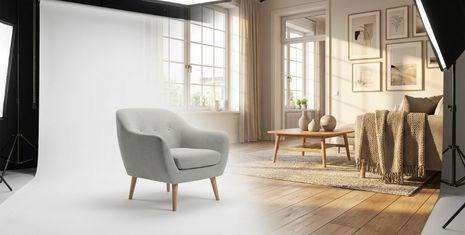
Image Quality for Westwing: How Your Sofa Meets the Listing Requirements in 2026

Westwing rejects product images before anyone even evaluates your sofa on its merits. As a curated marketplace, the platform reviews every listing against aesthetic criteria — and your image quality determines whether you even make it into the selection.
This article walks you through the specific technical specifications, the required image types, and a practical workflow to ensure your sofa images meet Westwing’s 2026 requirements. Similarly strict guidelines apply on Wayfair and Zalando Home — our guides help you cover all marketplaces.
What Westwing Expects from Your Product Images
Westwing works differently from Amazon or Otto. The platform actively curates its assortment — meaning an editorial team decides which products get listed at all. Your images are a central selection criterion.
What this means in practice: low-quality shots lead to rejection before anyone even evaluates your sofa on its content. The target audience on Westwing is design-savvy and expects images that match upscale interior styles.
- Curated selection: Westwing reviews every product before listing — image quality is part of that review.
- Premium standards: Your images compete with professionally staged products from established brands.
- Assortment consistency: All your products on the platform should be visually cohesive.
Why Sofas Are Hard to Photograph
Sofas are among the most challenging product categories in furniture photography. What looks convincing in the showroom can quickly appear flat, color-shifted, or simply unattractive in photos. Here are the biggest challenges you should be aware of.
Large, Bulky Dimensions Require Plenty of Space and Specialized Lighting
A sofa isn’t a decorative object you can simply place on a table and photograph. You need sufficient distance for the right perspective and even lighting across the entire width. Especially with corner sofas or sectionals, a standard room often isn’t enough to properly light the product and capture it without distortion.
Fabric Textures and Materials Often Appear Flat and Lifeless in Photos
Bouclé, corduroy, velvet, or leather — every material has its own character that easily gets lost in photos. Without targeted lighting that brings out textures, a high-quality velvet fabric looks the same as cheap polyester in the image. Customers spending several hundred euros on Westwing expect this visible material quality.
Color Accuracy Is Hard to Guarantee
The color you see in the showroom is rarely the color that reaches your customers’ screens. Between camera sensors, monitor calibration, and the various devices buyers use, there’s a long chain of potential color shifts. Especially with popular sofa colors like greige, taupe, or warm beige, even minimal deviations can lead to complaints.
Cushions and Curves Create Complex Shadow Patterns
Rounded armrests, deep seat cushions, and curved backrests cast shadows that can quickly look unnatural or unflattering. Hard shadows make the sofa appear heavy and bulky, while light that’s too soft swallows the three-dimensional form. Finding the right balance requires experience — or an AI tool that automatically optimizes these lighting conditions.
Technical Image Specifications for Westwing Furniture Listings
Before you worry about styling, check the technical fundamentals. An image that doesn’t meet the specifications won’t even be accepted.
Resolution and Pixel Dimensions
Westwing uses zoom functionality on product pages. Customers want to see fabric textures and stitch quality before spending several hundred euros.
Plan for at least 2000 pixels on the longest side. For large furniture like sofas, 3000-4000 pixels are better, so no blurriness appears even when zooming in closely.
File Formats and Maximum File Size
JPG works well for lifestyle images, PNG for cutouts with transparent backgrounds. Westwing accepts both formats.
Pay attention to the balance between quality and file size. Overly compressed images show visible artifacts — blurred edges, pixel blocks around contours. This looks unprofessional and can lead to rejection.
Color Profile and Correct White Balance
Use sRGB as your color profile. This is the web standard and ensures your colors are displayed consistently across different screens.
A neutral white balance is essential. If your beige sofa appears yellowish or bluish in the image, it leads to customer complaints after delivery.
| Specification | Westwing Requirement |
|---|---|
| Minimum resolution | 2000 px (longest side) |
| File format | JPG, PNG |
| Color profile | sRGB |
| Cutout background | Pure white (RGB 255, 255, 255) |
Which Image Types Your Sofa Listing Needs
A single product photo isn’t enough for Westwing. The platform expects multiple image types that answer different customer questions.
Cutout on White Background
The classic cutout is mandatory. It shows the sofa completely, without distractions, against a pure white background.
Important: the background is truly pure white (RGB 255, 255, 255), not light gray or cream white. Unclean cutout edges are immediately noticeable.
Lifestyle Images in Living Scenes
This is where customers decide whether to buy or keep scrolling. Lifestyle images show your sofa in a furnished living situation — with a rug, side table, decorations, and appropriate lighting.
Westwing customers expect inspiring content. They want to see how the sofa could look in their home. Plain cutouts don’t deliver this emotional component.
Detail Shots of Material and Craftsmanship
Fabric texture, stitch quality, upholstery, feet — customers buying a piece of furniture online for several hundred euros want to know what they’re getting beforehand.
Detail images reduce the return rate. When customers can see what the material really looks like before purchasing, there are fewer surprises after delivery.
Dimension Drawings and Size Representations
Seat depth, seat height, overall width — measurements belong not only in the text but also in the image. A visual dimension representation helps customers plan the sofa in their space.
Avoiding Common Mistakes in Westwing Product Images
Certain mistakes regularly lead to listing rejections. The good news: they’re easy to avoid.
Low Resolution and Compression Artifacts
Heavy compression saves storage space but costs quality. Typical signs include blurred edges, visible pixel blocks, and washed-out fabric textures.
Check your images at 100% zoom. What looks good as a thumbnail can be disappointing in the detail view.
Inconsistent Lighting and Color Reproduction
When you combine images from different sources — such as manufacturer photos with your own shots — color discrepancies often arise. The same sofa looks warm-beige in one image and cool-gray in the next.
Customers notice such inconsistencies. Ensure uniform color temperature and color correction across all images.
Missing Lifestyle Scenes and Context Images
Plain cutouts don’t work on Westwing. The platform thrives on inspiring content, and customers expect images that go beyond mere product representation.
Inconsistent Visual Language Across Your Assortment
If every one of your products is photographed in a different style — sometimes Scandinavian, sometimes industrial, sometimes classic — your assortment looks thrown together. Westwing customers often buy multiple products. A consistent visual language signals professionalism.
How to Create Westwing-Compliant Sofa Images
The path to a finished listing follows a clear workflow. Here’s the process that has proven effective in practice.
1. Use a High-Quality Cutout as Your Base
Everything starts with a clean cutout. Ensure neutral, shadow-free lighting and a perspective that shows the sofa completely.
The quality of this source image determines what’s possible afterward. A blurry or poorly lit cutout can’t be transformed into a convincing lifestyle image, even with the best tools.
2. Generate Lifestyle Scenes with AI
Traditional lifestyle shoots quickly cost 250-500 € per product and scene. With an assortment of 50 sofas in three room styles each, this becomes a budget problem.
AI image generation offers an alternative: from your cutout, photorealistic living scenes are created in seconds. Tools like showcase are specifically optimized for Home & Living and deliver results that meet Westwing requirements.
3. Create Color Variants Without Physical Prototypes
Your sofa comes in beige, gray, and petrol — but you only have the beige prototype? With AI tools, you create color variants digitally, without having each version individually photographed.
This saves not only shooting costs but also time. New color variants can go live immediately instead of waiting for the next production run.
4. Ensure Image Consistency Across Your Assortment
Brand identity features in AI tools analyze your brand and automatically generate scenes that match your style. This creates consistent results across your entire assortment.
Automated workflows enable scaling: instead of editing each image individually, you define the process once and apply it to hundreds of products.
Checklist for Your Westwing Sofa Listing
Before you upload your images, go through these points:
- ☐ Cutout with pure white background (RGB 255, 255, 255)
- ☐ Minimum resolution of 2000 px on the longest side
- ☐ At least one lifestyle image in a living scene
- ☐ Detail shots of material and craftsmanship
- ☐ Dimension drawing or size representation
- ☐ Consistent visual language across all products
- ☐ Correct color profile (sRGB)
- ☐ File size within upload limits
Photo Shoot or AI Image Generation for Westwing
Both approaches have their place. The question is: what fits your assortment, budget, and timeline?
| Criterion | Traditional Photo Shoot | AI Image Generation |
|---|---|---|
| Time to finished image | 2-6 weeks | Seconds to minutes |
| Cost per scene | 250-500 € | 0.50-5 € |
| Color variants | Each one photographed individually | Automatically generated |
| Lifestyle scenes | Studio setup required | Unlimited generation |
| Scaling | Linear with costs | Nearly constant |
For hero campaigns and catalog covers, real photography often remains the better choice. For daily product communication, variant images, and quick assortment expansions, AI is the more efficient alternative.
Create Westwing Images Faster with AI Product Photography
If you regularly want to list new products on Westwing, it’s worth looking at specialized AI tools. General image generators often deliver unsatisfying results for furniture — proportions are off, materials look unnatural.
showcase is an AI image studio specifically developed for Home & Living. The platform analyzes your brand and automatically generates scenes that match your style.
- Lifestyle image generation: Photorealistic living scenes are created from cutouts in various styles.
- Multi-product staging: Combine sofa, side table, and decorations in one scene — ideal for cross-selling.
- Color variants: Create all color options digitally without photographing every prototype.
- Workflow automation: Recurring tasks can be automated via drag-and-drop.
- Dimension drawings: Automatically generated technical drawings for your product pages.
Get started for free, no credit card required: Try showcase with your own products
Frequently Asked Questions About Westwing Image Requirements
How long does the image approval process take on Westwing after uploading?
The approval time varies depending on the product category and the quality of the submitted images. Expect a few business days and plan a buffer for any revisions.
Can I replace product images for existing Westwing listings retroactively?
Yes, you can update images in your seller backend. However, the new images go through the quality review again before they go live.
Does Westwing accept AI-generated product images for furniture listings?
Westwing evaluates images based on quality, not creation method. As long as your AI-generated images meet the technical requirements and accurately represent the product, they are accepted.
What image order does Westwing recommend for sofa product pages?
Start with the main cutout as the first image. Follow with lifestyle images showing the sofa in context. Detail shots and the dimension drawing come last.
Do I need separate lifestyle images for each color variant of my sofa?
Ideally yes — customers want to see each variant in context. With AI tools like showcase, you can efficiently derive color variants from a single base lifestyle image instead of photographing each color individually.
About the author

Author
Tim Hoffmann
Chief Product Officer, getshowcase.ai
Tim Hoffmann leads the product strategy for the AI image studio at showcase (getshowcase.ai). He brings years of e-commerce experience in product data, marketplace integrations, and visual content creation. His focus: helping Home & Living retailers turn product cutouts into photorealistic lifestyle images and room scenes in minutes – without expensive shoots, with measurably better conversion. Tim shares practical strategies for product images that perform on marketplaces and in your own shop.