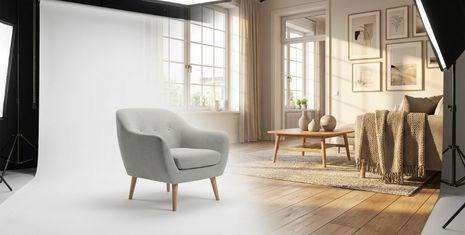
Multi-Product Staging: Showcase Multiple Items in Room Scenes for Cross-Selling
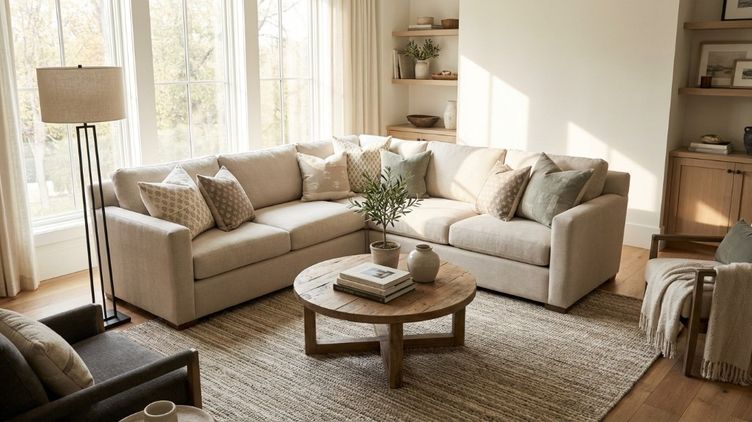
Multi-Product Staging: Showcase Multiple Items in Room Scenes for Cross-Selling
If you run an online store in the Home & Living space, you know the challenge: a single product image is helpful, but how do you show customers that the sofa pairs beautifully with the coffee table - or that the table lamp and side table create a cohesive look? Multi-product staging addresses exactly this: placing multiple items together in realistic room scenes. It presents products more effectively and drives cross-selling, which can increase the average order value. More on AI image generation: lifestyle images and color variants from cutouts and photorealistic lifestyle images - the underlying technology is the same.
What Is Multi-Product Staging?
Multi-product staging means arranging multiple items together in a realistic room scene. Instead of showing isolated cutout images, you present, for example, a living room featuring a sofa, coffee table, rug, wall shelf, and decorative cushions - all products from your catalog. This visual presentation creates context, evokes emotions, and helps customers imagine how the products would look in their own home.
A key benefit: customers are encouraged to buy not just a single product but to add matching items to their cart. That is cross-selling - and it works especially well when it is clear how well the products complement each other.
Why Multi-Product Staging Matters for Cross-Selling
Studies show that lifestyle images - product photos in realistic usage scenarios - can significantly boost conversion rates. A cutout on a white background is technically correct but offers little inspiration. A furnished dining room with a table, chairs, tablecloth, and dinnerware, on the other hand, evokes the feeling: “I want that too.”
Benefits of multi-product staging:
- Higher cart value: Customers buy the main product along with complementary items from the scene
- Better shopping experience: Matching products are found more quickly, and customers feel better guided
- Emotional connection: Room scenes tell stories and spark desire - far more than a single product photo
- Fewer returns: Customers better understand how products look and fit together; disappointment upon unboxing decreases
- Competitive advantage: Many stores only show individual images - cohesive room scenes set you apart
How to Implement Multi-Product Staging
The question is: how do you create these room scenes without an elaborate photoshoot every time? Traditionally, this would require: transporting multiple products to a location, booking a photographer, building sets, and often waiting weeks for results.
1. The Traditional Approach: Photoshoots
A classic photoshoot for multi-product scenes requires:
- A suitable space with matching interior design or a professional studio location
- All desired products physically on site
- An experienced product photographer including equipment
- Time for styling, lighting, and post-production
- Costs that quickly reach several hundred euros per scene
For large brands with the budget to match, this can work. For many online retailers in the Home & Living space, it is often too expensive, too slow, and too inflexible - especially when color variants, combinations, or seasonal scenes change regularly.
2. The Modern Solution: AI-Powered Multi-Product Staging
Modern AI platforms like showcase make it possible to place multiple products into photorealistic room scenes - in minutes instead of weeks. Cutout images are uploaded, a style and desired room scene are selected, and the AI generates a cohesive composite image with multiple products.
Advantages of this approach:
- Speed: Scenes are created in seconds to minutes
- Cost: Significantly more affordable than traditional shoots
- Flexibility: Unlimited variants and combinations are possible
- True-to-original rendering: Products remain undistorted and authentic
- Scalability: Whether one scene or many - the effort stays manageable
With AI-based multi-product staging, you can create sets like “The Complete Bedroom” or “Modern Living Room Set” without a physical shoot - quickly, consistently, and ready to use across your entire catalog.
Conclusion
Multi-product staging increases cart value and enhances the shopping experience by showcasing multiple items together in room scenes. Traditional photoshoots are too resource-intensive for many retailers. AI-powered solutions like showcase offer a scalable alternative: place multiple products in photorealistic scenes, drive cross-selling, and save time and money in the process.
showcase is an AI platform for Home & Living product photography. Create your first product images with showcase for free today and transform the way your customers see your products.
About the author

Author
Tim Hoffmann
Chief Product Officer, getshowcase.ai
Tim Hoffmann leads the product strategy for the AI image studio at showcase (getshowcase.ai). He brings years of e-commerce experience in product data, marketplace integrations, and visual content creation. His focus: helping Home & Living retailers turn product cutouts into photorealistic lifestyle images and room scenes in minutes – without expensive shoots, with measurably better conversion. Tim shares practical strategies for product images that perform on marketplaces and in your own shop.