Optimizing Armchair Product Images: How Home24 Sells Successfully
Armchairs are among the most-clicked product categories on Home24 - and at the same time among the most challenging when it comes to compelling product images. The combination of upholstery, material texture, and proportions makes every armchair a photographic challenge.
What sets successful listings apart from mediocre ones is rarely the product itself. It’s the images: the right context, the right perspectives, the visible material quality. This article shows you which image types Home24 expects, how to present materials convincingly, and how AI tools create in minutes what traditional shoots take weeks to produce. More Home24 guides: Sofa photos on Home24 and Armchairs on Otto.
What Makes an Armchair Product Image Successful on Home24
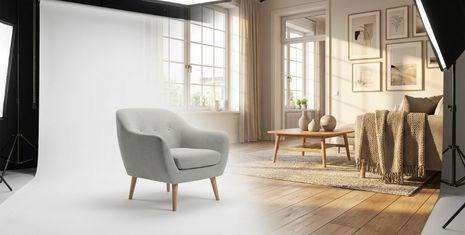
When you look at armchair listings on Home24, one thing immediately stands out: The most successful products don’t simply show an armchair against a white background. They show the armchair in a living room, next to a side table, with a lamp in the background. Customers want to see how the piece of furniture could look in their own home - not just what it looks like in isolation.
What “successful” specifically means here: more clicks in the category overview, higher conversion on the product page, and fewer returns. Because when customers understand exactly what they’re getting before purchasing, they return items less frequently.
The decisive factors can be reduced to four points:
- Context: An armchair in a room sells better than an armchair in a void
- Material presentation: Leather, boucle, velvet - the texture often decides the purchase
- Multiple views: Front, side, details - the more perspectives, the more confident the decision
- Technical quality: High resolution, clean cutout, accurate colors
Why Armchairs Are Difficult to Photograph
Armchairs often look impressive in the showroom, but a lot gets lost on screen. Knowing the typical pitfalls helps you avoid them and saves you frustrating rounds of post-processing.
Compact Shape with Many Curves Creates Complex Shadow Patterns
Armchairs rarely have straight lines. The curved armrests, arched backrest, and rounded seat surface cast uneven shadows under poor lighting, visually distorting the product. You need soft, diffused light from multiple directions to illuminate the shape evenly. Hard shadows quickly make the armchair look bulkier than it actually is.
Upholstery Textures and Fabric Quality Often Appear Flat and Undifferentiated in Photos
Boucle, velvet, or woven fabric have a tactile depth in reality that is easily lost on a flat screen. Without targeted close-ups and proper lighting, different materials look nearly identical in photos. Invest in detail shots with side lighting so the texture becomes visible and customers can tell the difference between a 200-euro and an 800-euro cover.
Color Reproduction Varies Significantly Depending on Lighting and Camera Settings
An armchair in “anthracite” can look black, dark gray, or even brown in a photo depending on the white balance and ambient light. Inaccurate color reproduction is one of the most common return reasons for upholstered furniture. Work with a calibrated monitor and a color card during the shoot so the result stays as close to reality as possible.
Armrests, Backrest, and Seat Must Be Shown from Multiple Angles
A single photo is not enough for an armchair because each side looks different. The front view shows proportions, the side view reveals depth and seat height, the rear view shows craftsmanship. You should plan for at least four to five perspectives so customers get a complete picture and don’t abandon their purchase due to unanswered questions.
Which Image Types You Need for Armchairs on Home24
Home24 requires different image types per listing because customers have different questions. One wants to see the overall shape, another wants to check the upholstery, a third wants to visualize the armchair in a room. If you only provide one image type, you lose potential buyers at the point where they have an unanswered question.
Cutout on White Background
A cutout shows the product against a pure white background, without shadows or decoration. That sounds boring but serves a clear purpose: In search results and product comparisons, this image type makes the product quickly identifiable. Customers can assess shape and color at a glance without being distracted by background elements.
Lifestyle Images and Milieu Shots
Milieu images show the armchair in a realistic living situation. Imagine: a recliner next to a bookshelf, a floor lamp in the background, perhaps a rug beneath the feet. This context helps customers picture the product in their own home.
The difference in conversion is measurable. Lifestyle images typically achieve conversion rates of 4-6%, while pure cutouts land at 2-3%. The reason is simple: customers make more confident purchase decisions with context images.
Detail Shots of Material and Craftsmanship
Close-ups of stitching, fabric texture, armrests, and feet answer the questions that customers would resolve by touching in a store. With an armchair at 500 € or more, nobody wants to be surprised. Show the upholstery, show the craftsmanship, show the small details that signal quality.
Dimension Drawings and Product Measurements
Technical drawings with measurements measurably reduce returns. When customers know before purchasing that the armchair is 90 cm wide and 76 cm tall, it will also fit through the door later. Home24 displays this information prominently on product pages - and for good reason.
Technical Image Requirements from Home24
Home24 has clear specifications for product images. Those who don’t comply risk rejected listings or poor display in search. The good news: the requirements aren’t complicated.
| Requirement | Recommendation |
|---|---|
| Minimum resolution | 1500 x 1500 pixels |
| File formats | JPG or PNG |
| Background (cutout) | Pure white (#FFFFFF) |
| Aspect ratio | Square (1:1) preferred |
| File size | Max. 10 MB |
Resolution and File Formats
JPG is suitable for most product images, PNG for cutouts with a transparent background. The minimum resolution of 1500 pixels ensures that zoom functions remain sharp. Customers like to zoom into material details - and blurry images look unprofessional.
Image Size and Aspect Ratio
Square images in 1:1 format work best in category overviews and on mobile devices. Rectangular formats are possible but are often automatically cropped. If you want to maintain control over the image crop, stick with square.
Background and Cutout
Cutouts require a pure white background (#FFFFFF) without shadows and with clean edges. Sloppy cutouts - meaning frayed edges or gray backgrounds - look unprofessional and lower trust. Most AI tools handle the cutout automatically, but check the result nonetheless.
How to Convincingly Present Materials in Armchair Images
Material presentation is decisive for purchases because customers can’t touch products online. A leather armchair that looks like faux leather in the image won’t sell - or will be returned. The challenge: each material requires a different approach.
Showcasing Leather Properly
Leather thrives on light reflections and texture. Soft side lighting makes the natural grain visible without creating harsh shadows. The color depth - whether cognac, black, or dark brown - comes across much better with correct lighting. Make sure the reflections aren’t overexposed, or the texture will be lost.
Photographing Fabric Covers with Texture
Boucle, velvet, or woven fabric - each material has its own texture that customers want to see. Close-ups with diffused light reveal the weave structure without creating harsh shadows. With velvet, the angle is crucial: depending on the light direction, the fabric appears lighter or darker.
Creating Color Variants Without a Photo Shoot
If an armchair is available in five colors, that classically means five separate shoots - or five prototypes that need to be photographed. With AI recoloring, you create all color variants from a single cutout in minutes. The material texture is preserved, only the color changes.
With showcase, you generate color variants automatically while preserving the material texture - without prototypes, without a studio.
Which Room Scenes Work for Armchairs on Home24
Not every room scene suits every armchair. A wingback chair in an industrial loft looks out of place, as does a cocktail chair in a country-house style. The scene conveys the style - and thereby speaks to the right target audience.
Living Room Settings for Recliners
Recliners and wingback chairs work in cozy living room scenes: warm colors, hardwood floors, a side table with a book and cup. These images convey relaxation and comfort. If you’re selling an armchair where people read or watch TV in the evening, show exactly that.
Modern Lofts for Cocktail Chairs
Cocktail chairs and designer armchairs fit in urban, minimalist settings: concrete walls, large windows, minimal decoration. The scene underscores the modern character of the product. Someone looking for a design classic doesn’t want to see it in a country-house style.
Reading Nooks and Cozy Corners
Small scenes - an armchair next to a bookshelf, under a reading lamp - show specific usage situations. These images help customers picture the armchair in their own apartment. Sometimes less is more: a focused scene often looks more convincing than a fully furnished living room.
Perspectives and Views That Sell Armchairs
Multiple views increase conversion because they answer different questions. A single frontal image isn’t enough to sell an armchair at 400 €. Customers want to see the product from all sides before deciding.
Front View for the First Impression
The front view is the main image - it shows overall shape, color, and proportions at a glance. This image decides whether customers even click. Make sure the armchair is centered and the proportions are correct.
Side View for Proportions
The side view makes depth, seat height, and backrest visible. Especially for armchairs with curved shapes or distinctive armrests, this perspective is indispensable. Customers can assess how the armchair looks in profile.
Detail Views for the Purchase Decision
Close-ups of upholstery, feet, and armrests eliminate the last doubts. Customers who have scrolled this far are close to buying - give them the confidence they need. Show the quality of craftsmanship, show the material details.
Traditional Product Photography vs. AI Image Generation
Traditional shoots deliver the highest quality but are slow and expensive. AI image generation is faster, cheaper, and more flexible - with results that are perfectly sufficient for product pages and marketplaces.
| Criterion | Traditional Shooting | AI Generation |
|---|---|---|
| Time required | 2-6 weeks | Minutes |
| Cost per image | 250-500 € | 0.50-5 € |
| Color variants | New shooting required | Automatically generated |
| Scalability | Linear with costs | Nearly constant |
| Flexibility | Low after shooting | Adjustable anytime |
For hero campaigns and print media, real photography remains worthwhile. For daily e-commerce content - product pages, marketplace listings, color variants - AI is the more efficient choice today. The difference becomes especially clear with large assortments: 100 products x 3 variants classically cost between 75,000 and 150,000 €, with AI between 500 and 1,000 €.
How to Create Armchair Images for Home24 in Seconds
With AI tools like showcase, you generate photorealistic milieu images, color variants, and different perspectives from a simple cutout - without a studio, without a photographer, without waiting.
The workflow in four steps:
- Upload cutout - a single product photo against a white background is enough
- Remove background - if needed, showcase handles this automatically
- Generate milieu - choose a room style or describe your desired scene
- Create variants - color changes, new perspectives, multi-product staging
The entire process takes less than a minute per image. For large assortments, you generate hundreds of images at once via batch processing.
Get started for free, no credit card required.
Checklist for Successful Armchair Images on Home24
Before you publish your armchair listing on Home24, go through this checklist. This ensures your images meet all important requirements and no conversion opportunities are wasted.
- Cutout on pure white background available
- At least one lifestyle image in a living context
- Detail shots of upholstery, fabric, and feet
- Dimension drawing with seat height, width, and depth
- Multiple perspectives (front, side, angled)
- All color variants individually illustrated
- Resolution and file formats comply with Home24 specifications
If you can check off all points, your listing is optimally set up and you maximize your chances for clicks, conversions, and satisfied customers.
FAQs About Armchair Product Images on Home24
How many images do I need per armchair listing on Home24?
Home24 recommends multiple images per product - at least a cutout, a milieu image, and detail shots. The more perspectives and context images you provide, the more confident customers feel about their purchase decision. Five to seven images per listing is a good benchmark.
Can I create professional armchair product images without a photo shoot?
Yes, with AI image generation like showcase, you create photorealistic milieu images and variants from a simple cutout - without a studio, photographer, or long waiting times. The results are optimized for product pages and marketplaces.
What image formats does Home24 accept for product images?
Home24 accepts JPG and PNG with a minimum resolution of 1500 x 1500 pixels. Cutouts require a pure white background (#FFFFFF) with clean edges. Square formats (1:1) work best.
How often should I update my armchair product images on Home24?
Update images during assortment changes, seasonal campaigns, or when you want to test new lifestyle scenes. A/B tests with different milieu images can measurably improve conversion - try different room styles and observe the results.
How frequently should I refresh my armchair product images on Home24?
Plan for a review of your product images at least every three to six months. Seasonal adjustments are particularly worthwhile: in autumn and winter, warm, cozy milieu images with blankets and dimmed lighting work better, while in spring and summer, bright, airy scenes perform best. Beyond that, you should update images immediately when materials, colors, or details of the product change. Use the performance data of your listings as a guide - if the click-through rate drops or the return rate increases, that’s a clear signal for an image update.
About the author

Author
Tim Hoffmann
Chief Product Officer, getshowcase.ai
Tim Hoffmann leads the product strategy for the AI image studio at showcase (getshowcase.ai). He brings years of e-commerce experience in product data, marketplace integrations, and visual content creation. His focus: helping Home & Living retailers turn product cutouts into photorealistic lifestyle images and room scenes in minutes – without expensive shoots, with measurably better conversion. Tim shares practical strategies for product images that perform on marketplaces and in your own shop.