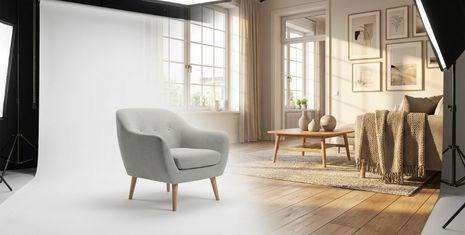
How to Optimize Your Armchair Images for Kaufland Marketplace

How to Optimize Your Armchair Images for Kaufland Marketplace
Kaufland is the underestimated furniture marketplace for German retailers: lower commissions than Amazon, less bureaucracy than Otto, and a price-conscious customer base that values clear, informative product images. Unlike Wayfair or Westwing, Kaufland does not require a mandatory lifestyle mix—but that doesn’t mean any images will do. In this article, you’ll learn what technical requirements Kaufland sets for armchair images, which image strategy actually works on this platform, and how to efficiently image all variants of your assortment with AI image generation.
Why Armchairs Are Particularly Hard to Photograph
Armchairs are the most complex upholstered furniture in product photography—not because of their size, but because of their variety of shapes. A couch is a couch. An armchair can be a simple upholstered stool with a back, a classic wing chair with deep button tufting, a swiveling lounge chair in mid-century style, or an electric recliner with an extendable footrest—and each type poses completely different photographic requirements.
The scale problem hits armchairs especially hard. While a couch conveys spatial presence through its dimensions alone, an armchair on a white background can look tiny or oversized—depending on camera distance and focal length. Without reference objects in the image, the actual seat size, armrest width, or seat height is hard for customers to estimate. Yet these exact dimensions are decisive for armchair purchases: an armchair that’s too wide won’t fit in the reading nook, one that’s too low is difficult for older buyers to get out of.
For Kaufland retailers, the variant effort adds up: many armchair models are offered in 15 to 30 upholstery colors and various configurations (with/without ottoman, with/without function). Photographing each variant individually in a studio is hardly scalable logistically for a piece of furniture weighing 15 to 40 kilograms—and in the price-sensitive Kaufland segment, studio costs pay off even less than on premium marketplaces. Traditional photography quickly becomes a margin killer here.
Image Requirements on Kaufland for Armchairs
Kaufland has clear technical image specifications documented in the Seller Portal under the product data guidelines. For armchairs, the general furniture category rules apply.
Technical specifications:
- Minimum resolution: 1,024 pixels in height or width
- Recommended resolution: 2,048 x 2,048 pixels (prerequisite for zoom function)
- Product coverage: The product must occupy at least 80 percent of the image area
- Formats: JPG (preferred), PNG (alternative)
- Maximum number of images: 10 images per listing
- Minimum number: 3 images (recommendation: 5–10)
Main image requirements:
- White or neutral background without color gradients—mandatory
- No advertising text, no logos, no discount notices in the image
- Complete product representation—no cropped elements
- Clear product silhouette without distracting elements
Additional image options:
- Perspective views (side, back, 45-degree)
- Detail shots of fabric, seams, leg options, craftsmanship
- Dimension drawings or infographics with measurements
- Optional: lifestyle images in neutral settings for size reference
- Color variant overview on uniform background
Kaufland-specific particularities:
Kaufland differs from Amazon in one important nuance: lifestyle images are not forbidden, but the platform primarily recommends neutral, informative product images. The Kaufland target audience is price-conscious and decision-oriented—less interested in emotional staging than in clear product information. That means for your armchair images: quality and information density over aesthetic staging. Anyone who still includes a lifestyle image should use it as a supplementary image (not as the main image) and opt for a neutral, uncluttered setting.
Which Image Types Your Armchair Listing Needs
| Image position | Image type | Why important for armchairs |
|---|---|---|
| Image 1 | Cutout (frontal, white background) | Mandatory main image on Kaufland—shows the armchair clearly and without distraction; displayed in search results and category overviews |
| Image 2 | Perspective view (45 degrees) | Shows depth, armrest shape, and backrest simultaneously—conveys a three-dimensional picture of the armchair better than the frontal view |
| Image 3 | Side view | Shows seat height, backrest inclination, and leg design—especially important for customers who want to assess size fit in the room |
| Image 4 | Detail shot (fabric and craftsmanship) | Closes the haptic gap—Kaufland buyers scrutinize price-performance critically; craftsmanship quality must be visible in the image |
| Image 5 | Dimension drawing/infographic | Directly reduces the most common return cause: armchairs with wrong size expectations get sent back. Show seat depth, armrest width, overall height in the image |
| Image 6 | Back view | For armchairs with distinctive backs (wingback, wing chair, design pieces)—often overlooked, but decisive when the armchair is visibly placed in the room |
| Image 7 | Lifestyle image (neutral, optional) | Provides size context when reference furniture is visible—should be styled subtly to match Kaufland aesthetics |
Creating Lifestyle Images for Armchairs Without a Photo Shoot
AI Workflow Step by Step
- Prepare cutout—Upload your existing armchair photo to showcase. The automatic background removal delivers a clean white cutout in seconds—directly usable as the Kaufland main image.
- Add lifestyle images strategically—Choose a simple, bright living room setting for Kaufland without elaborate styling. showcase offers ready-made scenes that match the price-conscious aesthetic.
- Create color variants in batch—showcase generates all upholstery variants automatically from one cutout. 25 color options with 7 images each means 175 finished images—from a single upload.
- Generate dimension drawings automatically—showcase generates dimension drawings directly from the cutout, which you upload as an infographic image to the Kaufland listing.
What AI Does Particularly Well for Armchairs
For Kaufland, AI image generation hits exactly the right balance: professional quality without the effort of traditional photography. The scale problem with armchairs is solved because showcase automatically inserts the armchair proportionally correctly into a furnished scene—customers immediately see the real spatial effect. Variant diversity becomes scalable through batch generation: instead of transporting and photographing 25 armchair versions individually, you generate all of them from one source cutout. showcase optimizes for maximum fidelity to form, color, and material—weave structure, velvet sheen, and leather grain remain recognizable in the generation.
Scene Types That Work for Armchairs on Kaufland
- Bright, simple living room—White floor or light parquet, neutral walls, minimal decoration. Matches Kaufland aesthetics and shows the armchair without distraction.
- Neutral home office—Armchair next to a simple desk or bookshelf. Shows usage context without over-staging.
- Simple reading nook—Armchair with a small side table and floor lamp as the only reference elements. Provides size context without overloading the image.
- White studio background with shadow—Not a real room, but a natural floor shadow that gives the armchair depth and stability. Looks more professional than a harsh white cutout.
Imaging Color Variants and Materials Efficiently
Armchair assortments on Kaufland are often broad: budget models in 10 to 15 standard colors, mid-range in 20 to 30 options. The price level on Kaufland makes it even less economically sensible than on premium marketplaces to go to the studio for each variant individually.
showcase makes color variants directly generatable from the cutout. The color variant tool takes material structure into account: a black faux leather armchair looks different from the same armchair in black woven fabric, because the material’s light reflection is preserved in the generation. For Kaufland, a uniform, light background for all variants is recommended—that makes it easier for customers to compare and looks more consistent on the platform. Via the Brand Identity function in showcase, you ensure that all generated images have the same lighting, camera angle, and visual language—even when you generate 100 variants over several weeks.
What Does Armchair Product Photography Really Cost?
| Method | Cost | Time effort | Scalability | Quality |
|---|---|---|---|---|
| Traditional photo studio | 400–1,200 Euro per armchair setup (excl. transport) | 1–2 weeks incl. logistics | Low—each variant individually | High |
| DIY photography | 150–400 Euro (equipment) | 1–3 days per armchair | Low—space and light limit | Medium |
| 3D rendering | 400–1,000 Euro per model | 1–2 weeks | Medium—variants cheaper | High—high entry costs |
| AI image generation (showcase) | From 1 Euro per image | Minutes per variant | High—all variants automated | High—consistent across all variants |
For the Kaufland price level, the calculation is particularly clear: for an armchair sold at 150 to 300 Euro, a studio photo set of 600 Euro only pays off after several sales—and with 20 color variants, costs explode. showcase makes it possible to scale professional image quality economically even for lower price segments. Break-even is reached after just a few images per article.
Common Mistakes With Armchair Images on Kaufland
1. Main image with colored or patterned background Mistake: Armchair stands on wooden floor or in front of a colored wall as main image. Why it happens: The image was originally produced for another channel. Solution: Kaufland requires a white or neutral background for the main image. showcase creates a white cutout from any photo automatically—in seconds.
2. Too few perspectives for a three-dimensional product Mistake: Only one frontal image as the sole view. Why it happens: The effort for multiple shots seems disproportionate. Solution: At least 5 images from different angles—Kaufland explicitly recommends this. An armchair without side and back views leaves central purchase questions unanswered.
3. Product occupies less than 80 percent of the image area Mistake: Armchair is too small in the image, lots of white space around it. Why it happens: Camera distance too great or wrong crop when trimming. Solution: Kaufland mandates 80 percent product coverage. The armchair must fill the image—showcase automatically adjusts the product size in the generated image.
4. No dimension information in the image material Mistake: Measurements only appear in the product description. Why it happens: Dimension images are considered “nice to have” instead of standard. Solution: For armchairs, a dimension drawing is especially important because seat width, seat height, and overall height directly determine purchase decision and returns. showcase generates dimension drawings automatically.
5. Inconsistent image quality across the assortment Mistake: New model with professional images, older models still with smartphone photos. Why it happens: Image sets are created at different times and with different means. Solution: Establish a consistent workflow across the entire assortment. showcase ensures consistent visual language through the Brand Identity function—regardless of when an article is generated.
Checklist—Optimize Armchair Images for Kaufland
- Main image on white or neutral background without color gradient (Kaufland requirement)
- Product fills at least 80 percent of the image area
- Resolution at least 1,024 pixels, recommended 2,048 x 2,048 pixels for zoom function
- At least 5 images: frontal, perspective, side, detail, dimension drawing
- Detail shot of fabric/material and craftsmanship quality present
- Dimension drawing with seat depth, armrest width, and overall height as separate image
- All color variants imaged with consistent quality and white background
- No advertising text, no logos, no price information in the images
FAQs on Armchair Product Images on Kaufland
How many images does an armchair listing on Kaufland need at minimum? Kaufland’s official minimum is 3 images, but 3 is not a competitive basis for armchairs. The platform recommends 5 to 10 images per listing. For upholstered furniture that can’t be touched, at least 5 to 7 images in different perspectives make sense—frontal, side, back, detail, and dimensions. showcase enables this complete image set from a single cutout.
May I use lifestyle images as the main image on Kaufland? No—Kaufland requires a white or neutral background without color gradients for the main image. You can use lifestyle images as additional images (images 2–10), but the main image must be a clean cutout on a neutral background. This distinguishes Kaufland from Wayfair, where lifestyle is also allowed as the main image.
Is lifestyle image generation worth it for the Kaufland price level? Yes, but with moderation. A simple lifestyle image that shows the armchair in room context measurably increases purchase intent—even among more price-conscious buyers. But it doesn’t have to be an elaborate styled shoot. showcase generates subtle living room scenes that look professional without being over-produced—ideal for the Kaufland segment.
What happens if my main image doesn’t meet Kaufland requirements? Kaufland can deactivate or restrict visibility of listings with inadequate images. Images with colored backgrounds, advertising text, or too small product representation violate the product data guidelines and can lead to warnings or listing suspension. The cutout on white background is therefore the first image that showcase automatically creates from every upload.
How do I image a recliner with function correctly for Kaufland? Show the function in at least two positions: upright and fully extended. Both images on white background. Additionally, a detail shot of the footrest and adjustment mechanism is recommended. Kaufland buyers are decision-oriented—those who understand the function without having to scroll through the description buy faster.
Related articles:
- Wie erfüllst du Wayfairs Bildanforderungen für Sessel skalierbar? - Armchair images for the internationally oriented furniture marketplace
- Wie erstellst du perfekte Sessel-Produktbilder für Amazon? - Armchair images for the largest German online marketplace
- Wie optimierst du deine Regal-Bilder für den Kaufland Marketplace? - Optimize more categories on Kaufland
Your next step: You have an armchair cutout but not yet a complete image set that meets Kaufland’s requirements? Try showcase for free—no credit card required: https://getshowcase.ai/
About the author

Author
Tim Hoffmann
Chief Product Officer, getshowcase.ai
Tim Hoffmann leads the product strategy for the AI image studio at showcase (getshowcase.ai). He brings years of e-commerce experience in product data, marketplace integrations, and visual content creation. His focus: helping Home & Living retailers turn product cutouts into photorealistic lifestyle images and room scenes in minutes – without expensive shoots, with measurably better conversion. Tim shares practical strategies for product images that perform on marketplaces and in your own shop.