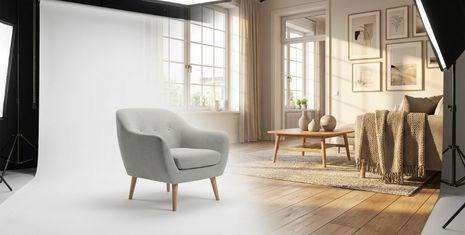
Creating Perfect Product Photos for Armchairs on Amazon

An armchair looks great in the showroom - but on Amazon, a single image decides whether customers click or keep scrolling. Without the ability to sit down and feel the fabric, your product images do all the convincing.
The problem: Traditional photo shoots for furniture quickly cost 300-500 € per product and take weeks. This article shows you which image types Amazon requires, how to create compelling armchair photos, and how AI tools cut the process from weeks to seconds. The same Amazon requirements and image types also apply to sofas and wardrobes - for upholstered furniture like armchairs and sofas, lifestyle images are especially important.
Why Great Amazon Product Images Make or Break Your Armchair Sales
Amazon requires a pure white background (RGB 255, 255, 255) for the main image, at least 1000 pixels on the longest side for the zoom function, and the armchair must fill at least 85% of the image frame. For additional images, lifestyle scenes, infographics, and detail shots are allowed - Amazon recommends at least six images plus one video per listing.
Customers can’t touch your armchair online, can’t try sitting in it, can’t feel the fabric quality. Your images take over all of that. They are the only way to build trust and support the purchase decision.
The first impression decides in seconds whether someone clicks or scrolls past. High-quality product images set you apart from competitors who only show simple cutouts.
Why Armchairs Are Difficult to Photograph
Armchairs look natural in a room - but on a photo, every weakness becomes visible. Before you start shooting, you should know the typical challenges so you can address them proactively.
Compact, Curved Shapes Create Complex Shadow Patterns
Unlike a rectangular shelf, an armchair casts unpredictable shadows due to its curved lines and rounded forms. You need even, diffused lighting from multiple sides to avoid harsh shadow lines. Even a single misplaced light source can distort the entire perception of the shape.
Upholstery Textures and Fabric Quality Often Appear Flat and Undifferentiated in Photos
Velvet, corduroy, or linen look completely different in reality - in photos, these differences quickly blur into a uniform surface. You need to work with side lighting and close-ups to make the material’s texture visible. Without targeted lighting, your armchair loses exactly the quality feature that sets it apart from cheaper alternatives.
Color Reproduction Varies Significantly Depending on Lighting and Camera Settings
A moss-green armchair can appear yellowish under artificial light and bluish in daylight. Always work with a calibrated monitor and check your camera’s white balance before each shot. Color discrepancies between image and reality are one of the most common reasons for returns with upholstered furniture.
Armrests, Backrest, and Seat Must Be Captured from Multiple Angles
A single photo cannot fully represent the three-dimensional shape of an armchair. You need at least five to six perspectives so customers can properly assess armrest shape, backrest height, and seat depth. Missing angles leave open questions - and open questions prevent purchase decisions.
Amazon’s Product Image Requirements
Amazon has clear technical and content guidelines for product images. Violations can lead to your listing being suspended, so it’s worth taking a close look at the specifications.
Technical Specifications
The zoom function is especially important for armchairs. Customers want to closely examine fabric texture, stitching, and craftsmanship details before buying. For the zoom function to activate, you need at least 1000 pixels on the longest side - 1600 pixels or more is optimal.
- Image size: Minimum 1000 pixels, optimal 1600+ pixels on the longest side
- File format: JPEG (preferred), PNG, or GIF
- Color profile: sRGB for consistent color display across different devices
Main Image Rules
The main image has the strictest requirements. The background must be pure white (RGB 255, 255, 255) - no gray tint, no visible shadows. The armchair fills at least 85% of the image frame.
No props, text, logos, or watermarks are allowed. Only the armchair itself.
Requirements for Additional Images
With additional images, you have significantly more flexibility. Lifestyle scenes, infographics with dimensions, detail shots, and text overlays are allowed and even encouraged here.
Use all available image slots. A listing with six to seven images plus a video typically performs better than one with only two or three shots.
The Most Important Image Types for Your Armchair Listing
A complete listing combines different image types. Each serves a different function in the purchase decision.
Cutout on White Background
The cutout is your mandatory main image. It shows the armchair isolated and without distraction, enabling quick product recognition.
Pay attention to even lighting and sharp edges. A sloppy cutout looks unprofessional and can lead to rejection by Amazon.
Lifestyle and Milieu Images
A milieu image shows your armchair in a realistic living environment - for example, next to a side table in a living room or in a cozy reading nook. Customers can picture the armchair in their own home this way.
This conveys size proportions, style, and usage context at a glance. At the same time, milieu images reduce returns because expectations better match reality.
Detail Shots of Material and Craftsmanship
Show close-ups of upholstery, stitching, armrests, and feet. Customers want to see the fabric texture, examine the wood grain, and assess the craftsmanship quality.
For armchairs, detail shots are decisive for purchases - after all, it’s a piece of furniture that will be used for years.
Dimension Drawings and Infographics
Technical drawings with exact measurements for height, width, depth, and seat height are essential for furniture. They help customers check whether the armchair fits their space.
One of the most common return reasons for furniture is “doesn’t fit the room.” Well-designed dimension drawings significantly reduce this problem.
Different Perspectives and Views
Show the armchair from all important angles: front, side, slightly from above, and also the rear view. An all-around view builds trust and visually answers questions about shape and construction.
Creating Compelling Armchair Product Images
1. Prepare the Product and Optimize Lighting
Clean the armchair thoroughly, fluff up cushions, and smooth out wrinkles in the fabric. Small details like a crooked cushion are immediately noticeable in photos.
Use diffused, soft light from multiple sides - for example, with softboxes. Hard shadows are difficult to correct later and look unprofessional.
2. Create a Pure White Background
You have several options: a seamless backdrop in a photo studio, a large white fabric or paper background, or digital background removal in post-production.
For the main image: The final background must be pure white (RGB 255, 255, 255). Check this in your image editing software with the eyedropper tool.
3. Capture Multiple Perspectives
Take at least five to six different angles. Use a tripod for consistent height, stable angles, and maximum sharpness across all shots.
4. Photograph Details and Materials
Get close to the product to capture fabric texture, wood grain of the feet, decorative buttons, or stitch quality. Your camera’s macro setting or an appropriate lens helps here.
5. Cut Out and Post-Process Images
Digitally remove the original background, leaving only the armchair. Correct colors for a true-to-life representation and sharpen the image slightly.
However, avoid excessive editing. Unnatural-looking images lead to customer disappointment - and ultimately to returns.
Generate Lifestyle Images for Armchairs Without a Photo Shoot
Traditional lifestyle shoots for furniture quickly cost 300-500 € per product - including studio rental, photographer, props, and post-processing. With a range of 50 or 100 armchairs, that’s barely feasible.
AI image generation solves this problem. Tools like showcase transform a simple cutout into photorealistic milieu images - in seconds instead of weeks. The workflow is straightforward: upload cutout, define scene (via prompt or template), generate image, export.
- Speed: Generate milieu images in seconds instead of waiting weeks for shoot dates
- Cost savings: No studio rental, no photographer fees, no props
- Flexibility: Test different room styles - Scandinavian, modern, classic - without a new shoot
For large catalogs, hundreds of images can be created at once via batch processing.
Efficiently Showcase Color Variants and Fabric Patterns
Many armchairs come in multiple colors or fabric variants. Sourcing and photographing a prototype for each variant is expensive and time-consuming. Often the variants don’t even physically exist yet.
AI tools solve this problem by digitally swapping colors and materials on a single photo. The armchair’s shape, shadows, and details remain true to the product, while only the color or fabric is changed.
This not only saves costs but also significantly accelerates time-to-market. New color variants can go online immediately, without waiting for prototypes or shoots.
These Mistakes Ruin Your Amazon Product Images
Wrong or Impure Background
A gray tint, visible shadows, or a cream-colored instead of pure white background will lead to rejection of the main image by Amazon. Always check the background with the eyedropper tool in your image editing software.
Over-Edited and Distorted Representation
Excessive Photoshop editing, unnatural colors, or artificial-looking images damage customer trust. If the delivered product looks different from the image, negative reviews and returns follow.
Too Few Images in the Listing
Listings with only one or two images waste enormous conversion potential. Use all available image slots - customers who see more images are more likely to buy.
Inconsistent Visual Language Across Products
Different lighting moods, image styles, and quality levels across your entire range look unprofessional. A consistent brand identity strengthens trust in your brand.
Traditional Product Photography vs. AI Image Generation
| Criterion | Traditional Shooting | AI Image Generation |
|---|---|---|
| Time required | Weeks (planning, shooting, post-processing) | Seconds to minutes |
| Cost per variant | 250-500 € (studio, photographer, equipment) | 0.50-5 € |
| Color variants | Each color photographed individually | Digitally recolored without prototype |
| Lifestyle images | Elaborate set design required | Automatically generated scenes |
| Scalability | Limited by time and budget | Hundreds of images at the push of a button |
Both approaches have their place. For the initial main image (cutout), a real photo is often the best foundation. For color variants and diverse milieu images, AI generation offers enormous advantages in speed, cost, and scalability.
Checklist for Perfect Armchair Images on Amazon
Before you publish your listing, go through this checklist. This ensures your armchair images meet all Amazon requirements and achieve maximum conversion.
- Main image on pure white background (RGB 255/255/255)
- Minimum resolution of 1600 pixels on the longest side
- At least one lifestyle image in a living context
- Detail shots of upholstery, fabric, and feet
- Dimension drawing with seat height, width, and depth
- All color and fabric variants individually illustrated
- No watermarks, logos, or text overlays
If you can check off all points, your listing is technically clean and persuasively structured.
Create Armchair Product Images in Seconds Instead of Weeks
Perfect Amazon product images for armchairs require the right combination of technical quality, different image types, and efficient production. With the right tools and processes, you can achieve both: high-quality results and fast time-to-market.
AI solutions like showcase are specifically designed for Home & Living products. They transform simple cutouts into professional milieu images and enable the display of color variants without physical prototypes - while maintaining high product fidelity.
Get started for free, no credit card required. Start now with showcase
FAQs About Amazon Product Images for Armchairs
Can I use AI-generated images on Amazon?
Yes, Amazon allows AI-generated images as long as they meet the technical requirements and accurately represent the product. The main image still follows the rules for pure white backgrounds. For lifestyle images in additional slots, there are no restrictions regarding the creation method.
How many images does an armchair listing on Amazon need at minimum?
Amazon requires at least one main image but strongly recommends six images plus one video. Use all available slots for different perspectives, details, and lifestyle scenes.
What is the optimal image size for Amazon product images?
Use at least 1600 pixels on the longest side for the zoom function to work optimally. The maximum allowed by Amazon is 10,000 pixels. Larger images allow customers to closely examine details like fabric texture and stitching.
How do I create dimension drawings for armchairs without a graphic designer?
Simple graphic programs like Canva or specialized AI tools create technical drawings with measurements for height, width, depth, and seat height from a photo. Such graphics significantly reduce returns because customers can check in advance whether the armchair fits their space.
Do I need separate images for each fabric variant of my armchair on Amazon?
Yes, Amazon expects separate images for each variant. Customers want to see exactly how the armchair looks in their chosen color or fabric - a single photo with color swatches is not sufficient. With AI tools like showcase, you can digitally generate all fabric variants from a single cutout, without sourcing and photographing each cover individually. This saves enormous time and costs, especially if your armchair is available in ten or more variants.
About the author

Author
Tim Hoffmann
Chief Product Officer, getshowcase.ai
Tim Hoffmann leads the product strategy for the AI image studio at showcase (getshowcase.ai). He brings years of e-commerce experience in product data, marketplace integrations, and visual content creation. His focus: helping Home & Living retailers turn product cutouts into photorealistic lifestyle images and room scenes in minutes – without expensive shoots, with measurably better conversion. Tim shares practical strategies for product images that perform on marketplaces and in your own shop.