How to Create Perfect Dining Table Product Images for Amazon

A dining table is one of the most difficult furniture pieces for Amazon product photos. Large dimensions, reflective surfaces, and customer expectations to see the product in a room context - traditional photo shoots quickly hit budget and time limits here.
This article shows you Amazon’s image requirements for furniture, which image types your listing needs, and how to create lifestyle scenes in seconds instead of weeks using AI tools. For other furniture categories on Amazon, we recommend Dining table images on Otto and Perfect sofa product images for Amazon - the requirements are comparable and the image types complement each other.
Why High-Quality Dining Table Images on Amazon Determine Your Sales Success
Amazon customers cannot touch your dining table. They cannot check whether the wood grain looks authentic, whether the legs appear sturdy, or whether the table fits their own dining room. Your images take over this task entirely - they are the only way to build trust.
This explains why listings with lifestyle images typically convert better than pure cutouts. Customers make purchase decisions more confidently when they see how a dining table looks in a real room. At the same time, the return rate drops because fewer surprises arise after delivery.
- First impression: Customers scroll quickly through search results - only strong images stop the scroll and generate clicks on your listing
- Purchase decision: Lifestyle images show size, style, and room impact - information a cutout alone cannot provide
- Trust: Professional image quality signals product quality - blurry or careless photos raise doubts
Why Dining Tables Are Difficult to Photograph
Dining tables are among the most demanding products in furniture photography. The combination of size, material, and shape presents challenges that simply do not exist with smaller products.
Large, flat tabletops reflect light and reveal every surface imperfection
A wide, horizontal surface catches every light source in the room and creates unwanted reflections. Even minimal scratches or unevenness become mercilessly visible through the flat perspective. You need very controlled lighting to achieve even illumination without hotspots.
Proportions and actual size are nearly impossible to gauge without a reference object
A dining table in a photo can appear as small as a side table or as large as a banquet table - without a reference, the viewer has no sense of scale. You must therefore deliberately work with context elements like chairs, tableware, or room scenes to convey the real size. Without this context, you risk false expectations and therefore returns.
Wood grains and material textures require precise, controlled lighting
The natural beauty of wood only shows with the right light. Too harsh light makes the grain look flat, too soft light swallows the texture completely. You must find the balance where the material structure appears three-dimensional and authentic.
Table legs and base need additional camera angles
The classic frontal perspective shows the tabletop but neglects the design of the legs and base. Especially with dining tables featuring distinctive bases - whether cross-foot, pedestal, or runners - additional perspectives are essential. You need at least an angled view and a side shot so customers can assess the entire construction.
Amazon Product Image Requirements for Furniture
Amazon distinguishes between the main image at position 1 and additional images at positions 2 through 9. Different rules apply to each. Before investing time in image production, it is worth reviewing the technical specifications.
Optimal Image Size and Resolution
The minimum resolution for the zoom function is 1,600 pixels on the longest side. However, Amazon recommends 2,000 pixels or more. For large furniture like dining tables, higher resolution is particularly important so customers can zoom into details like wood grain or table edges.
Permitted File Formats
Amazon accepts JPEG, PNG, TIFF, and GIF. For dining table photos, JPEG works best because the format offers good quality at a manageable file size.
Requirements for the Main Image
The main image requires a pure white background with the RGB value 255,255,255. The product fills at least 85% of the image frame. Props, text, and watermarks are not allowed.
Rules for Additional Images
With additional images, you have more freedom. Lifestyle scenes, detail shots, infographics, and dimension drawings are permitted here. These slots are where you show the dining table in context.
| Image Type | Background | Text/Graphics | Props |
|---|---|---|---|
| Main image | Pure white | Not allowed | Not allowed |
| Additional images | Freely selectable | Allowed | Allowed |
Image Types You Need for Dining Tables on Amazon
Amazon allows up to nine images plus video per listing. Each slot is an opportunity to answer customer questions. Here are the image types that have the greatest impact for dining tables.
Cutout Main Image on White Background
The mandatory image for position 1 shows the complete dining table without distraction. Pay attention to sharp edges and correct colors. This is where it is decided whether customers even click on your listing.
Lifestyle Images in a Living Context
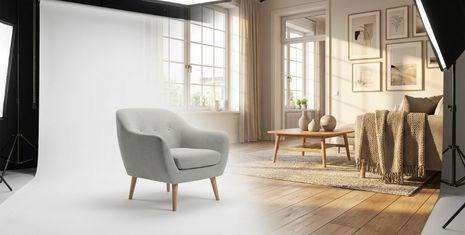
A dining table in a realistic dining room scene helps customers assess size and style. With AI tools like showcase, you generate such scenes in seconds - without a photo shoot, without props, without weeks of waiting.
Detail Shots of Surface and Material
Close-ups of wood grain, table edge, and legs show material quality. Customers buying online want to see these details before making a decision.
Dimension Drawings and Size Comparisons
An infographic with exact measurements answers the most common customer question: Does the table fit in my room? Optionally, show the dining table next to a person or chairs for additional size context.
Images from Different Perspectives
Front, side, top-down, angled - different viewpoints show the shape completely. For round or extendable tables, this is particularly important because customers want to assess proportions from multiple angles.
Multi-Product Scenes with Chairs and Decor
Combine the dining table with matching chairs, tableware, or decorations. This promotes cross-selling and shows a complete style world that inspires customers.
Creating Dining Table Product Images in Six Steps
The workflow from raw image to finished Amazon listing follows a clear sequence. Here are the individual steps.
1. Capture or Upload a High-Quality Cutout
Start with a clean product photo against a neutral background. Even lighting without harsh shadows is crucial. The source image determines the quality of all subsequent variants.
2. Remove and Optimize the Background
Use automatic cutout tools and check the edges for artifacts. With dining table legs featuring fine details, this check is particularly important because rough edges remain visible in every scene afterward.
3. Generate Lifestyle Scenes
Place the cutout dining table into photorealistic living scenes. With AI image studios like showcase, you select the room style, and the AI generates the scene - including matching shadows and lighting.
4. Add Detail Images and Additional Views
Create close-ups and alternative perspectives. For extendable dining tables, show both sizes so customers understand the product’s flexibility.
5. Check Images for Amazon Compliance
Review each image against Amazon’s guidelines before uploading. Incorrect backgrounds or prohibited elements in the main image lead to rejections and delay your listing.
6. Set the Gallery Order and Upload
Start with the strongest image after the main image. A logical order would be: overview, then details, then lifestyle, then dimensions.
Generating Lifestyle Images for Dining Tables Without a Photo Shoot
Traditional lifestyle shoots for furniture quickly cost 300-500 EUR per product. Studio rental, photographer, props, and post-processing add up. For larger ranges, this is barely scalable.
AI Image Generation as a Fast Alternative
AI tools create photorealistic scenes from a simple cutout in seconds instead of weeks. No studio rental, no photographer, no props needed. The process works like this: You upload a cutout, select a room style, and the AI generates the finished image.
Placing Dining Tables into Photorealistic Living Scenes
The dining table is automatically placed into a dining room setting with correct perspective. What matters here is product fidelity - shape, color, and details are preserved. Specialized tools like showcase are optimized for this accuracy, while generic image generators often distort proportions.
Automatically Creating Brand-Consistent Visual Worlds
With brand identity features, AI tools adapt the scenes to your brand. The result is a unified style world across your entire range. Instead of adjusting each image individually, you define your brand aesthetic once, and all generated images follow this style.
Visualizing Color Variants and Materials Without Prototypes
Photographing each color variant individually is expensive and slow. If you offer a dining table in oak, walnut, and white, that traditionally means three separate shoots. Digital variants solve this problem.
Digitally Adjusting Product Colors
Change the dining table color digitally - from oak to walnut, from white to black. The same base scene is preserved; only the product color changes.
Visualizing Different Wood Types
Show customers different wood surfaces without physically producing each table. This significantly accelerates time-to-market because you can create images for variants before the prototypes exist.
Creating Variants at Scale
With workflow automation, you create dozens of variants in a single run. With showcase, this works via drag-and-drop - recurring tasks like generating scenes, changing colors, and exporting run automatically.
These Mistakes in Dining Table Images Cost You Sales
Some mistakes appear repeatedly in dining table listings. They lead to low click-through rates or purchase abandonment.
Wrong Image Size or Low Resolution
Images that are too small deactivate the zoom function. Customers cannot see details and leave. Stick to at least 1,600 pixels, preferably 2,000 pixels on the longest side.
Missing Room Context
Only cutouts do not show how the dining table looks in a room. Customers cannot assess size and style - and buy from a competitor who shows lifestyle images.
Unrealistic Proportions
If the dining table looks distorted in the scene, customers lose trust. Pay attention to correct perspective and natural shadows. Specialized AI tools for Home & Living have an advantage here over generic image generators.
Inconsistent Visual Style Across Your Range
Different lighting moods, backgrounds, and styles confuse customers and weaken your brand. A consistent visual language signals professionalism.
How to Increase the Conversion Rate of Your Dining Table Listings
Show Context Instead of Just Cutouts
Lifestyle images generate higher conversion because they appeal to emotions. Customers do not just see a piece of furniture - they see their future dining room.
Evoke Emotions Through Lifestyle Scenes
Set tables, family scenes, cozy evenings - sell the feeling, not just the product. A dining table with candles and tableware tells a story that a cutout cannot tell.
Promote Cross-Selling with Multi-Product Images
Combine the dining table with chairs from your range. Customers buy complete sets more often when they see how everything works together.
Checklist for Amazon Dining Table Images
Before you upload your images, go through these points:
- Main image on pure white background (RGB 255,255,255)
- Minimum resolution 1,600 pixels, preferably 2,000+ pixels
- All image types covered: cutout, lifestyle, details, dimensions
- No prohibited elements in the main image
- Consistent visual language throughout the listing
- File formats and file sizes verified
- Gallery order optimized
Start Now with Professional Dining Table Images
High-quality Amazon product images determine your sales success. The traditional path with studio, photographer, and props is expensive and slow. With AI image studios like showcase, you create lifestyle images, variants, and scenes in seconds instead of weeks - without prototypes, without a studio.
Get started for free, no credit card required.
Frequently Asked Questions About Dining Table Product Images for Amazon
How many images should I upload for a dining table on Amazon?
Use all available slots. Amazon allows up to nine images plus video. Each additional image increases the chance of answering customer questions and removing purchase barriers.
Can I use AI-generated images on Amazon?
Yes, Amazon allows AI-generated images as long as they meet the technical requirements and accurately represent the product. Pay particular attention to product fidelity in terms of shape, color, and details.
How do I show the actual size of a dining table in the image?
Use a dimension drawing with exact measurements or show the table next to a reference object like a chair. This way, customers immediately grasp the proportions.
What are the costs for professional product photography for dining tables?
Traditional photo shoots for furniture often cost 300-500 EUR per product - including studio rental, photographer fees, props, and post-processing. AI-powered alternatives cost a fraction of that.
How often should I update my Amazon product images for dining tables?
Update your images when Amazon changes its guidelines, you introduce new variants, or A/B tests show that other image styles convert better.
About the author

Author
Tim Hoffmann
Chief Product Officer, getshowcase.ai
Tim Hoffmann leads the product strategy for the AI image studio at showcase (getshowcase.ai). He brings years of e-commerce experience in product data, marketplace integrations, and visual content creation. His focus: helping Home & Living retailers turn product cutouts into photorealistic lifestyle images and room scenes in minutes – without expensive shoots, with measurably better conversion. Tim shares practical strategies for product images that perform on marketplaces and in your own shop.