How to Create Perfect Sofa Product Images for Amazon in 2026

Selling a sofa on Amazon without customers being able to touch it is like running a restaurant where nobody gets to taste the food. The image does all the convincing - and most sellers underestimate how much revenue they leave on the table with mediocre product photos.
This article shows you which image types Amazon requires for furniture, how to create them without an expensive photo shoot, and which mistakes ruin your conversion rate. Similar principles apply to Armchairs on Amazon and Wardrobes on Amazon - these guides are worth a look if you list multiple furniture categories.
Why Amazon Product Images Determine Your Sales Success
Customers cannot touch a sofa on Amazon, cannot test-sit it, cannot check the fabric quality. The image is everything that stands between scrolling and buying. With furniture, this weighs particularly heavily because the purchase decision is emotional - customers want to know how the sofa looks in their living room.
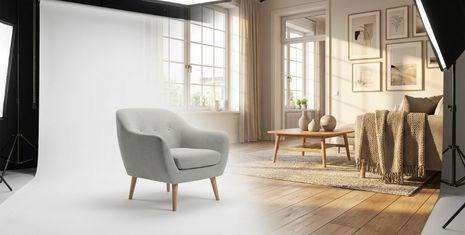
Cutouts on a white background fulfill Amazon’s mandatory requirements. However, they sell less effectively than lifestyle images that show the sofa in a real room. The difference lies in context: A sofa next to a side table and a plant conveys size, style, and atmosphere. A sofa against white nothingness remains abstract.
What does this mean in concrete terms? With 1,000 visitors to your listing, a good lifestyle image can make the difference between 20 and 50 sales. Multiply that by your average order value, and you understand why image quality is not a nice-to-have.
Why Sofas Are Difficult to Photograph
Before you start with implementation, you should understand why sofas are among the most demanding products in product photography. Knowing the typical challenges helps you avoid them deliberately.
Bulky dimensions require large studios or specialized setups
A three-seater is easily 2.20 meters wide and 90 centimeters deep. For even illumination, you need corresponding distance, large softboxes, and a seamless background wider than the sofa itself. In a normal room or office, you can barely manage this without shadows at the edges or perspective distortion.
Fabric textures and upholstery details lose depth and haptics in photos
You know the feeling: in person, the fabric feels soft and textured; in the photo, it looks flat and uniform. Cameras only capture fine weave patterns, boucle loops, or corduroy ribs correctly when light and angle are precisely right. Without targeted lighting, you lose exactly what sets your sofa apart from the competition.
Color reproduction varies depending on light source and display
The anthracite that looks elegant in the showroom suddenly appears dark brown on the customer’s display. Different light sources (daylight, LED, halogen) shift the color tone already during capture. On top of that, every monitor renders colors differently. If you do not calibrate properly here, you risk returns because “the color differs.”
Complex shapes with cushions and armrests create difficult shadow conditions
Sofas are not flat objects. Back cushions cast shadows on the seat, armrests create dark areas on the sides, and the underside often disappears completely into darkness. Evening out these shadow conditions without making the image look artificial requires multiple light sources and careful post-processing.
Image Types Every Sofa Listing Needs
Amazon allows up to nine images per listing. Most sellers use three or four - and waste potential in doing so. Each image type answers a different question in the customer’s mind.
Main Image with White Background
The main image appears in search results and determines whether someone clicks at all. Amazon requires a pure white background (RGB 255,255,255) here, no text, no decoration. The sofa stands alone in focus.
Lifestyle Images in the Living Room
Lifestyle images show the sofa in a realistic living scene - with a rug, cushions, perhaps a floor lamp nearby. They answer the question: “What does this look like in my home?” Without this context, a sofa remains an abstract object.
Detail Shots of Fabric and Stitching
Close-ups of material and craftsmanship replace what customers would check with their hands in a store. What does the fabric structure look like? Are the seams clean? Such details reduce uncertainty - and therefore returns.
Dimension Drawings for Size Comparisons
“Does the sofa fit through my door?” and “How much space do I need?” are questions a dimension image answers in seconds. Technical illustrations with measurements are standard for furniture. If they are missing, you risk returns and negative reviews.
Color Variants and Fabric Options
Show all available colors directly in the listing. With AI image generation, you create color variants digitally - without producing a physical prototype for each color. This saves weeks of lead time and thousands of euros in production costs.
What Image Requirements Apply at Amazon for Furniture
Amazon has clear technical specifications. Those who do not comply risk listing rejection or poor visibility in search results.
Image Size and Resolution
The longest side of your image needs at least 1,600 pixels - otherwise the zoom function does not work. A square format (1:1) is recommended because it works equally well on desktop and mobile.
Rules for the Main Image
The main image has the strictest requirements:
- Background: Pure white (RGB 255,255,255), no gray tones
- Product size: The sofa fills at least 85% of the image frame
- No text: Neither logos nor watermarks nor price information
- Product only: No decoration, no people, no additional objects
What Amazon Prohibits
The following elements lead to rejection:
- Frames, borders, or colored backgrounds
- Price information or advertising text in the image
- Multiple products (except for sets sold as a unit)
- Blurry, pixelated, or poorly lit images
- Drawings or illustrations instead of photos
How to Create Sofa Product Images Without a Photo Studio
A traditional furniture photo shoot quickly costs 300-500 EUR per product - photographer, studio rental, styling, and post-processing included. With 50 sofas in three color variants each, you end up at 45,000-75,000 EUR. AI image generation makes the same output possible for a fraction of the cost.
1. Upload Your Cutout
Start with a simple product photo. A smartphone image or the manufacturer’s photo works as a starting point - as long as the sofa is sharp and well-lit. Perfect is not necessary; usable is.
2. Remove the Background Automatically
AI tools recognize the sofa and remove the background in seconds. The result is a clean cutout you can use directly as the main image. In the past, a graphic designer did this in Photoshop - today, one click does the job.
3. Generate Lifestyle Images with AI
Now it gets interesting: Place the sofa in photorealistic living scenes. Scandinavian living room with wooden floor, modern loft with concrete wall, cozy country house with fireplace - anything is possible. Tools like showcase are specifically optimized for Home & Living and deliver results that are virtually indistinguishable from real photos.
4. Create Color Variants Without Prototypes
Change fabric colors and materials digitally. Instead of producing a physical prototype for each variant, you generate all color options from a single source image. Gray, beige, dark blue - in minutes instead of weeks.
5. Create Dimension Drawings and Detail Views
Generate technical drawings with measurements and various perspectives from a single photo. Side, back, top view - everything customers want to see without having to physically turn and re-photograph the sofa.
Tip: With showcase, you create all image types in one workflow. Upload a cutout, define your brand identity once, and generate consistent images for your entire range. Start for free without a credit card.
Photo Shoot vs. AI Image Generation Cost Comparison
The differences become particularly clear with larger ranges:
| Criterion | Traditional Photo Shoot | AI Image Generation |
|---|---|---|
| Cost per scene | 250-500 EUR | 0.50-5 EUR |
| Time required | 2-6 weeks | Seconds to minutes |
| 50 sofas x 3 variants | 37,500-75,000 EUR | 75-750 EUR |
| Color variants | New prototype + shoot | Digitally generated |
| Scalability | Linear with costs | Nearly constant |
Traditional photo shoots remain valuable for hero campaigns, catalogs, and print media. For Amazon listings, color variants, and rapid range expansions, AI is the more efficient choice today.
These Mistakes Ruin Your Sofa Product Images
Even good products sell poorly when images contain typical mistakes. Here are the most common ones - and how to avoid them.
Choosing the Wrong Perspective
Frontal views alone are not enough. Customers want to see the sofa from multiple angles: side, back, top view, armrest detail. A single image does not answer all questions. Unanswered questions lead to purchase abandonment - or worse, returns.
Inconsistent Brand Identity
Different image styles look unprofessional. If one sofa stands in a bright Scandinavian room and the next in a dark industrial loft, there is no common thread. Keep lighting, color temperature, and scene types consistent. A brand identity in your AI tool automates this.
Missing Room Context
Cutouts on a white background do not convey size. Is the sofa compact or room-filling? Without reference objects - a side table, a floor lamp, a rug - customers cannot gauge proportions. Lifestyle images solve exactly this problem.
Checklist for Perfect Sofa Images on Amazon
Before you publish your listing, go through this checklist. It covers the mandatory technical requirements and the most important sales-boosting image types.
- Main image on pure white background (RGB 255/255/255)
- Minimum resolution 1600 pixels on the longest side
- At least one lifestyle image in a living context
- Detail shots of fabric, stitching, and upholstery
- Dimension drawing with seat height, total width, and depth
- All color and fabric variants individually photographed
- No watermarks, logos, or text overlays
If you can check off all seven points, your listing is better positioned image-wise than the vast majority of sofa offers on Amazon.
Start Now with Professional Sofa Images
Perfect Amazon product images require the right combination: technically flawless cutouts, context-rich lifestyle images, meaningful details, and clear dimension information. With AI tools, you create all of this in minutes instead of weeks - and for a fraction of the cost of a traditional shoot.
Getting started is easier than you think: Upload a few cutouts, generate your first lifestyle images, and evaluate the results based on your own products.
Get started for free, no credit card required.
FAQs About Sofa Product Images for Amazon
Can I use AI-generated images on Amazon?
Yes, Amazon allows AI-generated product images without restrictions. What matters is that the images meet the technical requirements and accurately represent the product. Color, shape, and proportions must not be distorted.
How many product images does a sofa listing need?
Amazon recommends at least six images plus a video. Use all available slots: main image, two to three lifestyle scenes, detail shots, dimension drawing, and color variants. More images mean more answered questions - and fewer purchase abandonments.
What resolution activates the zoom function?
At least 1,600 pixels on the longest side. The zoom function is purchase-critical because customers want to see fabric textures and craftsmanship in detail before spending several hundred euros.
How do I create a 360-degree image of my sofa?
AI tools like showcase can generate various perspectives from a single product photo. For a complete all-around view, you combine multiple generated angles into an interactive view.
Do I need separate images for each fabric variant of my sofa on Amazon?
Yes, each variant should have its own images. Customers want to see exactly how the sofa looks in their chosen color and fabric - not just a sample image with the note “also available in beige.” Missing variant images are one of the most common reasons for returns on upholstered furniture. With AI tools like showcase, you generate all fabric variants from a single source image, keeping the effort manageable.
About the author

Author
Tim Hoffmann
Chief Product Officer, getshowcase.ai
Tim Hoffmann leads the product strategy for the AI image studio at showcase (getshowcase.ai). He brings years of e-commerce experience in product data, marketplace integrations, and visual content creation. His focus: helping Home & Living retailers turn product cutouts into photorealistic lifestyle images and room scenes in minutes – without expensive shoots, with measurably better conversion. Tim shares practical strategies for product images that perform on marketplaces and in your own shop.