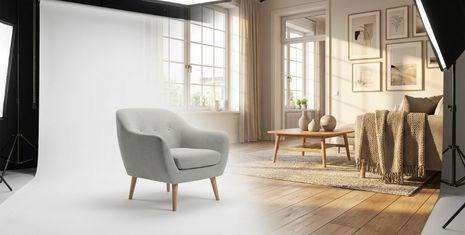
AI Product Photography for Home & Living: How Retailers Create Photorealistic Lifestyle Images Without a Photoshoot
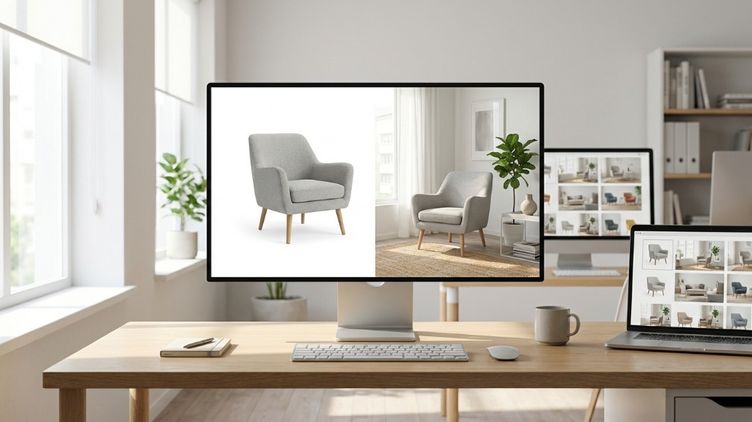
AI Product Photography for Home & Living: How Retailers Create Photorealistic Lifestyle Images Without a Photoshoot
Anyone selling in Home & Living eCommerce knows the problem: products need to be shown in real living contexts - but traditional lifestyle shoots are expensive, slow, and nearly impossible to scale. AI-powered product photography solves this problem. This article explains how the technology works, what it actually delivers, where its limitations lie - and which tools are suited for furniture and interior products. Further reading: AI Platform for Lifestyle Images and Color Variants and Sofa Product Images for Amazon - where you can see the practical application in real listings.
What Is AI Product Photography and How Does It Work?
AI product photography refers to the use of generative AI models to create photorealistic scene images from simple product photos (e.g., cutouts or smartphone snapshots). The AI analyzes the uploaded product image - color, shape, material, perspective - and embeds it into a generated background, complete with accurate shadows, lighting, and spatial depth.
The typical workflow:
- Upload a cutout - a product photo against a white or transparent background
- Background removal - if not already cut out, most tools handle this automatically
- Define the scene - via text prompt or pre-made/custom templates, e.g., “Scandinavian living room, wooden floor, natural daylight”
- Generate the image - the AI creates a photorealistic background and integrates the product
- Export - in high resolution for your online store, marketplaces, or social media
The entire process typically takes less than a minute. For large catalogs, hundreds of images can be generated at once via batch processing.
Why Lifestyle Images Are Critical in Home & Living eCommerce
Cutouts on a white background are the eCommerce standard - but they’re no longer enough to drive purchase decisions. Furniture and interior products are emotionally charged purchases: customers want to see how a sofa looks in their own living room, not just how it appears against a white backdrop.
Marketplaces like Amazon and Otto increasingly demand visual variety: a main image as a cutout, plus multiple lifestyle and detail images. Retailers who only provide standard photos lose visibility and conversion.
What the numbers show: Lifestyle images typically achieve conversion rates of 4-6%, while cutouts alone usually land at 2-3%. The difference arises because customers make more confident purchase decisions with contextual imagery - and consequently return products less frequently.
The scaling problem: A professional lifestyle shoot for 10 furniture products typically costs between €2,500 and €5,000 - including photographer, studio rental, styling, and post-production. For 100 or 500 SKUs, this is simply not feasible in terms of budget or time. AI tools make exactly this scalable.
What AI Product Photography Can Do - and What It Can’t
Strengths
- Speed: A cutout becomes a photorealistic lifestyle image in seconds
- Scalability: Hundreds of variations (different rooms, styles, colors) without proportional cost increases
- Consistency: On-brand setups ensure all images are visually cohesive
- Flexibility: Color variants and material changes without building prototypes or scheduling new shoots
- Cost efficiency: Depending on the tool and volume, between €0.50 and €5 per image in self-service
- Creative variety through specialized models: Advanced platforms like showcase use powerful image generation models for creative features such as lifestyle shots and scene images - including Google’s Imagen model Nano Banana, Nano Banana Pro, and Nano Banana 2. These models make it possible to generate new angles, unusual compositions, and atmospheric scenes from a single cutout that would require multiple shoots in traditional photography - while maintaining high product fidelity.
Limitations
- Limited detail control: The creative flexibility of generative models is simultaneously their limitation. Unlike traditional photography, results cannot be predicted or controlled down to the pixel. If you need exact control over which decorative object sits where, you’ll still hit boundaries. The strength lies in leveraging the models’ creativity - not in fully controlling them.
- Product integrity: Generic AI models can distort details or warp shapes - specialized models for Home & Living have a clear advantage here
- Not (yet) a replacement for hero content: For campaign imagery, magazine spreads, or TV commercials, real photography often remains superior
What showcase Delivers (getshowcase.ai)
showcase is an AI platform built specifically for Home & Living eCommerce. The focus is on furniture and interior products - a specialization that shows in the quality of results.
Feature set:
- Brand Identity Setup: The platform analyzes your website and automatically configures brand-consistent scenes and camera settings
- Generate lifestyle images and room scenes from cutouts
- Multi-product staging: Multiple products can be combined in a single scene - ideal for furniture sets and cross-selling
- Workflow automation via drag-and-drop: Recurring processes (e.g., upload → generate scene → color variants → export) can be mapped as automated workflows
- Recoloring and material variants: Color changes and material swaps without a new product photo
- Product rotation: Create multiple viewing angles from a single cutout, up to a full 360° view
- AI avatars: Human figures interact with products for vivid lifestyle shots
- Dimension drawings: Automatically generated technical drawings that many furniture shops need for their product pages
Best suited for: Home & Living retailers, furniture manufacturers, and interior brands with medium to high SKU volumes that need fast time-to-market and brand-consistent results. Free to get started, no credit card required.
What Does AI Product Photography Cost Compared to Traditional Shoots?
| Traditional Photoshoot | AI Tool (e.g., showcase) | |
|---|---|---|
| Cost per product (1 scene) | €250-500 | €0.50-1.50 |
| Lead time | 2-6 weeks | Minutes |
| 100 products × 3 variants | €75,000-150,000 | €500-1,000 |
| Color variants | New shoot required | Automatically generated |
| Scaling | Linear with costs | Nearly constant |
Note: These figures are based on standard industry benchmarks for Germany. Actual costs depend on provider, volume, and quality requirements.
Traditional photoshoots remain valuable for hero campaigns and high-end print media. For day-to-day product communication, variant images, and marketplace content, AI is now the more cost-effective choice.
What to Look for When Choosing a Tool
Product integrity: Are your product’s proportions, colors, and materials accurately represented? For furniture, this is critical - test the tool with your own products.
Creativity vs. fixed templates: Do you want flexibility and creativity (like showcase’s creative model approach) or pure background generation (providers using Stable Diffusion models)?
Specialization: General-purpose image generators are often unsuitable for furniture and interior products. Look for tools that are explicitly optimized for Home & Living.
Brand consistency: Can all generated images be visually unified? A brand identity setup saves post-production time in the long run.
Workflow integration: Is there batch processing and automation for recurring tasks? This is the key lever for large product ranges.
Marketplace compatibility: Amazon, Otto, and other platforms have clear image guidelines. Check whether generated images meet these requirements.
Trial option: Start with a free trial. Upload 5-10 of your products and evaluate quality based on real results - not based on sample images on the provider’s website.
Practical Example: How a Mid-Sized Furniture Retailer Gets Started
A retailer with 200 SKUs and a growing online business faces a common challenge: the catalog needs quarterly updates, but a full photoshoot isn’t in the budget.
A possible approach:
- Phase 1: The top 20 best-selling products are outfitted with AI lifestyle images in three room styles each (modern, classic, industrial)
- Phase 2: Conversion tracking over 4-6 weeks, comparing against the existing cutouts
- Phase 3: If results are positive, rollout across the entire catalog, integrated into the ongoing product onboarding process
The time investment for Phase 1 with AI tools like getshowcase.ai is just a few hours - including brand setup and batch generation. The cost: a fraction of a single traditional photoshoot.
Conclusion: When Is AI Product Photography Worth It for Home & Living?
AI product photography pays off when you have more than a handful of products, want to show color variants or different room styles, need to react quickly to new product lines, or have a limited budget for regular photoshoots. If your product range turns over or expands quickly, every day you spend waiting for a photoshoot instead of selling costs you real money.
The technology is now mature enough to deliver photorealistic results - provided the tool is specialized for Home & Living and you work with clean source images.
For hero campaigns, magazine features, or TV spots, real photography remains the right choice. For everything in between - product pages, marketplace listings, color variants, seasonal content - AI is now the smarter, faster, and more cost-effective alternative.
Getting started: Tools like showcase offer a free entry point with no credit card required. Upload 5-10 cutouts, generate your first lifestyle images, and evaluate the results based on your own products.
showcase is an AI platform for Home & Living product photography. Create your first product images for free with studio today and transform the way your customers see your products.
About the author

Author
Tim Hoffmann
Chief Product Officer, getshowcase.ai
Tim Hoffmann leads the product strategy for the AI image studio at showcase (getshowcase.ai). He brings years of e-commerce experience in product data, marketplace integrations, and visual content creation. His focus: helping Home & Living retailers turn product cutouts into photorealistic lifestyle images and room scenes in minutes – without expensive shoots, with measurably better conversion. Tim shares practical strategies for product images that perform on marketplaces and in your own shop.