How to Photograph Professional Shelf Product Images for Amazon

Shelves sell on Amazon through images - not through descriptions. Customers can neither feel the size nor touch the material, so image quality determines whether they buy or keep scrolling.
The problem: Shelves are bulky, difficult to photograph, and need context to be convincing. This article shows you which image types Amazon requires, how to professionally photograph large furniture pieces, and how AI tools speed up the process from weeks to minutes. More guides for furniture on Amazon: Wardrobe product images for Amazon and Shelf images for Otto - the image types and requirements are similar.
Why Amazon Product Images Determine Your Shelf Sales
Shelves are among the most searched furniture categories on Amazon. At the same time, they are difficult to photograph: large, bulky, and customers can neither feel the size nor touch the material. The purchase decision is therefore made almost entirely based on your images.
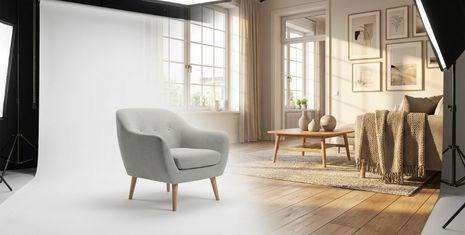
The problem with shelves is the lack of context. A cutout on a white background shows the product, but not how it looks in the living room or whether it fits next to the sofa. Customers scroll past if they cannot visualize it.
Listings with lifestyle images typically achieve higher conversion rates than pure cutouts. The difference arises because customers buy more confidently with context images and return products less often.
Why Shelves Are Difficult to Photograph
Shelves are among the most demanding product categories in furniture photography. Their open construction, material combinations, and sheer size present challenges that simply do not exist with more compact products.
Open structures with multiple compartments create complex shadow patterns
A shelf consists of horizontal shelves, vertical side panels, and often an open back. Each compartment casts its own shadows that interact with each other and create dark holes with incorrect lighting. You need to set the light so that all compartments are evenly illuminated without the shadows from the upper shelves darkening the lower areas.
Different materials like wood, metal, and glass require different lighting
Many shelves combine matte wood surfaces with glossy metal frames or glass shelves. Wood needs soft, diffused light to make the grain visible, while metal and glass produce unwanted reflections and glare under the same lighting. You need to find a compromise in lighting for each material that makes all surfaces look good simultaneously.
Depth and spatial effect are difficult to convey in two-dimensional images
A shelf is a three-dimensional object with noticeable depth, but in a photo everything becomes flat. Especially in the frontal view for the Amazon main image, the spatial effect is almost completely lost. You need additional angles and targeted shadow placement so customers can perceive the actual depth and stability of the shelf.
Empty shelves look boring, decorated shelves distract from the product
A completely empty shelf looks sterile and unappealing in photos because the compartments appear as dark rectangles. On the other hand, if you place books, vases, and decorations inside, the shelf itself fades into the background. You face the balancing act of showing enough context to make the shelf look lively without distracting from the actual product.
Amazon Image Requirements for Product Photos
Amazon rejects listings that do not meet the image guidelines. With furniture, this happens more often than expected because backgrounds, proportions, or image sizes are incorrect.
Technical Specifications for Size and Format
- Minimum size: 1,000 pixels on the longest side to activate the zoom function
- Recommended size: 2,000 x 2,000 pixels for optimal display on all devices
- File formats: JPEG, PNG, TIFF, or GIF
- Color mode: RGB, not CMYK - CMYK causes color shifts
Rules for the Main Image
The first image in the listing has the strictest requirements. Amazon requires a pure white background with the color value RGB 255, 255, 255. Off-white or slight gray leads to rejection.
The product fills at least 85% of the image frame. Text, logos, watermarks, or additional objects are not allowed. Only the shelf itself - no decoration, no hands, no packaging.
Requirements for Additional Images
With images 2 through 9, you have more flexibility. Lifestyle scenes, infographics, and detail shots are allowed here. Amazon recommends using all available image slots. For furniture, this means: Show the shelf in a room, not just against a white background.
Image Types Your Shelf Listing Needs
A complete Amazon listing combines different image types. Each serves a different function in the purchase decision process.
Cutout with White Background
The cutout is your main image. “Cutout” means the product is isolated from the background and placed against pure white. It shows shape and proportions without distraction and is mandatory for Amazon.
Lifestyle Images in a Living Context
Lifestyle images answer the most important customer question: “What does the shelf look like in my home?” Show it in the living room with books, in the children’s room with toys, or in the study with binders. Context helps customers visualize the product.
Detail Shots and Material Views
With shelves, details matter: wood grain, hardware, joints, surface texture. Close-ups convey quality and reduce returns because customers know what to expect.
Dimension Drawings and Size Comparisons
Incorrect size expectations are one of the most common return reasons for furniture. A clear dimension drawing with height, width, and depth belongs in every shelf listing. Arrows with centimeter measurements directly on the product work well.
Color Variants Without Prototypes
If your shelf is available in oak, walnut, and white, each variant needs its own images. Traditionally, this means three separate shoots. With AI-powered recoloring, you create all variants from a single photo in minutes instead of weeks.
How to Photograph Bulky Shelf Products
Shelves are large, heavy, and often reflect light unevenly. This makes them one of the most demanding product categories for photography.
Equipment and Studio Setup for Large Furniture
For furniture photography, you need space. At least 4 to 5 meters of distance from the product is necessary to avoid distortion. A heavy tripod ensures stability at greater distances.
A seamless background or large white cardboard, at least 3 x 3 meters, works well as a backdrop. A DSLR or mirrorless camera with at least 24 megapixels provides sufficient resolution for Amazon’s zoom function.
The Best Camera Angles for Shelves
- Frontal view: For the main image - straight, symmetrical, at eye level
- Side view: Shows the depth and stability of the shelf
- Angled view (45 degrees): Conveys three-dimensionality and spatial effect
- Detail shots: Close-ups of shelf boards, joints, surfaces
Optimizing Lighting for Large Furniture Pieces
Large softboxes with at least 120 cm diameter ensure even illumination without harsh shadows. With glossy surfaces like lacquered wood, you also need diffusers to control reflections. Matte surfaces are significantly easier to photograph.
Creating Lifestyle Images for Shelves Without a Photo Shoot
Traditional lifestyle shoots for furniture cost between 300 and 500 EUR per product when you factor in studio rental, photographer, styling, and post-processing. For 50 shelves, that amounts to 15,000 to 25,000 EUR. AI image generation makes the same output possible for a fraction of the cost.
Generating Living Scenes with AI Tools
The workflow is simple: Upload your cutout, choose a scene like “Scandinavian living room with wooden floor,” and the AI generates a photorealistic lifestyle image in seconds. Tools like showcase are specifically optimized for Home & Living and preserve the shape, color, and details of the original product.
Decor and Styling for Authentic Room Settings
A convincing scene needs matching elements: books, plants, decorative objects, fitting lighting. With a brand identity feature, you ensure all images match your brand without restyling each time.
Multi-Product Staging for Shelf Sets and Cross-Selling
Do you sell shelves as a set or together with matching dressers? Multi-product staging combines multiple items in one scene. This is ideal for cross-selling and shows customers how products work together.
Showing Dimensions and Proportions in Amazon Product Images
Customers cannot touch a shelf. They misjudge sizes and return items that do not fit. Clear dimensions in the image reduce returns.
Integrating Dimensions Visually
Three methods work well:
- Dimension lines in the image: Arrows with centimeter measurements directly on the product
- Infographic style: Separate image with all dimensions clearly presented
- Technical drawing: Schematic representation with exact measurements
Size Comparisons with Reference Objects
A book, a plant, or a vase in the image conveys size more intuitively than numbers. Customers immediately understand how tall the shelf is compared to familiar objects.
Avoiding Common Mistakes in Amazon Product Photos
Incorrect Background on the Main Image
Off-white or slight gray leads to listing rejection. Check the background with a color picker. It must be exactly RGB 255, 255, 255. Automatic background removal tools solve this problem in seconds.
Excessive Image Editing
Unrealistic colors, excessive smoothing, or distorted proportions lead to returns and negative reviews. The image may be optimized, but the product must remain recognizable.
Missing Additional Images in the Listing
Amazon offers up to 9 image slots. Every unused slot is a missed opportunity. Use them all: cutout, lifestyle, details, dimensions, color variants.
Inconsistent Visual Style Across Your Range
If every shelf is photographed in a different style, your shop looks unprofessional. Consistent styling strengthens brand perception. A brand identity feature automatically ensures consistency across all products.
Traditional Photography vs. AI Image Generation Compared
| Criterion | Traditional Shoot | AI Image Generation |
|---|---|---|
| Time required | 2-6 weeks | Minutes |
| Cost per image | 50-150 EUR | 0.50-2 EUR |
| Color variants | New shoot required | Automatically generated |
| Scalability | Linear with costs | Nearly constant |
| Flexibility | Low | High |
Costs and Time Compared
A furniture shoot with 3 scenes typically costs 300 to 500 EUR per product. For 20 shelves, that is 6,000 to 10,000 EUR and 4 to 6 weeks lead time. With AI tools, you create the same 60 images in a few hours for under 100 EUR.
When Traditional Shoots Are Still Worth It
For hero products, premium campaigns, or print media, professional photography remains valuable. For daily marketplace content, color variants, and rapid range expansions, AI is the more efficient choice.
What Amazon Says About AI-Generated Images
Amazon allows AI-generated images as long as they accurately represent the product. What matters is product fidelity: shape, color, and details must not be distorted. Specialized tools for Home & Living are optimized for exactly this.
Creating Shelf Product Images in Minutes with AI Tools
The workflow with showcase: Upload your cutout, select a scene, receive a finished lifestyle image in seconds. For recurring tasks, you automate the process via drag-and-drop, from background removal to color variants to export.
Start for free, no credit card required: showcase.ai
Checklist for Perfect Shelf Product Images on Amazon
Before you publish your shelf listing, go through this checklist. Each point helps you avoid rejections and maximize your conversion rate.
- Main image on pure white background (RGB 255/255/255)
- Minimum resolution of 1600 pixels on the longest side
- At least one lifestyle image with decorated compartments
- Detail shot of material and craftsmanship
- Dimension drawing with height, width, depth, and compartment sizes
- All color and material variants individually photographed
- No watermarks, logos, or text overlays
If you can check off all points, your listing is optimally set up image-wise and ready for publication.
FAQs About Amazon Product Images for Shelves
What image size is optimal for Amazon product images?
At least 1,000 pixels on the longest side; 2,000 x 2,000 pixels is recommended for the zoom function.
How many images should an Amazon listing for furniture have?
Use all 9 available slots: main image, lifestyle scenes, details, dimension drawing, and color variants.
Can I use the same product image for different color variants?
No, each color variant needs its own images. AI-powered recoloring creates all variants from a single photo.
How long does it take to create shelf product images with AI?
Seconds to minutes per image, depending on image type and chosen scene.
Does Amazon accept 3D renderings and AI-generated images as product photos?
Yes, as long as the product is accurately represented and the technical requirements are met.
About the author

Author
Tim Hoffmann
Chief Product Officer, getshowcase.ai
Tim Hoffmann leads the product strategy for the AI image studio at showcase (getshowcase.ai). He brings years of e-commerce experience in product data, marketplace integrations, and visual content creation. His focus: helping Home & Living retailers turn product cutouts into photorealistic lifestyle images and room scenes in minutes – without expensive shoots, with measurably better conversion. Tim shares practical strategies for product images that perform on marketplaces and in your own shop.