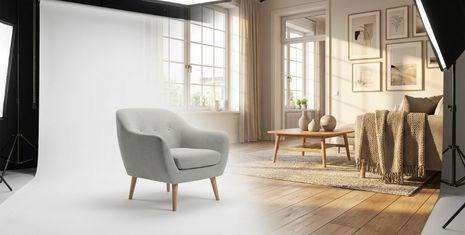
What Images Does Your Rug Need for Strong Performance on Otto?

Rugs are among the most difficult products for Otto listings. Large surfaces, subtle textures, and colors that look different on every screen - traditional product photography quickly reaches its limits here.
This article shows you which five image types your rug listing needs, what technical requirements Otto has, and how you create all variants in minutes instead of weeks. Related reading: Rug product images for Amazon and Rug conversion in your Shopify shop.
Why Product Images Determine Your Success on Otto
Otto shows only the main image first in product search. This one image decides whether customers even click. With rugs, there’s an additional problem: online, there’s no way to feel the material or gauge the size in a room. Your images take over this task entirely.
- Click-through rate: The main image in search results determines whether your product gets any attention at all
- Conversion: Lifestyle images with living context build trust and make the purchase decision easier
- Returns: Precise color representation and size information reduce incorrect purchases
Lifestyle images typically achieve higher conversion rates than plain cutouts. The difference arises because customers buy more confidently with contextual images - they see how the rug actually looks in a room.
Why Rugs Are Difficult to Photograph
Rugs place special demands on product photography. What becomes immediately clear in a store through touching and laying down needs to be conveyed purely visually online - and that’s exactly what makes it so challenging.
Flat Products Quickly Look Two-Dimensional and Boring in Photos
A rug is essentially a large, flat surface - and that’s exactly how it looks in a mediocre photo. Without the right perspective and lighting, all depth is lost. You need targeted shooting angles and light direction so your rug doesn’t look like a printed sheet of paper in the image.
Patterns, Colors, and Textures Need Even, Shadow-Free Lighting
Uneven light distorts colors and makes patterns appear irregular. Especially with large rugs, harsh shadows quickly form at the edges or reflections in the middle. You need to ensure the entire surface is evenly lit so customers can accurately judge colors and patterns.
Actual Size and Proportions Are Nearly Impossible to Gauge Without Room Context
An 80x150 cm rug and a 200x300 cm rug can look almost identical on a cutout. Without reference objects or room context, customers have no way to estimate the actual dimensions. This leads to incorrect purchases and expensive returns that you can prevent with the right image types.
Pile Height and Material Quality Are Hard to Convey in Images
Whether a rug is soft and fluffy or flat and robust is something you normally feel with your hands. In an online shop, this tactile experience is completely absent. You need to use close-ups and clever lighting to ensure customers can visually grasp the material quality and pile height.
These 5 Image Types Every Rug Listing Needs on Otto
A complete rug listing combines different image types. Each image type answers a different customer question.
Cutout as a Click-Generating Main Image
A cutout shows the product isolated on a neutral, usually white background. This image appears first in Otto search and determines the first click.
With rugs, the challenge lies in showing the pattern completely and without distortion. A slightly angled top-down view often works better than a purely frontal bird’s-eye perspective because it simultaneously conveys texture.
Lifestyle Images with Living Context
Lifestyle images show the rug in a furnished room scene - for example under a coffee table in the living room or next to a bed. Customers can see at a glance how large the rug looks and which interior style suits it.
Especially with rugs, this context is crucial. A 200x300 cm rug looks abstract on a cutout but is immediately assessable in a room.
Detail Shots for Texture and Material
Detail shots are close-ups of pile, weave structure, or edges. The pile refers to the fibers of the rug - what you feel when you walk across it. Customers want to “feel” the material, and detail images are the best substitute for that.
Show the difference between high pile (long, soft) and short pile (short, robust), the density of the fibers, or the quality of the edging.
Dimension Drawings for Size Orientation
A dimension drawing is a technical graphic with exact measurements in centimeters. It prevents incorrect purchases due to wrong size expectations.
Many customers underestimate how large a rug actually is. A clear dimension drawing saves returns and customer service inquiries.
Color Variant Views for the Range
Each color variant needs its own image views. If you offer a rug in grey, beige, and blue, customers expect complete images for each variant.
That sounds like a lot of effort - and with traditional shoots, it is. However, AI-based tools can generate color variants in seconds without you having to photograph each variant individually.
Technical Image Requirements from Otto
Otto has clear specifications for product images. Anyone who doesn’t meet these risks rejected listings or poor display in search.
| Requirement | Otto Specification |
|---|---|
| Minimum resolution | 1500 x 1500 pixels (recommended: 2000 x 2000) |
| Image format | JPG or PNG |
| Main image background | Pure white (RGB 255/255/255) |
| File size | Max. 10 MB |
| Color profile | sRGB |
Minimum Resolution and Image Format
Otto recommends at least 2000 x 2000 pixels for the zoom function to work. Customers zoom in frequently with rugs to check texture and pattern details.
JPG is suitable for most product images. PNG makes sense for cutouts with transparent backgrounds.
Background Specifications and Color Profiles
The main image requires a pure white background without visible shadows. For additional images like lifestyle shots, these restrictions don’t apply.
Use the sRGB color profile so colors are displayed consistently across different screens.
File Sizes for Fast Loading Times
Keep file size under 10 MB, ideally under 5 MB. Compress images so no visible quality loss occurs - tools like TinyPNG or the export settings in Photoshop help with this.
Optimizing Cutouts for Maximum Click-Through Rate
The cutout is your most important image. This is where it’s decided whether customers click on your product in Otto search or keep scrolling.
Neutral Background Without Distracting Shadows
Otto requires pure white. A light, soft drop shadow may be allowed and gives the image depth. However, harsh shadows or grey backgrounds lead to rejections.
Even Lighting of the Entire Surface
Rugs are large, flat products. With traditional photography, uneven exposures easily occur, especially at the edges. Make sure the entire pattern is evenly lit.
Perspective for Optimal Pattern Display
A slightly angled top-down view (about 15-20 degrees) shows the pattern best while simultaneously conveying a sense of the texture. Purely frontal shots can distort patterns or make them look flat.
Lifestyle Images That Show Rugs in Living Worlds
Lifestyle images are the conversion booster for rugs. They answer the central customer question: “What does this look like in my home?”
Choose Room Styles to Match the Target Group
The room style in the lifestyle image ideally matches the target group and rug design:
- Scandinavian: Bright rooms, light wood furniture, minimalist decor - ideal for simple, light rugs
- Modern: Clean lines, neutral colors, little decoration - suits geometric patterns
- Boho: Warm tones, natural materials, many textures - perfect for vintage or ethnic rugs
Use Furniture Combinations for Cross-Selling
Show the rug with matching furniture - a sofa, a coffee table, an armchair. This not only conveys size proportions but also promotes additional purchases.
With multi-product staging, multiple products can be combined in one scene. This is especially useful if you also have furniture or home accessories in your range.
Lighting Moods for Emotional Purchase Impulses
Warm daylight feels inviting and homely. Different lighting moods - morning light, afternoon sun, dimmed evening light - create different emotional effects.
Detail Shots for Texture and Craftsmanship
Detail images close the gap between online purchase and tactile in-store experience.
Close-Ups of the Pile Surface
Show in close-ups whether it’s high pile or short pile. Fiber length and density are decisive purchase factors for many customers.
Edge Details and Craftsmanship Quality
Edging, serging, fringes - these details signal quality. An image of the rug edge shows customers you have nothing to hide.
Pattern Accuracy and Color Representation
A detail image of the pattern shows whether lines are sharp and colors are accurately represented. This is especially important for patterned rugs.
Creating Images for Color Variants Without Additional Shoots
Each color variant needs its own images. However, a shoot per variant is neither time-efficient nor cost-effective.
- Problem: A new color variant traditionally means a new shoot with all costs and lead times
- Solution: AI-based recoloring preserves product details and generates variants in seconds
- Advantage: You can create images for color variants before physical prototypes exist
Tools like showcase make it possible to generate any number of color variants from one cutout - with correct texture and realistic color rendering.
Visually Conveying Dimensions and Size Proportions
Size is one of the most common return reasons for rugs. Customers regularly underestimate how large or small a rug actually is.
- Dimension drawing: Technical graphic with exact cm measurements - clear and unambiguous
- Reference objects: A sofa or table in the image shows the proportion intuitively
- Room context: Lifestyle images convey the spatial impact in the room
Ideally combine all three approaches: dimension drawing for the exact numbers, lifestyle image for the visual impression.
Image Mistakes That Ruin Your Conversion Rate
Even good products sell poorly when images contain typical mistakes.
Overexposed Whites and Incorrect Colors
Cream or beige rugs often appear pure white in photos. This leads to disappointed customers and returns. Calibrate your color representation carefully.
Missing Room Context with Cutouts
Only cutouts without lifestyle images mean: customers can’t gauge the size. This leads to uncertainty and lower conversion rates.
Low Resolution for the Zoom Function
Customers zoom to check texture. Pixelated images look unprofessional and raise doubts about product quality.
Inconsistent Visual Language in the Range
Different exposure, backgrounds, or styles in the range look unprofessional. A uniform brand identity ensures a professional overall impression.
Creating All Image Types in Minutes Instead of Weeks
Traditional photo shoots for rugs take weeks - from planning to execution to post-processing. With AI image generation, you create all image types in minutes.
| Task | Traditional Shooting | AI Generation |
|---|---|---|
| Cutout | 1-2 days | Seconds |
| Lifestyle image | 3-5 days | Seconds |
| Color variants | New shooting | Automatic |
| Dimension drawing | Commission a designer | Automatic |
| Cost per product | 250-500 EUR | 1-5 EUR |
- Cutouts: Remove background automatically
- Lifestyle images: Generate living worlds in seconds
- Color variants: Recolor products without a new shoot
- Dimension drawings: Have them created automatically
Get started for free, no credit card required
Frequently Asked Questions About Rug Images on Otto
How many images should a rug listing on Otto have?
Otto allows multiple images per listing. At least five are recommended: main image (cutout), one to two lifestyle images, a detail shot, and a dimension drawing. More images generally mean better conversion.
In what order should I arrange product images on Otto?
Start with the cutout as the main image - this appears in search. Ideally followed by a lifestyle image, then detail shots, and finally the dimension drawing.
Do I need a separate shoot for each rug color variant?
Not with AI image generation. Tools like showcase can create color variants digitally without you having to photograph each variant individually. This saves time and costs, especially with large ranges.
Can I use AI-generated product images on Otto?
Yes, as long as the product is correctly represented and customers are not misled. What matters is product fidelity: the shape, color, and details of the original product are preserved.
How do better product images affect the conversion rate?
High-quality images with living context increase trust and purchase probability. Lifestyle images generally perform better than plain cutouts - and simultaneously lower the return rate.
Checklist for High-Performing Rug Images on Otto
Before publishing your rug listing on Otto, use this checklist to verify that your images meet all important criteria.
- Cutout on pure white background available
- At least one lifestyle image with room context
- Detail shot of pattern, texture, and pile height
- Dimension drawing or size comparison in the image
- Multiple perspectives (top-down, angled, detail)
- All color variants individually photographed
- Resolution at least 1500 x 1500 pixels
If you can check off all points, your rug listing is optimally positioned to achieve the best possible performance on Otto.
Get started for free, no credit card required
About the author

Author
Tim Hoffmann
Chief Product Officer, getshowcase.ai
Tim Hoffmann leads the product strategy for the AI image studio at showcase (getshowcase.ai). He brings years of e-commerce experience in product data, marketplace integrations, and visual content creation. His focus: helping Home & Living retailers turn product cutouts into photorealistic lifestyle images and room scenes in minutes – without expensive shoots, with measurably better conversion. Tim shares practical strategies for product images that perform on marketplaces and in your own shop.