Which Image Strategy Increases Your Shelf Conversion in Your Shopify Store?

A shelf on a white background doesn’t sell itself. Customers want to see how it looks in their living room, whether the compartments are large enough for their books, and whether the wood really looks as high-quality as described.
The images in your Shopify store take on exactly this role - and directly determine your conversion rate. This article shows you which image types, perspectives, and technical optimizations help your shelves sell better, and how you can avoid relying on traditional photo shoots even with a large assortment. Further reading: Shelf images for Otto and which image strategy works for rugs in Shopify stores.
Why Product Images Determine Your Shopify Conversion Rate
High-quality product images for shelves on Shopify are crucial because furniture requires explanation. Customers can’t touch a shelf online, can’t feel the wood grain, can’t check whether it fits next to their sofa. Your images take on all of that.
The conversion rate refers to the percentage of store visitors who actually make a purchase. For furniture, this rate strongly depends on how well your images answer open questions: How big is the shelf really? Does it match my interior style? Does the material look high-quality?
- Visual purchase decision: Customers make their decision primarily based on what they see - very few read the product description completely.
- Need for context: A shelf on a white background says little about how it looks in their own living room.
- Building trust: Professional images signal quality - and reduce the uncertainty before purchase.
Why Shelves Are Difficult to Photograph
Shelves are among the most challenging furniture pieces in product photography. Their open construction, the combination of different materials, and the expectation of an appealing presentation make every shoot a challenge - and that’s exactly why many Shopify stores struggle with convincing shelf images.
Open Structures with Compartments and Shelves Create Complex Shadow Patterns
With a shelf, light falls through multiple levels, bounces off back panels, and casts shadows in compartments that make the entire image look restless. You need to position lighting so that each compartment is evenly illuminated without hard shadows visually cutting through the structure. This often requires multiple light sources and diffuse reflectors, which significantly increases the effort compared to simpler furniture pieces.
Different Materials Like Wood, Metal, and Glass Need Different Lighting
Many shelves combine wooden shelves with metal frames or glass inserts, and each material reacts differently to light. Wood needs soft light to make the grain visible, while metal quickly creates unwanted reflections, and glass becomes nearly invisible under the wrong lighting. You’re faced with finding a compromise that does justice to all materials simultaneously.
Depth and Three-Dimensional Effect Are Lost in Two-Dimensional Images
A shelf thrives on its depth - the compartments invite you to place things inside, and you need to convey exactly this spatial effect in the photo. On a flat screen, however, shelves quickly look like a two-dimensional surface if you choose the wrong angle or a too-frontal perspective. You need deliberately chosen camera angles and lighting to make the three-dimensionality visible.
The Right Amount of Decoration: Empty Looks Bare, Cluttered Distracts
A completely empty shelf often looks sterile and uninviting in photos, while an overloaded shelf distracts from the actual product. You need to find the perfect balance: enough decoration to make the shelf look lively, but not so much that customers can barely perceive the shelf itself. In practice, this means curating each compartment individually while maintaining a harmonious overall effect.
Which Image Types Your Shelf Needs
A complete product presentation consists of different image categories. Each image type serves a different purpose in the decision process, and if one is missing, questions remain unanswered.
Cutouts on White Background
The standard image for overview pages, product catalogs, and Google Shopping. It shows the shelf neutrally, clearly, and without distraction. Shopify recommends square images at 2048 x 2048 px for optimal display across all devices.
Lifestyle Images in Room Context
Show the shelf in a furnished environment - living room, office, or bedroom. Such images help customers envision the product in their own home. At the same time, they provide a size comparison because other furniture in the image serves as reference.
Detail Shots for Material and Craftsmanship
Close-ups of wood grain, hardware, or surface texture build trust. They answer unspoken questions about quality that customers could otherwise only clarify by touching the product.
Dimension Drawings and Size Comparisons
A technical drawing with exact measurements (height, width, depth) reduces uncertainty. Size uncertainty is one of the main reasons for returns in online furniture purchases - a clear dimension drawing can prevent that.
Multi-Product Scenes for Cross-Selling
Combine the shelf with matching products from your assortment: desk, lamp, or decoration. This inspires customers and can increase the average cart value because they see multiple items together.
How Many Images Per Shelf Maximize Conversion
The ideal number is a balance. Too few images lead to abandoned purchases because questions remain unanswered. Too many can overwhelm or increase loading time.
| Image Count | Effect |
|---|---|
| 1-2 images | Insufficient, appears unprofessional |
| 3-5 images | Good standard, but often too few for furniture |
| 6-8 images | Optimal for shelves - shows context, details, and dimensions |
| 9+ images | Only worthwhile for modular or variant-rich products |
For a typical shelf, at least six images are recommended: a cutout, two lifestyle views, a detail shot, a dimension drawing, and optionally a multi-product scene.
The Best Perspectives and Camera Angles for Shelves
Different angles highlight different product properties. A thoughtful mix provides the customer with a complete picture - literally.
Frontal View
The classic product view from the front clearly shows proportions, compartment layout, and basic design. It’s particularly suitable as the main image because customers immediately recognize what to expect at first glance.
45-Degree Angle for Depth
This perspective conveys three-dimensionality. The customer can better estimate how much space the shelf occupies in the room - an often underestimated factor in the purchase decision.
Close-Ups of Details
Here the focus is on material quality, joints, and surface texture. Such shots build trust and underscore the value of your product, especially with higher-priced shelves.
Room View with Interior Context
Show the shelf in relation to other furniture - sofa, chair, or door. Customers know the standard sizes of these objects and can thus intuitively grasp the proportions without having to mentally convert measurements.
Why Lifestyle Images Convert Better Than Cutouts
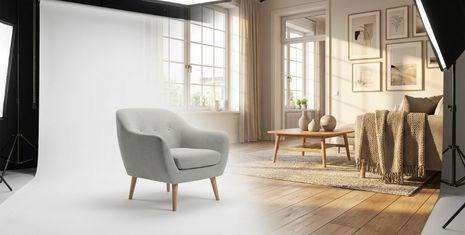
Lifestyle images evoke emotions and help customers build a personal connection with the product. A shelf on a white background is abstract - a shelf in a cozy living room tells a story.
- Emotional appeal: Lifestyle images don’t just sell a shelf, but a feeling of home and order.
- Context understanding: Customers immediately recognize size and style in relation to other objects.
- Brand differentiation: Unique room scenes set you apart from competitors who often only show generic cutouts.
The problem: Traditional lifestyle shoots quickly cost 250-500 € per product and take weeks. With larger assortments, that’s barely feasible. AI tools like showcase generate photorealistic lifestyle images from a single cutout in seconds - at a fraction of the cost.
How to Show Dimensions and Proportions Visually
Size uncertainty leads to returns. There are practical methods to present measurements understandably without customers needing a tape measure.
Measurements Directly in the Image
Integrate height, width, and depth as a graphic overlay in one of your product images. A clear dimension drawing is often more understandable than plain text in the description because customers can see the proportions directly.
Size Comparison with Everyday Objects
Show the shelf filled with books, plants, or binders. These objects serve as visual reference points that everyone knows - and they help estimate compartment sizes.
Room Scenes as Reference
Place the shelf next to a sofa or a door. Customers can intuitively grasp the proportions because they already know the standard sizes of these objects.
How to Technically Optimize Images for Shopify
Technical optimization is the foundation for fast loading times and better search engine visibility. Even the best image is of little use if it takes forever to load or can’t be found by Google.
Optimal Formats and File Sizes
Use WebP or compressed JPEGs. Shopify supports images up to 20 megapixels and 20 MB - but smaller files load faster. Faster loading times improve user experience and are positively rated by Google.
Alt Tags for SEO and Accessibility
Alt tags are short description texts for images that search engines and screen readers read. Describe precisely what’s shown in the image: “Oak shelf with five compartments in living room” instead of “IMG_1234.” This helps Google and makes your store accessible to people with visual impairments.
Mobile-First Display
Always check how your images look on smartphones. Most customers shop on mobile - images that look great on desktop can appear blurry or cropped on small screens.
How to Scale Product Images Without a Traditional Shoot
There are cost-effective alternatives to traditional product photography that become especially relevant with larger assortments.
Time and Cost of Traditional Photo Shoots
A traditional shoot requires planning, studio rental, photographer, styling, and post-processing. The process often takes 2-6 weeks and costs 250-500 € per product. With 50 shelves in different colors, that adds up quickly.
AI-Powered Image Creation as an Alternative
AI tools generate high-quality lifestyle images in various environments from a single cutout in seconds. Platforms like showcase are specifically optimized for Home & Living and deliver brand-consistent results that match your store.
| Traditional Shoot | AI Tool | |
|---|---|---|
| Cost per image | 250-500 € | 0.50-1.50 € |
| Lead time | 2-6 weeks | Minutes |
| Color variants | New shoot required | Automatically generated |
Automate Workflows for Large Assortments
With many products or color variants, automation saves enormous time. With drag-and-drop workflows and batch processing, you create hundreds of images consistently and efficiently - without having to edit each one individually.
How to Test Image Variants and Measure Conversion
Find out through targeted testing which images work best for your target audience. What works for one store may look different for another.
Set Up A/B Testing for Product Images
A/B testing means showing two variants (for example, two different main images) to different user groups and measuring which version performs better. Test cutout against lifestyle image and use Shopify apps or external tools for statistically significant results.
Key Metrics for Measuring Success
The most important KPIs: conversion rate (purchases per visitor), time on the product page, and add-to-cart rate (how often a product is added to the cart). Compare these values before and after image optimization to measure the effect.
How to Get Started with Better Shelf Images in Your Shopify Store
Here’s a practical checklist to get started:
- Review your current product images for completeness (cutout, lifestyle, details, dimensions)
- Add missing lifestyle images for your most important shelves
- Optimize file sizes and fill all alt tags with descriptive texts
- Test different main images (cutout vs. lifestyle)
- Use AI tools for fast and cost-effective scaling
Get started for free, no credit card required: https://getshowcase.ai/
FAQs on Image Strategy for Shelves in Shopify Stores
Do I need a separate photo shoot for each color variant of my shelf?
No. With AI tools like showcase, you can create all additional color variants digitally and photorealistically from a single image. This saves time and costs compared to individual shoots for each version.
Which image file names improve SEO for my Shopify store?
Use descriptive file names like solid-oak-shelf-5-compartments-living-room.jpg instead of IMG_1234.jpg. This helps search engines understand the image content and find your products in image search.
Can I legally use AI-generated product images in my store?
Yes, as long as you own the usage rights to the source images. With professional tools like showcase, you retain full rights to the created images and can use them commercially.
How long does it take to create a lifestyle image with AI?
With specialized tools, generation takes just a few seconds. Compared to traditional shoots that take weeks, this is a massive time saving - especially when you have many products or variants.
How many product images should I show per shelf in my Shopify store?
Plan for at least six to eight images per shelf: one cutout on a white background, two to three lifestyle images in different room scenes, a detail shot of material and craftsmanship, a dimension drawing with exact measurements, and optionally a scene with matching products for cross-selling. More images are especially worthwhile for modular shelves or products with many configuration options, as customers can then visually follow each variant.
About the author

Author
Tim Hoffmann
Chief Product Officer, getshowcase.ai
Tim Hoffmann leads the product strategy for the AI image studio at showcase (getshowcase.ai). He brings years of e-commerce experience in product data, marketplace integrations, and visual content creation. His focus: helping Home & Living retailers turn product cutouts into photorealistic lifestyle images and room scenes in minutes – without expensive shoots, with measurably better conversion. Tim shares practical strategies for product images that perform on marketplaces and in your own shop.