What Images Does Your Shelf Need for Strong Performance on Otto?

Your shelf can be top quality - on Otto, the image decides whether someone clicks or keeps scrolling. Customers can’t touch anything, can’t try anything out. They only see what you show them.
A single cutout is no longer enough. Otto favors listings with multiple image types in search, and customers expect context, details, and variety. This article shows you which five image types your shelf needs, what technical requirements Otto has, and how you go live in minutes instead of weeks with AI image generation. More guides: Shelf product images for Amazon and Shelf images for Kaufland Marketplace.
Why Images on Otto Decide Between a Sale or Abandonment
Product images are the decisive factor for your conversion on Otto. Customers can’t touch shelves, can’t feel the wood surface, can’t check whether the depth fits their alcove. Images take over this task entirely.
Anyone who only uploads a cutout is giving away visibility and sales. Otto favors listings with multiple image types in search, and customers simply scroll on to the next seller when image variety is lacking.
- First impression: In under two seconds, it’s decided whether someone clicks or moves on
- Purchase decision: Lifestyle context shows how the shelf looks in their own home and reduces uncertainty
- Return rate: Detail-rich images lower false expectations and thus returns
Why Shelves Are Difficult to Photograph
Shelves are among the most demanding furniture pieces in product photography. Their open structure, material variety, and the question of proper styling make every shoot a challenge.
Open Structures with Compartments and Shelves Create Complex Shadow Patterns
Shelves consist of many horizontal and vertical surfaces that cast shadows on each other. Each compartment casts its own shadows, and with multiple shelf levels, dark areas quickly appear that make the product look heavy and unattractive. You need lighting that reaches every compartment evenly without creating harsh contrasts.
Different Materials Like Wood, Metal, or Glass Require Different Lighting
An oak shelf reflects light completely differently than one with a metal frame and glass shelves. Wood needs soft light so the grain becomes visible, while metal creates unpleasant reflections with the wrong lighting angle. If your shelf combines multiple materials, you need to find a compromise that shows each material favorably.
Capturing Depth and Three-Dimensional Effect in a Two-Dimensional Image
Shelves thrive on their depth, yet on a photo, this dimension is quickly lost. Frontal shots make a shelf look flat, as if it were just a surface with lines. You need to work with slight angles and targeted lighting so the compartments appear three-dimensional and the viewer gets a sense of the actual depth.
The Right Amount of Decoration: Empty Shelves Look Bare, Overloaded Ones Distract
A completely empty shelf looks lifeless and uninspiring in photos, yet too many objects distract from the actual product. You need to find the balance: a few, well-placed objects like books, a plant, or a decorative element that showcase the shelf without dominating it. This styling takes a lot of time in traditional shoots and requires a good eye for staging.
These 5 Image Types Your Shelf Needs on Otto
Otto and your customers expect different image types for different purposes. Each serves a specific function in the purchasing process. If one is missing, a gap in trust emerges.
Cutout with White Background
A cutout shows your shelf isolated on a pure white background (RGB 255/255/255), without shadows or decoration. This image type is mandatory for Otto listings and serves as the main image in the product overview.
The cutout makes products comparable and simultaneously forms the basis for all further image variants. Without a clean cutout, AI generation of lifestyle images won’t work either.
Lifestyle Images in Living Context
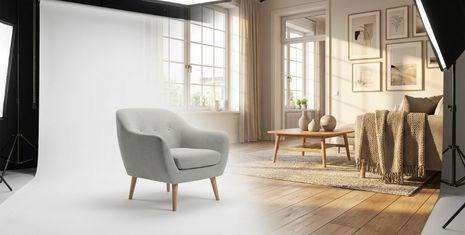
Lifestyle images show your shelf in a furnished living scene. A bookshelf in a Scandinavian living room, a wall shelf above a desk, a bathroom shelf next to the shower.
For Home & Living, lifestyle images are particularly important. Furniture purchases are emotional decisions, and context makes the difference between “interesting” and “purchased.” Customers want to see how the product might look in their own space.
Detail Shots of Material and Surface
Close-ups of wood grain, edges, handles, or connecting elements replace the in-store touch experience. Customers want to know: Is this real wood or laminate? What do the corners look like? Does the surface look premium?
Detail images build trust, especially with higher-priced shelves where material quality is a deciding purchase factor.
Dimension Drawings for Size Orientation
A dimension drawing is a technical representation with all relevant measurements: height, width, depth, compartment sizes. Customers want to know whether the shelf fits in their alcove before they order.
Without clear dimensions, the probability of returns increases significantly. A shelf that doesn’t fit gets sent back. That costs you money and reviews.
Perspectives from Front, Side, and Open
Different views show the shelf completely. The front view serves the overall impression, the side view shows the depth, and an open view presents the interior layout.
Especially with shelves that have doors, drawers, or adjustable shelves, multiple perspectives are essential. Customers want to understand the storage space, not guess it.
Technical Requirements for Otto Product Images
Otto has specific guidelines for product images. Images that don’t meet the guidelines get rejected or perform worse in search.
| Requirement | Otto Specification |
|---|---|
| Minimum resolution | 1500 x 1500 pixels |
| File formats | JPG, PNG |
| Cutout background | Pure white (RGB 255/255/255) |
| Aspect ratio | Square preferred |
| Watermarks | Not allowed |
Minimum Resolution and Image Size
The zoom function on Otto allows customers a detail view. This only works with sufficient resolution. Images below 1500 x 1500 pixels look pixelated and unprofessional when zoomed in.
Plan with high resolution from the start, even if you compress later.
Allowed File Formats
JPG is suitable for photos with many colors and gradients, i.e., for lifestyle images and detail shots. Use PNG when a transparent background is needed or for dimension drawings with clear lines.
Quality Standards for Cutouts
The background is pure white, without shadows, color cast, or grey haze. The product sits centered with sufficient margin to the image edge. Watermarks, logos, or text overlays are not allowed.
Check your cutouts before uploading on a calibrated monitor. What looks white on your laptop may have a yellow tint on Otto.
What Successful Shelf Listings on Otto Have in Common
Top sellers for shelves on Otto show observable patterns. These listings don’t have high conversion rates by coincidence - they follow a clear image strategy.
- Image variety: At least four different image types per listing, often six or more
- Consistent visual language: Uniform style across all product variants with the same lighting mood and similar room scenes
- Context images: Shelves are shown decorated, with books, plants, decorative objects
- Color variants with images: Each color variant has its own lifestyle images, not just recolored cutouts
The most successful listings look cohesive. This is the result of a well-thought-out brand identity that runs through all images.
Traditional Furniture Photography vs. AI Image Generation for Shelves
Two paths lead to professional product images. Traditional photography means studio rental, photographer, props, styling, and post-processing with lead times of several weeks. AI generation creates lifestyle images, color variants, and scenes from a cutout in minutes.
| Criterion | Traditional Photography | AI Image Generation |
|---|---|---|
| Lead time | 2-6 weeks | Minutes |
| Cost per scene | 250-500 EUR | 0.50-5 EUR |
| Color variants | New shooting required | From the same cutout |
| Scalability | Linear with costs | Nearly constant |
| Subsequent changes | Expensive or impossible | Adjustable at any time |
For hero campaigns and print media, traditional photography often remains the right choice. For daily product communication, variant images, and marketplace content, AI is the more cost-effective alternative today.
With showcase, you create complete image series for Otto from a single cutout, including lifestyle scenes, color variants, and different perspectives. Getting started is free, no credit card required.
How to Create Otto Images for Shelves in Minutes
The workflow with AI image generation is surprisingly simple. Instead of weeks of planning and expensive shoots, you work with what you already have: a cutout.
1. Upload Your Cutout
Start with a high-quality cutout of your shelf. If you don’t have one, use the automatic background removal that most AI tools offer as an integrated feature.
Pay attention to good lighting and sharp edges in the source image. The better the cutout, the better the generated results.
2. Generate Lifestyle Images with Living Scenes
Choose suitable room scenes: living room, home office, hallway, children’s room. The AI places your shelf realistically into the scene, with matching lighting, shadows, and perspective.
Try different styles: Scandinavian, modern, industrial, classic. Different target groups respond to different aesthetics.
3. Create Color Variants Without a New Shoot
If you offer your shelf in oak, white, and anthracite, generate images for each variant from the same cutout. No prototypes, no additional shoots, no waiting time.
This is especially valuable with seasonal color trends or when you’re testing new variants before producing them.
4. Export in Otto-Compliant Formats
Download the finished images at the correct resolution (at least 1500 x 1500 pixels) and in the right format (JPG or PNG). Check before uploading that all technical requirements are met.
Checklist for High-Performing Shelf Images on Otto
Before publishing your listing, go through the following points:
- Cutout on pure white background available
- At least one lifestyle image in living context
- Detail shot of material or surface
- Dimension drawing with all relevant measurements
- Multiple perspectives (front, side, open)
- All color variants individually photographed
- Resolution at least 1500 x 1500 pixels
- File formats comply with Otto specifications
- No watermarks or logos in the image
Integrate the checklist directly into your product onboarding process. Every new shelf goes through the same steps - this saves time and ensures quality.
Go Live Faster on Otto with Better Images
The right image types make the difference between a listing that sells and one that gets lost in search. Cutouts alone are no longer enough. Customers expect context, details, and variety.
With AI image generation, you create image variety in minutes instead of weeks, at a fraction of the cost of traditional photography. This means: faster time-to-market, more image variants per product, better conversion rates.
Get started for free, no credit card required: showcase specializes in Home & Living and creates photorealistic lifestyle images, color variants, and complete image series for Otto from your cutouts.
FAQs About Product Images for Shelves on Otto
How many images should I upload per shelf listing on Otto?
Four to six images per product is a good benchmark: cutout, lifestyle, detail, dimension drawing, and different perspectives. Otto allows multiple images, and more image variety improves the purchasing decision. Top sellers often use six or more images per listing.
Does Otto accept AI-generated product images for furniture?
Yes, Otto accepts AI-generated images as long as they meet the technical requirements and correctly represent the product. What matters is image quality and product fidelity, not the creation method. Make sure proportions, colors, and materials are realistically reproduced.
Can I use the same product images for Otto and Amazon?
In principle yes, but check the respective guidelines. Both marketplaces have similar but not identical requirements for resolution, background, and aspect ratio. The cutout usually works on both platforms; for lifestyle images, the specifications may vary.
What happens if my shelf images don’t meet Otto’s guidelines?
Otto may reject images or your listing will be placed lower in search. In the worst case, the product won’t be activated until compliant images are uploaded. That costs you time and revenue. So check the requirements before uploading.
How often should I update my product images on Otto?
Update images when products change, for seasonal occasions, or when you notice your conversion rate is declining. Fresh lifestyle images can also revitalize existing listings, especially when you show new room scenes or decoration styles that pick up on current trends.
About the author

Author
Tim Hoffmann
Chief Product Officer, getshowcase.ai
Tim Hoffmann leads the product strategy for the AI image studio at showcase (getshowcase.ai). He brings years of e-commerce experience in product data, marketplace integrations, and visual content creation. His focus: helping Home & Living retailers turn product cutouts into photorealistic lifestyle images and room scenes in minutes – without expensive shoots, with measurably better conversion. Tim shares practical strategies for product images that perform on marketplaces and in your own shop.