Which Product Images Sell Sofas? 10 Conversion Strategies for Shopify Stores

Selling a sofa online is harder than most other products. Customers can’t try sitting on it, can’t feel the upholstery, can’t estimate the size - all they have are your images.
That’s exactly why product images make or break sofa sales. This article shows you ten concrete image strategies that Shopify merchants use to increase conversion rates - from lifestyle room scenes to mobile optimization to A/B testing. If you also sell on marketplaces, our guides on sofa images on Otto and dining table conversion in Shopify stores will help.
Why Product Images Determine Sofa Sales
When buying a sofa online, there’s no test sitting. Customers can neither test the upholstery nor estimate how the furniture actually looks in the room. That’s exactly why product images take on the role of the salesperson - they convey quality, comfort, and fit at a glance.
Purchase uncertainty with high-priced furniture is naturally high. Nobody buys a sofa for 800 € when the only image is a blurry cutout on a white background. The more visual information you provide, the fewer questions remain open - and the less often customers abandon the purchase.
Why Sofas Are Difficult to Photograph
Sofas are among the most challenging products in product photography. Before diving into image strategies, it helps to understand why conventional photography so often reaches its limits with upholstered furniture.
Bulky Dimensions Require Large Studios and Elaborate Lighting
A sofa isn’t a sneaker - you need a large studio to properly light it and photograph it from various angles. Even with professional equipment, the sheer size quickly creates uneven lighting conditions that make the result look flat or unnatural. This drives up not only costs but also the time required per shoot significantly.
Fabric Textures and Upholstery Details Lose Their Tactile Quality in Photos
The soft feel of velvet fabric or the textured grip of a woven material is difficult to convey in a two-dimensional image. You need to work with close-ups and targeted light direction so customers can at least visually assess the material quality. Without this detail work, even high-quality covers look generic and interchangeable in photos.
Color Reproduction Varies Between Camera Capture and Screen Display
Every camera interprets colors differently, and every screen renders them differently. Especially with sofas, where color is a central purchase criterion, this regularly leads to complaints and returns. You need to work with color profiles and calibrated monitors to minimize the deviation.
Soft Shapes with Cushions and Curves Create Challenging Shadow Conditions
Sofas rarely have hard edges - instead, curved armrests, arched back cushions, and loosely placed decorative pillows dominate. These soft shapes cast diffuse shadows that can swallow contours or create unwanted dark zones under the wrong lighting. You need a well-thought-out lighting setup with multiple softboxes to preserve the three-dimensional effect of the sofa in the photo.
What Is a Good Conversion Rate for Furniture in Shopify
The conversion rate describes the percentage of store visitors who actually make a purchase. In furniture eCommerce, the average typically ranges between 1% and 3% - significantly lower than for consumables like clothing or cosmetics.
The reason is obvious: furniture is a high-priced purchase with long decision cycles. Customers compare, deliberate, come back. Optimized product images address exactly this - they shorten the decision process and lower the barrier to purchase.
10 Image Strategies That Boost Your Sofa Conversion
The following strategies are specifically tailored to sofas and upholstered furniture. Each one addresses a concrete purchase barrier.
1. Show Lifestyle Room Scenes Instead of Just Cutouts
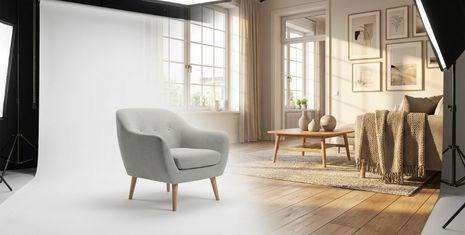
A cutout shows the sofa in isolation on a white background. A room scene image, on the other hand, places it in a furnished setting - with a rug, side table, lighting, and atmosphere.
The difference for customers: They see not just the product but can imagine how it looks in their own living room. Tools like showcase generate such room scene images from simple cutouts in seconds - no photo shoot, no waiting time.
2. Offer Multiple Perspectives and Detail Shots
Show the sofa from the front, side, back, and in detail. Close-ups of seams, upholstery, and feet answer questions before they arise.
- Front view: Shows proportions and overall impression
- Side view: Illustrates seat depth and armrest height
- Detail shots: Make craftsmanship and material quality visible
More angles mean fewer open questions - and fewer open questions mean higher purchase intent.
3. Visually Display All Color Variants
Customers are reluctant to buy when they can only imagine a color. Every available variant deserves its own image.
Traditional photo shoots make this expensive - a new setup for each color variant. AI-powered recoloring solves this problem: All color variants are created automatically from a single cutout, with correct fabric texture and realistic lighting.
4. Integrate Dimension Drawings and Size Comparisons
Dimension drawings are technical illustrations with all relevant measurements - width, depth, seat height, armrest height. They help customers check whether the sofa fits in the intended space.
Even more effective are size comparisons with people or standard objects. A sofa next to a standing person conveys the dimensions more intuitively than any centimeter measurement - and measurably reduces returns.
5. Enable High-Resolution Zoom Function
Customers want to enlarge details - fabric texture, craftsmanship, material quality. A functioning zoom function requires sufficiently high-resolution images.
Make sure image quality doesn’t come at the expense of loading time. Shopify supports responsive images that load the appropriate resolution depending on the device.
6. Make Material and Texture Tangible
With sofas, material quality is a crucial purchase criterion. Close-ups of cover fabrics, leather, or wooden feet make quality visible.
Show the texture as clearly as possible - ideally with natural light that emphasizes the surface structure.
7. Stage Products in Room Context
Different customers have different living styles. A sofa shown only in a modern loft appeals less to traditionally furnished households.
Show the same sofa in different room scenes - modern, Scandinavian, classic. With AI tools like showcase, you create variants from a single cutout without planning multiple elaborate shoots.
8. Use Multi-Product Staging for Cross-Selling
Multi-product staging combines multiple products in one scene: sofa plus coffee table plus cushions plus floor lamp. This increases the average cart value and shows customers attractive combination possibilities.
For Shopify merchants with a broad assortment, this is a direct lever for higher revenue per order.
9. Ensure a Consistent Visual Brand Style
All product images in your store deserve a unified visual language - same lighting mood, similar color palette, consistent perspectives. This builds trust and strengthens brand identity.
showcase offers a Brand Identity feature that automatically adapts scenes to your brand’s style. Once set up, all generated images remain visually consistent.
10. Optimize the Hero Image for the Product Gallery
The first image in the gallery determines whether customers keep scrolling or bounce. Choose the most appealing lifestyle image as the hero image - not the classic cutout.
A room scene with atmosphere sparks interest. The cutout can follow as the second or third image, once customers are already engaged.
Mobile Optimization for Product Images in Shopify
The majority of Shopify visitors come via smartphones. Images that are convincing on desktop can become a problem on mobile.
Adjust Image Sizes for Mobile Loading Times
Large image files significantly slow down the store on mobile devices. Use responsive images that automatically load the appropriate size depending on the device - Shopify supports this natively.
Use a Touch-Friendly Gallery
Swipe gestures and zoom function work differently on touchscreens than with a mouse. Test the gallery on real smartphones, not just in the browser simulator.
Use Vertical Formats for Smartphones
Portrait formats use screen space on smartphones more efficiently than landscape formats. Especially for detail views, the vertical format is worthwhile.
Optimize Loading Time Without Losing Image Quality
Fast loading times are a direct conversion factor. Every additional second of loading time measurably costs sales.
Properly Compress Images for Shopify
Image compression reduces file size with minimal quality loss. Tools like TinyPNG or Shopify apps like Crush.pics handle this automatically.
Enable Lazy Loading for Product Galleries
Lazy loading means images are only loaded when the user scrolls to them. This significantly reduces the initial loading time of the product page - especially for galleries with many images.
Use WebP Format for Faster Loading Times
WebP offers better compression than JPEG or PNG at the same quality. Shopify often automatically converts uploaded images to WebP.
How to Properly Run A/B Tests for Product Images
Assumptions are good, data is better. A/B tests show you which image strategy actually works for your customers.
Which Image Variants You Can Test
- Hero image: Cutout vs. lifestyle image as the first gallery image
- Image count: 6 images vs. 10 images in the product gallery
- Sequence: Different arrangements of perspectives and detail shots
Tools for Image A/B Testing in Shopify
Shopify-compatible apps like Intelligems or Neat A/B Testing enable testing different image variants. Let the tests run for at least two weeks before drawing conclusions.
Create Lifestyle Images Without a Photo Shoot
Traditional photo shoots are expensive and time-consuming. AI image generation offers an efficient alternative.
| Traditional Shoot | AI Image Generation | |
|---|---|---|
| Time required | 2-6 weeks | Seconds to minutes |
| Cost per product | 250-500 € | 0.50-5 € |
| Color variants | New shoot required | Automatically generated |
| Scalability | Linear with cost | Nearly constant |
Tools like showcase generate professional room scene images from simple cutouts in seconds. The key advantage: shape, color, and details of the original product are fully preserved.
Quick Wins vs. Deeper Image Optimizations
Not every optimization requires the same effort. Some improvements are implemented in minutes, others need a long-term strategy.
Immediately Actionable Improvements
- Swap the hero image for an appealing lifestyle image
- Enable lazy loading for product galleries
- Compress existing images
- Check and enable zoom function
Long-Term Investments in Image Quality
- Equip the complete assortment with high-quality room scene images
- Establish consistent Brand Identity across all visual content
- Set up systematic A/B tests
- Develop multi-product staging for cross-selling
Sell More Sofas in Shopify with Better Product Images
Lifestyle images, multiple perspectives, all color variants, room context, and mobile optimization - these are the most important levers for higher conversion rates on sofas. They reduce purchase uncertainty and make your product desirable.
Getting started is easier than you think: Start with the quick wins, test different approaches, and scale what works.
Start for free with showcase - no credit card required. Try it now
FAQs on Sofa Product Images in Shopify
How many images should I show per sofa in my Shopify store?
At least six to eight images per product. A mix of different perspectives, detail shots, a room scene image, and a dimension drawing covers the most important customer questions. For high-priced sofas, ten or more images can also make sense.
Which image format is best for Shopify product images?
WebP offers the best balance of quality and file size. If you upload JPG or PNG, Shopify often automatically converts to WebP. For maximum compatibility, upload images at a minimum of 2048 x 2048 pixels.
Can I replace product images in Shopify without losing SEO?
Yes, you can replace images at any time. Make sure to keep or optimize the alt texts - they’re the most important SEO factor for product images. The product page URL remains unchanged.
Do 360-degree views improve the conversion rate for sofas?
360-degree views can positively influence the conversion rate, especially for high-priced furniture. They increase time on page and reduce purchase uncertainty. However, the implementation effort is higher than with traditional image galleries.
What does professional sofa photography cost compared to AI image generation?
Traditional photo shoots cost 250-500 € per product depending on the effort - photographer, studio, styling, and post-processing included. AI image generation with tools like showcase costs 0.50-5 € per image and scales effortlessly with your assortment.
About the author

Author
Tim Hoffmann
Chief Product Officer, getshowcase.ai
Tim Hoffmann leads the product strategy for the AI image studio at showcase (getshowcase.ai). He brings years of e-commerce experience in product data, marketplace integrations, and visual content creation. His focus: helping Home & Living retailers turn product cutouts into photorealistic lifestyle images and room scenes in minutes – without expensive shoots, with measurably better conversion. Tim shares practical strategies for product images that perform on marketplaces and in your own shop.