What Product Images Does Your Sofa Need for Top Sales on Otto

Selling a sofa on Otto without customers being able to touch it - that only works through images. Your product photos take on the role of salesperson, showroom, and tactile experience simultaneously.
The problem: a single cutout is no longer enough to compete against hundreds of similar listings. This article shows you which image types your sofa listing needs, which perspectives and material presentations convince - and how you scale image production with AI tools without booking a new shoot for every color variant. Dive deeper with Sofa product images for Amazon and Sofa images for Shopify.
Why Images Decide Success or Failure on Otto
Otto buyers can’t touch your sofa, can’t try sitting on it, and can’t check the color in their own living room. Your product images take over all of that - they are the only way to convey quality, comfort, and style. The thumbnail decides in a split second whether someone clicks or keeps scrolling.
High-quality images automatically signal product quality. Customers compare listings side by side, and whoever shows more wins the click. Listings with multiple image types typically achieve significantly better conversion rates than products with just a cutout.
Why Sofas Are Difficult to Photograph
Sofas are among the most demanding products in furniture photography. Between size, material variety, and color accuracy, numerous pitfalls lurk that can ruin your image quality - if you don’t know them.
Bulky Dimensions Require Large-Scale Studio Equipment
A sofa easily spans two to three meters in width, and for clean lighting you need correspondingly large softboxes, backdrop systems, and distance to the camera. Without a professional studio with sufficient space, you get distortions, cropped edges, or uneven shadows. For many sellers, the space issue alone is why traditional shoots become so expensive.
Fabric Textures and Upholstery Details Often Get Lost in Photos
The feel of a sofa - whether soft corduroy, textured leather, or velvety velour - is difficult to capture two-dimensionally. Without targeted close-ups and the right lighting, surfaces look flat and generic. You need to work deliberately with light direction and image framing so customers can sense the material quality even on screen.
Color Reproduction Varies Depending on Lighting and Screen
The same sofa looks different under daylight than under studio lights - and different again on the customer’s screen. Color deviations are one of the most common return reasons for upholstered furniture. Pay attention to calibrated lighting and work with color profiles so your product images stay as close to reality as possible.
Multiple Perspectives Needed to Convey Seating Comfort and Proportions
A single frontal image shows neither the seat depth nor the cushion firmness nor the actual spatial impact of your sofa. Customers need side, angled, and detail views to form a complete picture. Plan for at least four to six perspectives from the start that together create a realistic overall impression.
What Image Types Your Sofa Listing Needs on Otto
A complete listing consists of different image categories. Each image type answers a different buyer question - from the first impression to the final purchase decision.
Cutout with White Background
The cutout shows your sofa without distraction against a neutral background. Otto prefers this image type as the main view because it creates comparability. Pay attention to even lighting and sharp edges.
Lifestyle Images and Staged Scenes
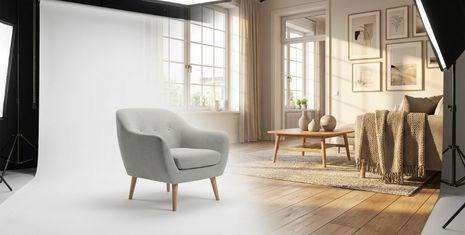
A lifestyle image places the sofa in a furnished living scene. Customers immediately see how the furniture piece looks in a real room - this reduces uncertainty and returns.
With AI tools like showcase, you generate various room scenes from a single cutout in seconds instead of weeks.
Detail Shots of Upholstery and Craftsmanship
Close-ups of fabric structure, stitching, and feet answer the question “What does the material feel like?” Especially with higher-priced sofas, customers expect visual proof of quality.
Dimension Drawings with Measurements
A technical illustration with length, width, height, and seat depth helps customers with room planning. Without exact measurements, you risk returns because the sofa doesn’t fit through the door or overwhelms the room.
Function Images for Sofa Beds and Reclining Sofas
Show the sofa in different states: unfolded as a bed, with activated reclining function, or with open storage compartment. Customers want to see what the sofa can do - not just read about it.
Best Perspectives for Sofa Product Images
Different viewing angles answer different customer questions. A single perspective is rarely enough to clear all doubts.
Frontal View for the First Impression
The classic front-on view shows overall proportions and is usually the main image. It conveys symmetry and gives a quick design overview.
45-Degree Angle for Depth and Shape
The angled view conveys spatial depth and is particularly important for corner sofas and sectionals. Customers better understand how the sofa actually sits in a room.
Detail Views of Upholstery and Stitching
Close-ups deliver the proof of quality. With AI tools, you can rotate products to generate new views - without an additional shoot.
Top-Down View for Room Planners
The bird’s-eye perspective shows the footprint and helps customers plan the sofa into their floor plan. Especially with large sectionals, this view is valuable.
Showing Material and Texture Convincingly
Customers pay particular attention to the upholstery of sofas. Different materials require different image strategies to look authentic.
Lighting Leather Textures Properly
Leather needs even lighting without harsh reflections. The natural grain and subtle sheen make the difference between “cheap” and “premium” in the image.
Presenting Fabric and Fine Corduroy Authentically
The structure of the weave needs to be made visible. With fine corduroy, highlight the characteristic ridges - this gives customers a sense of the feel even though they can’t touch the fabric.
Capturing Velvet and Velour with Sheen
Velvety surfaces have a characteristic shimmer effect. Side lighting emphasizes the texture and makes the material look alive.
Creating Images for Color Variants Without Individual Shoots
Many sofas are available in five, ten, or more colors. Traditionally, this means one shoot per variant - time-consuming and expensive.
The alternative: AI-powered recoloring from a single image. Upload a cutout and generate all color variants from it. The result is a complete color palette without additional production.
| Approach | Time Required | Cost per Variant |
|---|---|---|
| Traditional shooting | 1-2 days per color | 200-400 EUR |
| AI recoloring | Seconds | 0.50-2 EUR |
Displaying Dimension Drawings and Size Proportions
A dimension drawing is essential for furniture. Customers need exact specifications for their purchase decision - and Otto expects this information.
- Overall width: Does the sofa fit through the door and into the room?
- Seat depth: How comfortable is the seating, how much space remains behind?
- Seat height: Important for comfort when standing up, especially for older customers
- Armrest height: Relevant for side tables and lamps
With showcase, you automatically create dimension drawings from product images - without manual tracing.
Lifestyle Images for Different Interior Styles
Customers want to imagine the sofa in their home. Different target groups prefer different interior styles - and you reach more buyers when you cover multiple styles.
Modern Style with Clean Lines
Minimalist scenes with neutral colors and little decoration suit contemporary sofas. Less is more here.
Country Style with Warm Colors
A cozy atmosphere with wooden furniture and warm textiles - ideal for classic, comfortable sofas with soft shapes.
Scandinavian Style with Light Tones
Bright, airy scenes with natural materials are popular for understated fabric sofas. This style appeals to a broad target group.
With showcase, you set up a brand identity so all lifestyle images match your brand - consistent across the entire range.
Multi-Product Staging for Sofa Sets and Cross-Selling
Multi-product staging means combining multiple products in one scene. This is ideal for sofa sets, sofas with ottomans, or sofas with matching cushions.
- Sets: Show 2-seater and 3-seater sofa together
- Complementary products: Sofa with matching ottoman or chaise longue
- Accessories: Sofa with cushions and throws for cross-selling
- Room concepts: Complete living room scene for inspiration
showcase offers multi-product staging as a feature - combine multiple cutouts in one scene without photographing each product individually.
Technical Image Requirements for Otto at a Glance
Without the right standards, images get rejected or perform poorly. Here are the key specifications at a glance.
Minimum Resolution and File Formats
Otto accepts JPG and PNG. Higher resolution enables better zoom functionality - plan for at least 1500 x 1500 pixels.
Number of Images per Listing
Use as many images as possible. Each additional image answers another customer question and increases time spent on your listing.
Background and Quality Specifications
White background for cutouts is mandatory. No watermarks, no text on images, no collages. Sharp, undistorted product presentation is a basic requirement.
Scaling Image Production with AI Instead of Photo Shoots
Traditional photo shoots are often too slow and too expensive for large ranges. A professional shoot for 10 sofas typically costs between 2,500 and 5,000 euros - with 100 SKUs, that’s financially hard to justify.
AI image generation solves this problem:
- Time savings: Images in seconds instead of weeks of waiting
- Cost savings: No studio rental, no photographers, no props
- Scalability: From one to hundreds of images at the push of a button
- Consistency: Uniform look across all product variants
Start for free now with showcase - no credit card required: https://getshowcase.ai/
FAQs About Product Images for Sofas on Otto
How many images should I upload per sofa on Otto at minimum?
Upload at least five to eight images per sofa to cover cutouts, lifestyle images, detail shots, and dimension drawings. The more images, the better the performance - Otto rewards complete listings with better visibility.
Does Otto accept AI-generated product images?
Otto accepts AI-generated images as long as they meet the technical requirements and correctly represent the product. What matters is image quality, not the method of creation.
How long does image production take with AI tools compared to a traditional shoot?
With AI tools like showcase, you generate lifestyle images and variants in seconds to minutes. Traditional shoots often require weeks from planning to delivery - a difference that’s crucial with fast product cycles.
Can I use existing cutouts for generating lifestyle images?
Yes, AI image studios like showcase are designed precisely for this. Upload your cutout and generate lifestyle images, color variants, and additional image types from it - without a new shoot.
What typical image mistakes lead to rejection of product images on Otto?
Common rejection reasons are resolution too low, colored or uneven backgrounds on cutouts, watermarks, text overlays, and blurry or distorted product presentations. Check every image against these criteria before uploading.
Checklist for High-Performing Sofa Images on Otto
Before publishing your sofa listing, go through this checklist. It summarizes the key requirements so your images perform on Otto from the start.
- Cutout on pure white background available
- At least one lifestyle image in living context
- Detail shots of fabric, stitching, and feet
- Dimension drawing with all relevant measurements
- Multiple perspectives (frontal, side, back)
- All color variants individually photographed
- Resolution at least 1500 x 1500 pixels
- No watermarks or logos in the image
If you can check off all points, your listing is optimally positioned. Missing image types can be added with showcase in just a few minutes - without a new shoot.
Get started for free, no credit card required: https://getshowcase.ai/
About the author

Author
Tim Hoffmann
Chief Product Officer, getshowcase.ai
Tim Hoffmann leads the product strategy for the AI image studio at showcase (getshowcase.ai). He brings years of e-commerce experience in product data, marketplace integrations, and visual content creation. His focus: helping Home & Living retailers turn product cutouts into photorealistic lifestyle images and room scenes in minutes – without expensive shoots, with measurably better conversion. Tim shares practical strategies for product images that perform on marketplaces and in your own shop.