What Makes Successful Sofa Photos on Home24: Practical Tips for Sellers

Sofas are the most difficult products in the Home24 catalog when it comes to product images. Large, bulky, available in dozens of fabric and color variants — and customers still expect to understand how the thing feels just from looking at a screen.
Most sellers underestimate how much revenue they’re leaving on the table with mediocre sofa images. This article shows you which image types and perspectives work on Home24, how to efficiently create visuals for variants, and why AI image generation is increasingly replacing traditional photo shoots. Dive deeper with sofa product images for Otto and sofa images for Amazon.
What Makes a Successful Sofa Product Image on Home24
A successful sofa product image on Home24 shows the product so that customers understand within seconds what it looks like, how big it is, and how it fits in their space. That sounds simple, but this is exactly where many listings fail. Home24 itself relies on multiple perspectives, detail shots, and lifestyle scenes — while many sellers only provide a single cutout.
The difference shows directly in click-through rates. Customers can’t touch a sofa, can’t sit on it for a test, can’t feel the fabric quality. Your images take over this role entirely.
Technical Requirements for Home24 Listings
Home24 has clear specifications for product images. Here are the key points:
- Resolution: At least 1500 x 1500 pixels for sharp rendering on desktop and mobile
- Background: White for the main image (cutout), neutral or context-rich for additional images
- File format: JPG or PNG, file size under 10 MB
- Aspect ratio: Square or slightly rectangular works best in the product overview
Check the current guidelines in the seller portal, as requirements may change.
Visual Quality Criteria for High Conversion
Technical specs alone aren’t enough. What “high quality” specifically means:
- Lighting: Even and soft, no hard shadows that swallow details
- Color accuracy: Realistic, not over-edited — customers expect the delivered sofa to look like the image
- Sharpness: The product in focus, no blur on seams, cushions, or feet
A common mistake: images are over-processed, colors look unnatural. This leads to returns and negative reviews.
Image Consistency Across Your Entire Assortment
If you offer multiple sofas, ensure a consistent look. Same angles, same lighting, same styling across all products.
Consistency builds trust. Customers scrolling through your assortment subconsciously notice whether your brand looks professional or thrown together.
Why Sofas Are Hard to Photograph
Sofas are among the most demanding products in furniture photography. Shape, material, and size present challenges that simply don’t exist with smaller products. Here are the most common pitfalls you should know about.
Large Dimensions Require Plenty of Space and Even Lighting
A sofa isn’t a decorative item you can just place on a table. You need a studio or at least a room that allows enough distance between camera and product. At the same time, the lighting must evenly cover the entire piece of furniture without the sides appearing darker than the center. Uneven light is immediately noticeable in product images and looks unprofessional.
Fabric Textures and Cushion Details Lose Depth in Photos
Corduroy, velvet, bouclé — these materials thrive on their tactile quality. On a flat screen, that depth is lost if you don’t deliberately work with light and close-ups. You need to balance sharpness and lighting so the texture remains visible and the viewer gets a sense of the material.
Color Reproduction Varies Between Camera, Screen, and Reality
The dark green sofa in your showroom looks different on the camera display than on your laptop and different again on the customer’s smartphone. Color management is especially critical for sofas because color deviations are the most common reason for upholstered furniture returns. Calibrate your monitor and work with a consistent color profile.
Complex Shapes with Curves and Cushions Create Challenging Shadow Conditions
Sofas rarely have clean, straight edges. Curved armrests, voluminous cushions, and soft upholstery cast shadows in all directions. These shadows can obscure details or make the product appear heavier than it is. You need to work with multiple light sources to cleanly bring out the three-dimensional form.
Why Product Images Determine Your Home24 Success
On a marketplace like Home24, you’re competing directly with dozens of other sellers. The first filter is the image in the product overview. If your sofa doesn’t stand out there, it won’t get clicked — no matter how good the price or quality.
The impact of good images can be observed in three areas:
- Click-through rate: Appealing images in the overview attract more visitors to your product page
- Time on page: Multiple perspectives and lifestyle images keep customers on the page longer
- Return rate: Realistic representation reduces wrong purchases because customers know what they’re getting
The difference arises because customers buy with more confidence when they have context images. They can envision how the sofa would look in their own living room.
Which Image Types Your Sofa Listing Needs
A complete listing consists of multiple image types. Each serves a different function in the customer’s decision-making process.
Cutout with White Background
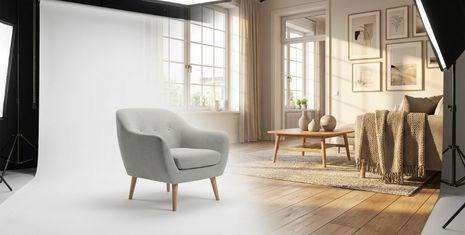
The main image on Home24 is almost always a cutout. The product is isolated, the background white, full attention on shape and design. This is about clarity, not emotion.
Lifestyle and Ambiance Images
An ambiance image shows the sofa in a furnished setting — a living room, a reading nook, an open loft. Customers can envision how the product would look in their own home.
Ambiance images are the strongest lever for conversion. They answer the question: “Does this fit me?”
Detail Shots of Fabrics and Seams
Close-ups show material quality: fabric texture, stitch work, cushion details. Especially with higher-priced sofas, customers expect these insights because they can’t check the craftsmanship in person.
Dimension Markings and Feature Demonstrations
Images with overlaid measurements or demonstrations of features like a sleeper function or adjustable backrest help with the practical purchase decision. Customers want to know if the sofa fits through the door and into the intended corner.
Which Perspectives Work Best for Sofas
A sofa is a three-dimensional product. A single image isn’t enough to fully capture it. Different angles answer different questions.
Front View for the First Impression
The classic view for the main image. It shows the overall shape and design at a glance — what customers see in the product overview.
Side View for Proportions
The side view shows seat depth, armrest height, and backrest angle. Important for comfort assessment, especially for sofas with distinctive shapes.
45-Degree Angle for Spatial Depth
A combination of front and side. This angle conveys three-dimensionality and looks more natural than a pure front view.
Top View for Room Planning
The bird’s-eye view shows the footprint. Customers planning their space appreciate this view because it helps answer whether the sofa fits in the corner.
How to Present Fabric and Color Variants Convincingly
Many sofas come in multiple colors and fabrics. The challenge: physical samples or prototypes often don’t exist for every variant.
Color Variants in a Consistent Setting
Show all colors in the same image style — same lighting, same angle, same room. This way, customers can compare directly without being distracted by different visual styles.
Fabric Textures Through Close-Ups
Corduroy feels different from velvet, leather different from woven fabric. Detail images convey this material character visually, even when customers can’t touch it. Show the fabric structure in close-up.
Creating Visuals for Variants Without Physical Samples
What do you do when you have 12 color variants but only 3 prototypes? This is where AI image generation comes in. Tools like showcase can create digital color variants from a single cutout — without a new shoot, without building prototypes.
Why Ambiance Images Boost Conversion
The difference between cutouts and ambiance images isn’t just aesthetic — it’s measurable.
| Image Type | Strength | Use Case |
|---|---|---|
| Cutout | Product focus, technical clarity | Main image, comparison |
| Ambiance image | Emotional appeal, spatial effect | Additional images, inspiration |
Cutouts show what the product is. Ambiance images show what it feels like to own it. For emotional purchase decisions — and furniture is almost always emotional — this difference is decisive.
Customers who see a sofa in a furnished room can better envision how it would look in their own home. This reduces uncertainty and increases purchase readiness.
How to Create Sofa Product Images Without a Photo Shoot
Traditional product photography for sofas is elaborate: studio rental, photographer, styling, transporting the furniture, post-processing. Per product and scene, costs quickly reach 250-500 €. With 50 sofas in 3 color variants each, this becomes unaffordable.
AI image generation offers an alternative that has matured significantly in recent years.
AI Image Generation for Lifestyle Images
From a simple cutout, a photorealistic lifestyle image is created in seconds. The AI analyzes your product — shape, color, material — and embeds it in a generated living scene, complete with matching shadows and lighting.
Tools like showcase are specifically optimized for Home & Living and deliver results that work on marketplaces.
Automatic Background Removal
If your source image isn’t a clean cutout: most AI tools remove the background automatically. This saves manual clipping in Photoshop and significantly speeds up the workflow.
Virtual Color Variants and Material Swaps
Digital recoloring and material adjustment without a new photo. Ideal for assortments with many variants — you photograph once and generate all colors digitally. This is especially useful when prototypes don’t exist yet or would be too expensive.
Produce Sofa Images for Home24 Faster and More Affordably
The math is simple: a traditional shoot for 10 sofas costs 2,500-5,000 €. With AI tools, costs are a fraction of that — and you have the images in hours instead of weeks.
| Traditional Shoot | AI Tool (e.g. showcase) | |
|---|---|---|
| Cost per product (1 scene) | 250-500 € | 0.50-1.50 € |
| Lead time | 2-6 weeks | Minutes |
| Color variants | New shoot required | Automatically generated |
For hero campaigns and print media, real photography remains valuable. For product pages, marketplace listings, and variant images, AI is today the faster and more cost-effective choice.
Get started for free with showcase — no credit card required: getshowcase.ai
Checklist for Compelling Sofa Images on Home24
Before you upload your sofa images to Home24, go through this checklist. It summarizes the key points to ensure your listing is professional and complete from the start.
- Cutout on pure white background available
- At least one lifestyle image in a living context
- Detail shots of fabric, seams, and upholstery
- Dimension drawing with seat height, overall height, and depth
- Multiple perspectives (front, side, angled)
- All color and fabric variants individually visualized
- Resolution and file formats meet Home24 specifications
If you can check off all points, your listing is well-positioned. If you’re missing images, many of these requirements can be addressed quickly and cost-effectively with AI image generation.
FAQs About Sofa Product Images on Home24
How many images should a sofa listing on Home24 have?
A complete listing includes at least a main image (cutout), multiple perspectives, and ideally an ambiance image. The more meaningful images you provide, the more confident the purchase decision — and the lower the return rate.
What file formats does Home24 accept for product images?
Home24 accepts common formats like JPG and PNG. Check the current guidelines in the seller portal for exact specifications on resolution and file size.
Can I use the same sofa images on multiple marketplaces?
In principle, yes. But pay attention to different technical requirements — Amazon has different specs than Otto or Home24. Some platforms also prefer unique content.
Do I need a separate ambiance image for each color variant of my sofa?
Ideally yes, as customers want to see each variant in context. With AI image generation, this can be done efficiently without photographing each variant individually.
Do I need separate images for each fabric variant of my sofa on Home24?
Yes, each fabric variant should have its own images. Customers want to see how corduroy, velvet, or woven fabric looks on the specific model — a color swatch alone isn’t enough. If you can’t photograph each variant individually, use AI tools like showcase to generate realistic fabric variants from an existing cutout. This ensures every variant is visually covered without blowing your budget.
About the author

Author
Tim Hoffmann
Chief Product Officer, getshowcase.ai
Tim Hoffmann leads the product strategy for the AI image studio at showcase (getshowcase.ai). He brings years of e-commerce experience in product data, marketplace integrations, and visual content creation. His focus: helping Home & Living retailers turn product cutouts into photorealistic lifestyle images and room scenes in minutes – without expensive shoots, with measurably better conversion. Tim shares practical strategies for product images that perform on marketplaces and in your own shop.