What Images Does Your Wardrobe Need for Strong Performance on Otto?

A wardrobe on Otto competes with hundreds of similar products - and customers decide in seconds whether they click or keep scrolling. Your images are the only selling argument that counts before someone even reads the product description.
The problem: Most sellers underestimate how many different image types a wardrobe actually needs to be convincing. This article shows you the five image types every wardrobe on Otto should have, the best perspectives for furniture photography, and how to create color and material variants without elaborate shoots. Similar requirements apply to wardrobes on Amazon and wardrobe product images on Home24 - a comparison is worthwhile if you sell on multiple channels.
Why Product Images Determine Your Success on Otto
On Otto, customers buy wardrobes without ever having touched them. Your images take over the role that touching, opening, and looking inside plays in a furniture store. If a customer can’t see how the drawers are organized or what the wood actually looks like, they’ll buy elsewhere.
In search results, you compete with dozens of similar products. A sharp, well-lit main image stands out and generates more clicks than a blurry or poorly cut-out photo. But the click alone doesn’t make a sale.
On the product page itself, detail images and context shots then convince. Customers who can see exactly what they’re getting buy with more confidence and return less often. The connection is direct: better images lead to higher conversion and lower return rates.
Why Wardrobes Are Difficult to Photograph
Wardrobes are among the most demanding products in furniture photography. Their size, surfaces, and functionality present challenges you don’t face with smaller products.
Large Dimensions Require Specialized Studio Equipment
A wardrobe is easily two meters tall and over a meter wide. That means: you need a studio with enough space, large-scale lighting, and a camera position that captures the entire product without distortion. Improvising with a small room and a phone camera won’t deliver convincing results here.
Reflective or Smooth Surfaces Reflect Light and Surroundings
High-gloss fronts, lacquers, or even glass elements are not uncommon for wardrobes. These surfaces reflect every light source and, in the worst case, show the photographer, tripod, or studio in the image. To avoid this, you need diffused light and controlled environmental conditions.
Interior Layout and Storage Space Are Hard to Represent Two-Dimensionally
The interior of a wardrobe - shelves, clothes rails, drawers - has real depth. On a two-dimensional photo, this spatial information is easily lost. You need to work deliberately with perspective and lighting so customers can recognize the actual layout and depth of the compartments.
Different Opening States Need to Be Shown
A wardrobe has a completely different effect when closed versus open or half-open. Customers expect images in multiple states, which multiplies the effort per product. Each state needs its own lighting and camera settings for a professional result.
These 5 Image Types Every Wardrobe Needs on Otto
For a complete product presentation, you need different image types that each answer different customer questions.
Cut-Out Main Image
The main image shows your wardrobe closed in full view against a pure white background. A “cutout” is an image where the product has been isolated from the original background - the full focus is on the product itself.
This image appears in search results and determines the first click. Pay attention to clean edges without artifacts and even lighting.
Lifestyle Images in Living Scenes
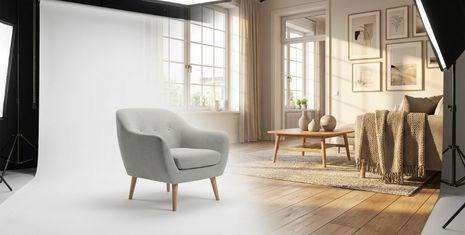
A lifestyle image shows the wardrobe in a furnished room setting - such as a bedroom or hallway. Customers can imagine how the product will look in their own home.
The emotional connection that emerges is often the deciding purchase factor. A wardrobe against a white background remains abstract; a wardrobe next to a bed with bedding and a bedside lamp becomes tangible.
Interior Views with Open Doors
Customers want to know how much storage space is available and how they can organize their clothes. A shot with open doors shows shelves, clothes rails, and drawers at a glance.
Without this information, many will buy from a competitor who provides it. So show at least one view with fully open doors.
Detail Shots of Handles and Hardware
Close-ups of handles, hinges, or wood grain convey quality. They answer questions about material quality that customers have with a higher-priced product.
A good detail image can justify the price difference from the cheaper competitor. Show the surface structure so customers can almost feel it.
Dimension Drawings with Measurements
A dimension drawing is a technical representation with all relevant measurements - height, width, depth, interior dimensions. For furniture, it’s indispensable.
Customers use it to check whether the wardrobe fits in the intended space. Missing dimensions lead to uncertainty and abandoned purchases - or worse: returns.
The Best Perspectives for Wardrobe Photography
The right perspective shows your wardrobe at its best and delivers all the information customers need.
Frontal View Closed
The classic catalog view is the standard for the main image. It shows design, proportions, and fronts clearly and directly - without distraction from angles or shadows.
Frontal View Open
This perspective shows the complete interior layout at a glance. It’s crucial for communicating functionality and storage space. Open all doors and drawers completely.
Angled View for Spatial Depth
A slightly lateral angle - about 30 to 45 degrees - conveys three-dimensionality. The wardrobe looks more vivid and three-dimensional than in a purely frontal view.
Close-Ups for Material Details
Zoom in close on wood grain, fabric covers, or surface structures. Such images show quality and help justify a higher price.
Lifestyle Images vs. Cutouts on Otto
Cutouts and lifestyle images serve different purposes. The cutout informs factually, the lifestyle image inspires emotionally. For strong performance, you need both.
| Criterion | Cutout | Lifestyle Image |
|---|---|---|
| Purpose | Show product clearly | Context and inspiration |
| Background | White/neutral | Furnished room |
| Position in gallery | Main image | Supplementary images |
| Effect on customers | Informative | Emotional, inspiring |
How Lifestyle Images Boost Conversion
Lifestyle images boost conversion because customers can better imagine the product in their own home. The emotional appeal sparks desires and leads to higher purchase readiness.
A wardrobe in a stylishly furnished bedroom sells better than the same wardrobe against a white background. The difference is measurable.
When Cutouts Are Sufficient
Cutouts are mandatory for the main image on Otto - that’s a platform requirement. They also work well for technical views or very simple products.
On their own, however, they rarely deliver strong performance. The emotional context is missing, and customers can’t imagine the product in their space.
Creating Color and Material Variants Without a Photo Shoot
The problem is well known: Photographing every color or material variant individually is extremely labor-intensive. With a wardrobe in five colors and three handle variants, you quickly end up with 15 separate shoots.
AI tools solve this problem. From a single source image, variants can be generated - in seconds instead of weeks.
- Color variants: Create variants in white, anthracite, or any other color from one image of your oak wardrobe instantly.
- Material changes: Transform a wood front into a high-gloss surface to show different styles.
- Handle variants: Show the same wardrobe body with different handles for more customization options.
With a specialized solution like showcase for Home & Living, this works photorealistically and true to product - without prototypes, without a new shoot.
Multi-Product Staging for Wardrobe Combinations and Sets
Multi-product staging means combining multiple products in a single, cohesive scene. This is ideal for furniture sets, modular wardrobe systems, or cross-selling.
- Wardrobe systems: Show how different modules combine into a large wardrobe wall.
- Room concepts: Present a complete bedroom setup with wardrobe, dresser, and nightstand in one scene.
- Cross-selling: Feature matching products like a stool or lamp next to the wardrobe.
The multi-product staging feature from showcase enables such complex scenes with just a few clicks - without elaborate props or studio rental.
Technical Requirements for Product Images on Otto
Otto has clear specifications for product images. Follow them so your images are accepted and look professional.
Resolution and File Size
Use high resolution - at least 1000x1000 pixels, 2000x2000 pixels recommended. This enables sharp display with zoom functionality.
Keep the maximum file size for upload in mind. Compress images so that quality is preserved.
File Formats and Color Profiles
Use JPG or PNG as file format. Make sure your images are saved in the sRGB color profile.
The sRGB profile ensures consistent color display across all devices - from desktop to smartphone.
Background and Cutout Specifications
The main image needs a pure white or transparent background. The cutout must be clean, without distracting shadows, edges, or artifacts.
Check the edges at 100% zoom. Sloppy cutouts look unprofessional and can lead to rejection.
Photo Shoot or AI Generation for Wardrobe Images
While a traditional photo shoot offers maximum control, AI generation is the more efficient alternative for most use cases.
| Criterion | Traditional Photo Shoot | AI Image Generation |
|---|---|---|
| Time required | Weeks (planning to delivery) | Seconds to minutes |
| Cost per variant | 250-500 EUR | 0.50-1.50 EUR |
| Flexibility | Low (new shooting required) | High (adjustable at any time) |
| Scalability | Limited | Nearly unlimited |
Specialized AI image studios for Home & Living like showcase place particular focus on product fidelity. The results are virtually indistinguishable from real photos - at a fraction of the cost.
Avoid These 5 Mistakes with Wardrobe Images on Otto
The following mistakes cost you clicks and sales. Check your images against every single point.
1. Resolution Too Low or Blurry Details
Pixelated images look unprofessional and make customers doubt the product quality. They get skipped - you lose the potential buyer.
2. Missing Interior Views and Layouts
Without a look inside, customers can’t evaluate the storage space. When in doubt, they buy from the competitor who provides this information.
3. No Context Images in Living Situations
Showing only cutouts means: customers can’t imagine how the wardrobe looks in a room. The missing emotional appeal costs conversion.
4. Inconsistent Visual Language Across Variants
If every color variant is photographed from a different perspective, your range looks thrown together. Ensure a uniform visual language across all variants.
5. Variants Without Their Own Product Images
The biggest mistake: not offering unique images for a color variant. Customers won’t buy what they can’t see. Every selectable option needs its own image.
How to Build Your Optimal Image Set for Otto
To answer all customer questions and convince maximally, follow this order for your image gallery:
- Cut-out main image (frontal view closed)
- Lifestyle image in living situation
- Interior view open
- Detail shots (handles, material)
- Dimension drawing
- Additional perspectives (angled view, back if relevant)
With showcase, you create all image types from a single cutout - getting started is free, no credit card required. Start now
Checklist for High-Performing Wardrobe Images on Otto
Before uploading your wardrobe images to Otto, go through this checklist and make sure you’ve checked every point:
- Cutout on pure white background available
- At least one lifestyle image in living context
- Interior view with open doors/drawers
- Detail shot of material and surface
- Dimension drawing with all relevant measurements
- All color variants individually photographed
- Resolution at least 1500 x 1500 pixels
- No watermarks or logos in the image
When all points are met, your image set is ready for strong performance on Otto.
FAQs About Product Images for Wardrobes on Otto
How many images per wardrobe are advisable on Otto?
A good guideline is 5-7 images per product. This number covers all important aspects - overall view, context, interior, details, measurements - without overwhelming the customer.
Can I use AI-generated images on Otto?
Yes, as long as the images meet the technical requirements and correctly represent the product. Product fidelity is the most important criterion - the image must show what the customer actually receives.
What image size works best for the Otto app?
Square (1:1) or slightly portrait-oriented images (4:5) optimally fill the smartphone screen. Avoid wide landscape formats that appear small on mobile.
Does every color variant need its own product images?
Yes. Customers won’t buy a variant if they only see images of another color. AI generation is the most efficient solution here to visualize every variant.
What’s the best way to show the interior layout of my wardrobe?
Open all doors and drawers completely and photograph the wardrobe frontally with even lighting throughout the interior. Dark corners or shadows inside make the storage space look smaller than it is. If your wardrobe has adjustable shelves or removable elements, it’s best to show a sensibly stocked version - this helps customers imagine everyday use.
About the author

Author
Tim Hoffmann
Chief Product Officer, getshowcase.ai
Tim Hoffmann leads the product strategy for the AI image studio at showcase (getshowcase.ai). He brings years of e-commerce experience in product data, marketplace integrations, and visual content creation. His focus: helping Home & Living retailers turn product cutouts into photorealistic lifestyle images and room scenes in minutes – without expensive shoots, with measurably better conversion. Tim shares practical strategies for product images that perform on marketplaces and in your own shop.