What Should I Prompt for a Good Product Video? AI Video Prompts and Modes for Home & Living 2026
What Should I Prompt for a Good Product Video? AI Video Prompts and Modes for Home & Living 2026
Product video prompting works differently from creative video prompting. The product already exists - you don’t want it reinvented, you want it set in motion: believably, briefly, and product-faithful across every frame. What belongs in a product video prompt and which mode fits which use case? Where does AI video already make sense today, and where is traditional filming still the more honest path?
Quick Answers
What should I prompt for a good product video?
Mode, motion type, camera move, pace, lighting consistency and - for product function - the end state. You deliberately don’t describe the product itself; it comes from the image or frame input. Keep the prompt compact: every additional instruction has to fit into eight seconds of footage.
Which mode fits which use case?
showcase ships four preset modes that map to common eCommerce needs: “Bring to life” for lifestyle motion on product detail pages and hero banners, “Show product function” for explainer clips on drawers, fold-out mechanisms, and extendable elements, “Product rotation” for marketplace listings and configurators, “Free prompt” for brand campaigns with their own story. These mode names are not industry standards: other platforms label comparable motion differently or offer no presets at all. showcase automatically picks the right backend model per mode.
Are prompts enough or do I need more?
For single videos, prompts are enough. As soon as you’re animating dozens of SKUs across several marketplace formats, you also need templates and workflows that apply your prompt automatically to every SKU - otherwise video production becomes the new bottleneck.
Why product video prompting follows different rules
Four things set product videos apart from arbitrary video generation. First: product fidelity across frames. What’s a risk in stills becomes an ongoing concern across eight seconds of motion - models cannot morph the sofa between frame 1 and frame 192. Second: motion physics has to hold. Furniture is heavy; an armchair doesn’t bounce. Drawers slide open evenly, not jerkily. Third: context stability. The room shouldn’t change, only the product or the lighting. Fourth: a hard length constraint. Eight seconds sounds short - until you try to fit three movements plus two camera moves into them.
That’s exactly why mode selection comes before the prompt for product video.
The 4 modes: when to use which
A note up front: the four modes below are preset workflows in showcase that bundle common eCommerce motion under clear labels. Other AI video platforms offer similar motion under different names, or expect you to compose it from scratch via prompting. The labels themselves are not established industry standards. What matters is which motion your use case actually needs.
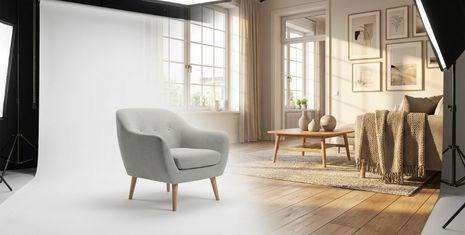
1. Bring to life. Animates an existing lifestyle image with subtle motion, a slow camera move, or an AI avatar that interacts naturally with the product. Use cases: product detail pages, hero banners, social ads, lookbooks. Prompt focus: motion type, camera move, lighting consistency.
2. Show product function. Animates a functional state change between a start and an end frame. Use cases: drawers opening, fold-out mechanisms, extendable tables, lift beds, ergonomic adjustments. Prompt focus: what exactly moves, in which direction, how far, how fast - plus the end state.
3. Product rotation. Animates a rotation between two viewing angles - from start to end frame. Use cases: marketplace listings (Otto, Wayfair, Amazon), configurator transitions, multiple viewing angles from a single cutout. Prompt focus: start and end angle, rotation direction, pace.
4. Free prompt. You write your own video prompt and can optionally anchor it with a start and end frame. Use cases: brand campaigns, storytelling, atypical use cases. Highest creative control, but also the highest risk that the model misinterprets the prompt. Use it when the other three modes are too narrow.
The 7 building blocks of a good product video prompt
These seven blocks are general best practices that work across most AI video models. Each model has its own sweet spots though: some respond more to precise motion descriptions, others to camera-move instructions, others to style anchors. With preset modes (as in showcase) the platform handles the model-specific tuning automatically. With direct model usage, a few iterations per model are worth the effort to find the sweet spot.
1. What you do NOT prompt. The product itself - form, material, color come from the image input. You only describe the environment if you’re working in “Free prompt” mode without a frame anchor.
2. Mode selection. Pick the mode first. It determines which of the following building blocks are relevant. Rotation needs no lighting note; product function needs no camera move.
3. Subject motion. “Subtle lifestyle motion” or “drawer opens evenly by 25 cm” - physically plausible and concrete, not dramatic. Heavy furniture moves slowly, light textiles can flow.
4. Camera move. Static, slow push-in, pan, dolly. “Static” is often the best choice - camera moves eat into the eight-second budget fast and can compromise product fidelity on top.
5. Pace. “Slow and calm”, “medium pace”, “even”. Fast motion looks unnatural for furniture and home textiles in most cases. Rule of thumb: rather too slow than too fast.
6. Lighting and atmosphere consistency. “Daylight remains constant” or “warm evening light, no shift” - lighting that drifts during the clip pulls focus from the product. Only deliberate lighting narratives benefit from a shift.
7. End state (only for product function). What does the last frame show? “Drawer fully open, contents visible.” Without a clear end state, the model decides on its own - usually not the way you want.
Full example (mode: Bring to life): “Subtle lifestyle motion, slow push-in toward the sofa, daylight remains constant, curtains drift slightly in the breeze, static product, slow pace, photorealistic.”
6 prompting mistakes to avoid
- Overdoing motion. “Dramatic rotation, fast pan” produces camera jumps and product distortion. Subtlety beats drama for furniture almost every time.
- Mixing modes. “Rotation and push-in at the same time” overwhelms most models in eight seconds. One mode per clip; stitch multiple clips later.
- Subjective adjectives. “Dynamic”, “vibrant”, “premium” have little visual translation. Replace them with motion anchors and pace cues.
- Ignoring physics. “Sofa bounces gently” or “armchair floats briefly” produces cartoon effects. Furniture moves because the world around it moves - not the other way around.
- Cramming 30 seconds of action into 8. Three movements plus two camera moves plus a lighting shift become hectic in eight seconds. One deliberate motion per clip is enough.
- Mixing languages. “Subtle lifestyle motion mit weichem Tageslicht” weakens most models. Stay in one language.
Example prompts for the most common video use cases
Four ready-to-use prompts for the most common Home & Living scenarios. Take them as a starting point one-to-one and only adjust mode, pace, or end state to fit your brand.
Sofa (Bring to life). “Subtle lifestyle motion, slow push-in to the sofa, daylight remains constant, a sunbeam moves slowly across the upholstery, static product, slow pace, photorealistic.”
Sideboard with drawer (Product function). “Middle drawer opens slowly and evenly by 25 cm, contents partially visible, static frontal camera, even studio lighting, medium pace. End state: drawer fully open.”
Floor lamp (Rotation). “Rotation from start frame (frontal) to end frame (three-quarter view from the right), even pace, clockwise, white studio background, frontal eye level, soft shadow underneath, photorealistic.”
Dining table (Free prompt). “Dining table in a loft, morning light streams from the left through tall windows, slight dolly-in onto the laid centerpiece, steam rises slowly from two cups, otherwise calm composition, slow pace, photorealistic.”
Swap pace, lighting or end state and you have a new variant of the same SKU in seconds.
Mode selection: 6 criteria
- Is the product static and the environment provides the atmosphere? → Bring to life. Sofa in a lifestyle room, curtain billows, light drifts.
- Is there a moveable functional element? → Product function. Drawer, fold-out mechanism, extendable table.
- Do you need a second viewing angle or a configurator-style transition? → Rotation. Marketplace hero loops, configurator transitions between two views.
- Do you need a story of your own? → Free prompt. Brand campaigns, hero spots.
- Should an avatar interact with the product? → Bring to life with avatar. Lifestyle shots with a human in the scene.
- Multiple modes for one campaign? → Generate several 8-second clips and stitch them in post-production into a longer piece.
Which video models work for product video and which don’t?
| Model family | Examples | Strength | Weakness |
|---|---|---|---|
| Foundation video models | Veo, Sora, Kling | Photorealism, longer clips, high resolution | No dedicated product tuning, heavy setup, no mode logic |
| General video tools | Generic video tools without H&L specialization | Creative range, fast prototyping | Product fidelity across frames, no eCommerce modes |
| Image-to-video templates | Generic template tools | Fast, simple, many presets | Limited adaptation to product and brand |
| Specialized H&L platforms | showcase | Mode selection, product fidelity across frames, licensed training data, integrated with the image workflow | Lower creative range than generic tools (a tradeoff of specialization) |
The most important line runs between generic video models that re-generate every frame and platforms that take the product from your input and only build the motion around it. For listings, marketplaces and brand campaigns, only the second variant is production-viable. Even a strong foundation model like Veo or Kling needs a specialized layer on top that orchestrates modes and ensures product fidelity across frames.
How specialized platforms combine prompting and video models
Pure prompting is good for single clips. Catalog-scale video production needs four layers, all of which showcase handles:
- Mode curation. The right model per mode, without you having to choose - Bring to life, Product function, Rotation, and Free prompt each run on a backend optimized for that mode.
- Brand motion. Define once whether your brand is “calm and slow” or “lively and mid-pace”. Every new clip automatically inherits your motion style.
- Reusable templates. Define a scene as a video template once, run every SKU through it. Prompting becomes catalog-scale video production.
- Workflow automation. Drag-and-drop pipelines connect image and video generation: cutout goes in, lifestyle image is generated, the image is set in motion, the clip is exported.
Limits: what AI product video doesn’t solve yet
- Clips longer than 8 seconds. Currently the industry-wide standard across all leading AI video models, not specific to showcase. Workaround: generate multiple clips and stitch them in post-production.
- Live-action with real humans. AI avatars only. If you need real models in the scene, traditional filming remains the more honest path.
- High-precision interaction physics. Doors, drawers and fold-out mechanisms work. More complex manipulations - assembling furniture, hands turning screws - are still unreliable in 2026.
- Audio. Not included. Sound design happens in post-production, or you don’t add audio at all (most social feeds play silently anyway).
Checklist: are your product video prompts production-ready?
- Exactly one mode per video.
- Motion described physically plausibly and concretely.
- Camera move stated explicitly or deliberately set to “static”.
- Pace defined (slow, medium, even).
- Lighting consistency or deliberate lighting shift clearly stated.
- For product function: end state specified precisely.
- Subjective adjectives replaced with concrete motion and pace anchors.
- One language, no mixing.
FAQ
What separates a good product video prompt from a bad one?
A good prompt names mode, motion type, camera move and pace concretely - and doesn’t describe the product itself. A bad prompt piles up subjective adjectives, mixes modes, and overloads the eight-second length with too many actions.
Which mode fits which marketing use case?
Product detail pages and hero banners benefit most from “Bring to life”, because lifestyle atmosphere creates the buying context. Marketplace listings (Otto, Amazon, Wayfair) often want rotation clips for the product gallery. Furniture that needs explanation - lift beds, extendable tables, modular sideboards - becomes tangible with “Product function”. Brand campaigns with their own story call for “Free prompt”.
What’s the maximum video length?
With showcase, you generate product videos in 720p or 1080p with up to 8 seconds per clip. Eight seconds is the current industry standard across all leading AI video models, not specific to showcase. For longer pieces, stitch multiple clips in post-production.
What aspect ratios are supported for the videos?
showcase generates product videos in 16:9 (landscape, ideal for product detail pages, marketplace hero loops, and YouTube) and 9:16 (portrait, ideal for Instagram Reels, TikTok, and YouTube Shorts). Important: make sure your input image matches the desired output aspect ratio. If you want a 9:16 video, upload a 9:16 image. Otherwise you risk crops or distortion at the edges.
Do I need different input images for video than for product images?
No. A clean cutout or an already-generated lifestyle image are enough as input. For “Product function” it also helps to provide an end frame showing the target state - it noticeably improves hit rate.
How many tries do I need before a video lands?
A video prompt that follows the seven building blocks usually delivers a usable result on the first or second try. If you need more than three tries, it’s rarely the model - it’s almost always an anti-pattern. Most common causes: too many movements, the wrong mode for the use case, or a vague end state in product function.
Conclusion
Good AI product videos come from precise prompts and the right mode selection. The four modes, the seven prompt building blocks, and the six anti-patterns are the toolkit. As soon as the requirements grow - catalog coverage, multiple marketplace formats, a coherent brand world - the prompt logic gets joined by the layer of mode curation, brand motion, templates and workflow automation that orchestrates image and video generation together.
Further reading:
- What Should I Prompt for a Good Furniture Image? AI Prompts and Model Selection for Home & Living 2026
- Photorealistic Lifestyle Images with AI
- AI vs. CGI for Product Images: When to Switch in 2026
- AI Product Images in eCommerce: Legal Guide 2026
showcase is an AI platform for Home & Living product images and videos. From a single cutout, photorealistic lifestyle images, multi-product scenes and product videos in four modes are created in seconds - with curated model selection, brand-faithful templates and automated workflows. Try it free, no credit card required →
About the author

Author
Tim Hoffmann
Chief Product Officer, getshowcase.ai
Tim Hoffmann leads the product strategy for the AI image studio at showcase (getshowcase.ai). He brings years of e-commerce experience in product data, marketplace integrations, and visual content creation. His focus: helping Home & Living retailers turn product cutouts into photorealistic lifestyle images and room scenes in minutes - without expensive shoots, with measurably better conversion. Tim shares practical strategies for product images that perform on marketplaces and in your own shop.